


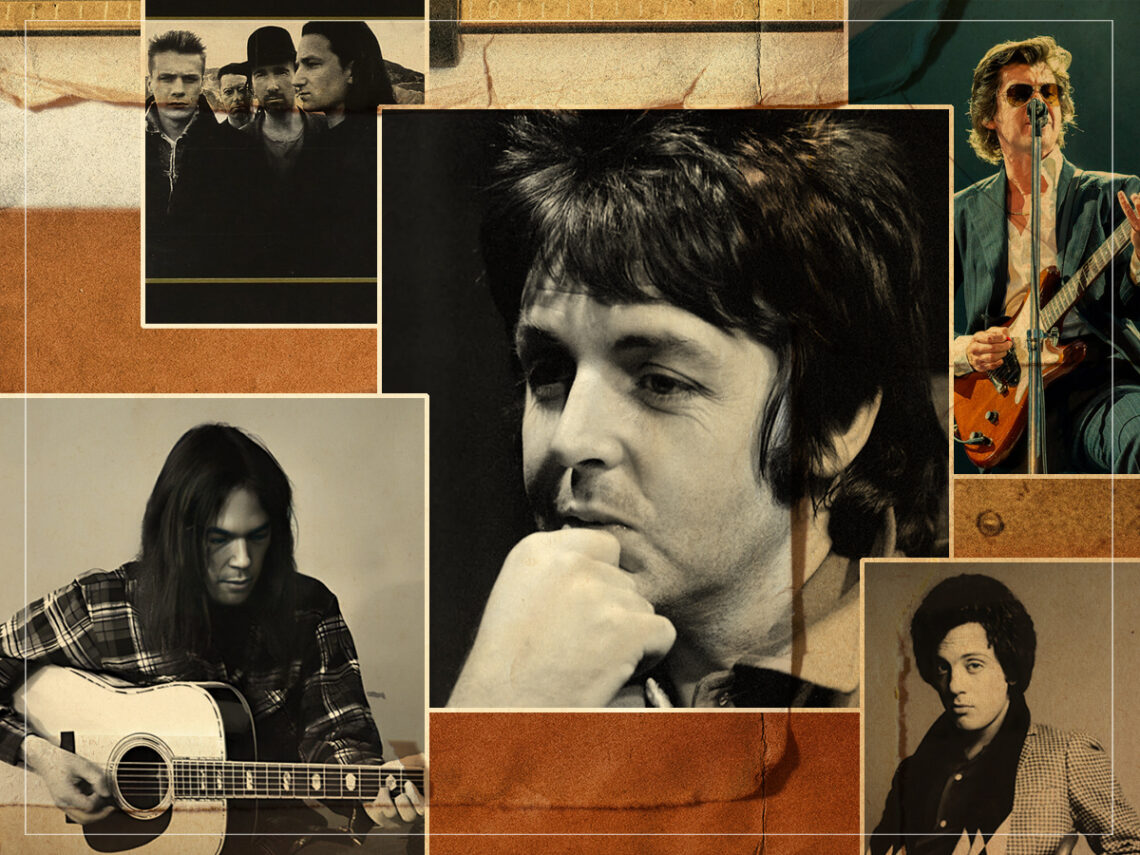
Dreaming of second drafts: 10 songs musicians wished they could rewrite

If you’ve ever witnessed someone write a song before your eyes, you realise that they are not a solid and fixed form that the bulk of vinyl and acetate might suggest. Every note, lyric, and beat is subject to the whims of fate and memory. Perhaps in the 1960s, Bob Dylan dreamt up the greatest line in human history on the bus but forgot it by the time he got home. Maybe ‘Free Bird’ would’ve been four minutes if there was a good football game on TV that evening.
These are factors musicians know all too well, but the public often disregards them. Many albums that have been met with scathing reviews can legitimately have tight deadlines to blame. Likewise, many masterpieces hailed as monumental moments in music can also point to having little time to overthink as the secret ingredient of their triumph. As the old saying goes, sometimes you eat the bear, and sometimes the bear eats you.
However, in the recorded analogue age, music did not seem like a fluid beast. As soon as songs were recorded and released, they were set in stone forever. People even questioned the virtues of Dylan’s jazzy approach to reciting his old songs live. This rigid outlook on music has often led to musicians wishing that they could have a second attempt at an old track.
We’ve compiled a list of these regretted releases below. From Paul McCartney battling against the naivety of youth to Neil Young regretting the anthem that many might call his masterpiece, these are the songs that artists might not regret enough to want to delete them from history, but they do make them wish there was an ‘edit draft’ option on analogue formats.
10 songs musicians wished they could rewrite:
‘When I’m Sixty Four’ – The Beatles
It’s an astounding fact that Paul McCartney was only 24 when Promethean feats like Sgt. Pepper’s Lonely Hearts Club Band came to the fore. This had ‘Macca’ looking forty years into the future with the track ‘When I’m Sixty-Four’, and there is a fair dose of thorny irony in the fact that this is one of the anthems that he regrets writing.
As the star explained in a Los Angeles Times interview: “It was really an arbitrary number when I wrote [‘When I’m Sixty-Four’]. I probably should have called it ‘When I’m 65,’ which is the retirement age in England. And the rhyme would have been easy, ‘something, something alive when I’m 65.’ But it felt too predictable. It sounded better to say 64.”
Seeing as though the song grapples with the crux of ageing, McCartney seemingly found it too juvenile to do justice. As he said with a sigh, “If I were to write it now, I’d probably call it ‘When I’m 94.’” However, if ageing teaches us one thing, it’s that you can’t go back and change the past, so McCartney’s sigh with the song doesn’t last long.

‘Heart of Gold’ – Neil Young
It’s Neil Young‘s only US number one and many casual fans might class it as his classic. So, what exactly is the problem with ‘Heart of Gold’ and why does Neil Young regret it? Well, you might find an answer from his hero. As Bob Dylan explains: “The only time it bothered me that someone sounded like me was when I was living in Phoenix, Arizona, in about ’72 and the big song at the time was ‘Heart of Gold’.”
Dylan thought it was the sort of rip-off he wished he hadn’t inadvertently just about written. I’m sure he’d hope to inject a touch more originality to the lyrical side of proceedings if he had. None of this, however, makes the song inherently bad. Music always has a place for mawkish mundanity, provided that it’s done with the sort of melody and performance that makes dullsville seem like the dominion where pop music truly belongs. However, the issue for Young is that he never wanted to live there. His tracks up until this point had poked and prodded at the mainstream. Now, with a few chords and a simplified sentiment, he was being dragged into that very fold—but he knew he was just a few edgier lines and colourful chords away from a true masterpiece.
Five years on from its release, a decade into his glistening career, he mused: “This song put me in the middle of the road. Travelling there soon became a bore, so I headed for the ditch. A rougher ride but I saw more interesting people there.” As those liner notes on Decade suggest, reaching the top – ‘Heart of Gold’ is Young’s only US number one – actually proved to be a fork in the road.

‘We Didn’t Start the Fire’ – Billy Joel
Billy Joel got many things right with ‘We Didn’t Start the Fire’. In the song, he charts his way through history in an abridged manner that condenses knowledge like microchip science. He weaves his way through manic modern history to arrive at the message that society is simply predisposed to unruly chaos—and he pairs this in a postmodern fashion with a maelstrom of synth-driven music to add to the feeling of society’s unstoppable combustion. He accepts that this element of the anthem is a masterstroke.
However, it is the inherent contemporary cheesiness of this music that he feels hamstrings the clever thesis of the track. Speaking about the much-maligned masterpiece on We Didn’t Start the Fire: The History Podcast, Joel said of his 1989 single: “The only thing I’ve heard about that song from people is, ‘I hate song!’ Some people hate that song. It’s one of the most hated things I ever wrote! And I don’t get the hate.” However, Joel is ambivalent towards it, musing that it is clever, catchy, and affecting; he just wishes it cooler—many have had similar thoughts in a more generalised sense.
“I mean, I hate the music, because it’s not good,” Joel rather harshly admitted. “But I think the lyrics are fairly clever, I think I did a pretty good job with the words, but some people just hate that thing.” He explained: “I wrote the words first, which is why the music is so horrible in that song. I usually write the music first, and then I write the lyrics, but in that song, the melody…it’s like a mosquito buzzing around your head! It’s more annoying than musical.” At least, he got half of it perfect.

‘Only Ones Who Know’ – Arctic Monkeys
It’s a maudlin and mellow break on the Arctic Monkeys‘ second album, Favourite Worst Nightmare, and it hinted at the many differing chapters that lay ahead of the band. However, the one element they hadn’t mastered at that stage was the grand, orchestral collision of classical music and rock ‘n’ roll, so the weepy slide guitar sounds just a little bit more dainty than perhaps Alex Turner had intended it.
However, he got a whiff of what his muse was aiming at when Tony Christie covered the tune—the most unlikely source of a revelation that Turner could’ve ever wished for. When listening to Christie’s doo-wop Dion-inspired version, the Sheffield indie rocker claimed it sounded closer to how he must’ve inadvertently wanted it to sound all along.
Fatefully, Christie took the track back to the 1960s, which is perhaps where it sentimentally belonged, with Christie explaining, “The reason I like the Monkeys is because they take me back to the ’60s. It’s very similar to that’ 60s scene, The Beatles, and all that. It reminds me of that and of a time when I was kicking off in the business. So it’s a bit retro but great.”

‘Train Kept a-Rollin” – The Yardbirds
Jeff Beck was always keen to pay homage to the past that inspired him. However, the flip side of that was equally apparent in his work: the blues isn’t going anywhere, so you may as well add something new to it. So, when he found himself in The Yardbirds in 1965, they decided to reinvent an old classic. “We did that with Sam Phillips at Sun Studios in Memphis on our first tour of America,” he told Louder Sound of their cover of ‘Train Kept a Rollin”.
The British invasion was underway, and bands needed to roll out the hits rapidly to keep pace with the raucous frontier. So, even in the midst of their first major tour, they had to plead to squeeze in some studio time. “Giorgio Gomelsky, who was in charge of the band at that time, phoned him up, and Sam said: ‘It’s Sunday. We’re closed’. Giorgio told him he was missing a great opportunity to record a happening band, and eventually persuaded him,” Beck recalled. The band were right up against it.
Road-weary and pushed for time, they perhaps weren’t at their best. It’s a bold move to try such a classic when you’re not at your best, and, in truth, Beck rued it. “To be honest, our version of Train Kept A Rollin’ was pretty awful, but it was different,” he said. He still adored the blues classic and was more than delighted that the band were fondly associated with it, but he simply wished he could redo the cover and add some much-needed refinement.

‘S.A.T.O.’ – Ozzy Osbourne
As anyone who has followed the wild daily life of Ozzy Osbourne via the classic MTV reality exposé can attest, the Prince of Darkness is certainly not the pedantic fussy type. Nevertheless, when the bat-decapitating rock star sat down with Billy Idol guitarist Billy Morrison to discuss certain elements of his solo back catalogue, he was asked whether there were any songs that he wished he had done differently. The Black Sabbath frontman unflinchingly offered up the following: “‘S.A.T.O.’ was one.”
As it happens, it was his lack of fussiness that would be the undoing of this long-since regretted song. “I always remember that,” he continues. “I was in the studio, and Sharon wanted to go somewhere and I went, ‘That’ll do!’ And in the back of my mind, I knew I let something go. But you know what? The amount of people that come up to me and go, ‘Why don’t you ever play that live?’ Only I know.”
The rousing Diary of a Madman classic is one of Osbourne’s most introspective tracks. It was inspired by a letter entitled A Ship to Cross the Sea of Suffering by a Buddhist monk named Nichiren Daishonin from 1261. No, you didn’t often spot Ozzy leafing through his copy of that on The Osbournes. But it does prove that there was substance to this song somewhere in the mix that he failed to deliver on.

‘Babe I’m Going to Leave You’ – Led Zeppelin
The problem with being in a band with as much technical brilliance as Led Zeppelin is that there is always a chance you could be the one who let down a classic. Not many people would say that there is much wrong with the masterful ‘Babe I’m Going to Leave You’, but Robert Plant is his own harshest critic, and he wishes he could re-record his vocal take on the classic.
Penned by Anne Bredon back in 1959, ‘Babe I’m Gonna Leave You’ had Greenwich Village’s authenticity-obsessed folkies in mind. At the time when Led Zeppelin cut their version of the track, they were pushing back against tradition. They wanted swaggering, macho style, but such sequined pomposity was a world away from the one that Bredon initially intended for the record—its true heart.
Plant later recognised that. “[I] realised that tough, manly approach to singing I’d begun on [1966 track] ‘You Better Run’ wasn’t really what it was all about at all,” he earnestly told the Guardian. “Songs like [Zeppelin’s] ‘Babe I’m Going to Leave You’… I find my vocals on there horrific now. I really should have shut the f*** up!”

‘The Sound of Silence’ – Simon and Garfunkel
As it happens, Simon and Garfunkel strictly don’t wish they could rewrite ‘The Sound of Silence’, but they do wish they could rewrite the version most of the world knows. As the story goes, Tom Wilson was sitting behind the mixing desk for the recording sessions of Bob Dylan’s masterpiece, ‘Like a Rolling Stone’. He had also been around for the recording of ‘Sounds of Silence’, a sweet little masterpiece that lacked the muscle to stand up to the British Invasion and slumped out of the charts, prompting its progenitors to go their separate ways and call time on being a duo. However, Wilson knew a good track when he heard one, and he felt certain that the fate of such a masterpiece was not the ash heap of history. The solution he concocted was simple: give it the ‘Like a Rolling Stone’ treatment.
Without even Simon and Garfunkel’s knowledge, during sessions Wilson’s recording sessions with Dylan, he asked drummer Bobby Gregg, guitarist Al Gorgoni to stay behind, he then welcomed Vinnie Bell and Bob Bushnell into the mix, and an impromptu rock band were formed. They recut ‘The Sound of Silence’ as an electric folk-rock track. It became a huge hit, but it failed to get Paul Simon’s approval. Ironically, as Al Stewart comments in Paul Simon: A Life, “Paul was horrified when he first heard it”.
The rhythm section slowed down at one point to allow the original melody to catch up. These blemishes did not go amiss for a musical purist like Paul Simon. So, while he eventually accepted that the treatment worked in its own way, he no doubt bemoans not being able to craft an approved electric version.

‘Have a Cigar’ – Pink Floyd
When fractures in bands begin to appear, some songs can fall through the cracks. While Pink Floyd were writing Wish You Were Here, Roger Waters’ lyrics were becoming increasingly verbose, creating problems for David Gilmour, who preferred for his vocals to be enunciated and measured. They failed to see eye to eye, and both admitted that certain songs, unfortunately, suffered as a result.
So, when it came time to cut ‘Have a Cigar’, and Waters’ voice was already spent from recording ‘Shine On You Crazy Diamond’ earlier that day, Gilmour flat out refused to offer up what he felt would be a subpar performance if he got behind the microphone for the song. So, Roy Harper had to be drafted in to pave over the impasse. But the whole ordeal was indicative of where the song was set to go wrong.
“Eventually, we said, ‘Go on then, Roy, have your bloody go’,” Gilmour told Mojo. “Most of us enjoyed his version, though I don’t think Roger ever liked it.” So, in the end, the mix was simply slung onto the record with a hefty feeling of slapdash frustration, perhaps hamstringing the classic rock track.

‘Where The Streets Have No Name’ – U2
It isn’t always the band with a problem; sometimes, producers can lament tunes, too. For a man renowned for loving technology, Eno once firmly stated, “The problem with computers is that there is not enough Africa in them”. He wanted to break the binary when it came to The Joshua Tree and introduce a new singular swell of instrumentation. “Africa is everything that something like classical music isn’t,” he told Kevin Kelly. “Classical—perhaps I should say ‘orchestral’—music is so digital, so cut up, rhythmically, pitch-wise and in terms of the roles of the musicians. It’s all in little boxes.”
Bono was on a similar page at this point. He had just been to Ethiopia after Live Aid and was enthused by fresh musical ideas. The nation’s music has a gorgeous tesselation of cultures. It was this flowing nature that Eno hoped to encapsulate among U2’s established rock vitality. The opening track, ‘Where The Streets Have No Name’, would set the tone. Fittingly, Bono already referred to it as a mere “sketch” by the time it entered the studio, so its vagueness matched Eno’s loose intent perfectly. The problem was that it was perhaps too unstructured, and honing it became an obsession for Eno, taking up “40% of his time” on the album. In turn, he grew so frustrated by the track that he ended up hating it. He eventually told the studio’s assistants to destroy it.
Lanois told Mojo that for whatever reason, perhaps out of fear or better judgement, this never happened. “It was a bit of a tongue-twister for the rhythm section, with strange bar lengths that got everybody in a bad mood,” he recalled. “I can remember pointing at a blackboard, walking everybody through the changes like a science teacher. There’s a part of Eno that likes instant gratification.” With ‘Where The Streets Have No Name’, he wasn’t getting it. He began to see his Ethiopian dream slide towards a half-baked farce, and he hated it. It was eventually released, but Eno would love even more time with it.


Never Miss A Beat
The Far Out Beatles Newsletter
All the latest stories about The Beatles from the independent voice of culture.
Straight to your inbox.