


10 shocking films that went too far

Extreme filmmakers have challenged this question for years, using extreme violence and disturbing story material to sicken and unsettle audiences. Exploitation films care little for censorship guidelines and viewers’ comfort, receiving heavy bans and scathing reviews as a response.
Extreme cinema can morph into the genres of horror, psychological, drama, and even coming-of-age if a filmmaker feels like making such a risk. They earn ‘extreme’ status by pushing the boundaries of these genres and presenting the most outrageous and shocking content they can.
These films earn somewhat of a ‘cult’ or ‘urban legend’ status, with those daring to watch then telling others ‘I dare you to watch this thing’. They become notorious milestones in film viewing, challenging audiences to handle their disturbing content.
So what specific examples represent these shocking films? Here are ten films where the director went a little too far and shocked audiences like no other.
10 shocking films that went too far:
Cannibal Holocaust (Ruggero Deodato, 1980)
During a rescue mission into the Amazon rainforest, a professor stumbles across a lost film shot by a missing documentary crew whose goal was to study the region’s indigenous cannibalistic tribes. The footage they find is beyond anything they could imagine.
Cannibal Holocaust achieved legendary status in film through its graphic violence, which caused a great deal of controversy. These include animals killed on screen, and human bodies turned into feasts. To put this in further context, after its premiere, it was ordered to be seized by a local magistrate, and the director Deodato was arrested on obscenity charges as critics believed the deaths shot were real. Cannibal Holocaust is placed as the apex of the cannibal genre and is a prevalent addition to the extreme cinema category.
The Human Centipede II: Full Sequence (Tom Six, 2011)
A depraved disturbed man takes his love for another piece of extreme filmmaking too far. He goes on a killing and collecting spree to recreate the experiment portrayed in The Human Centipede (First Sequence).
Going above and beyond the first film, Human Centipede II portrays some disgusting images, just in case people being sewn together via mouth to the rectum isn’t enough. The film also shows a pregnant woman forced to give birth in a car after escaping. She stomps on the accelerator in pure survival mode, killing her child who is under the pedal. Furthermore, the ending takes us right back to the start, leaving it up to debate if the events happened. Essentially, audiences have been forced to witness a disturbing ordeal just to be told it may have all been an illusion.
The House That Jack Built (Lars Von Trier, 2018)
When the premise of the movie is: Jack, a psychopath serial killer, revisits the shocking series of murders he committed over a period of 12 years, which he considers to be a work of art, then you know there are issues of vulgarity ahead.
The House that Jack Built is a disturbing psychological gore fest that doesn’t just cross lines but wholly violates them. The film features brutal child killings and sickening mutilations of the victims. The title has a whole new meaning when you see what he does with his body count.
August Underground (Fred Vogel, 2001)
A sick serial killer named Peter kidnaps and kills several innocent people, while his unnamed accomplice films and documents the murders.
August Underground is packed full of stomach-churning visuals from start to finish, all presented in a grimy colour palette and poor quality. There is no plot, no structure, and no actual characters to speak of. It’s just one gory whirlpool of blood, guts and other graphic material, There is nothing that resembles a movie, aside from the fact it was filmed.
Mother! (Darren Aronofsky, 2017)
A poet and his wife live a normal life in a burnt-out house. However, when uninvited guests come barging in, the couple’s life turns chaotic and is threatened. The wife soon starts to realise there is no one she can trust.
Although it generally received positive reviews for some effective storytelling and style, Mother! received some controversy due to its biblical allegories and depiction of violence being synonyms of one another. A horrifying scene forces us to watch a newborn baby being eaten, with Mother scrambling to get the innards out of the cult’s mouths.
Pink Flamingos (John Waters, 1972)
A distasteful unlikeable woman and her misfit family compete with a Baltimore couple to be named the filthiest people alive. This soon proves to be a competition that knows no bounds., and thus, one of John Waters’ most notorious films is given the urgency of adventure.
John Waters marketed this film as “an exercise in poor taste” and it effortlessly lives up to that branding through its notorious outrageousness nudity, and language. Its story material is built from the values of exhibitionism, voyeurism, sexual violence, murder, cannibalism, and fetishism.
グロテスク/Grotesque (Kōji Shiraishi, 2009)
Grotesque sees a doctor with extreme, and depraved needs, kidnap a couple and force them to compete in a game of torment that slowly erodes their hopes of survival.
Grotesque has audiences struggling to derive any value whatsoever. Some have proposed its graphic content is an exploration of willingness to survive or to sacrifice everything necessary. However, others have cited its shocking violence as shallow torture porn. It’s clearly designed to have audiences grabbing their own bodies from the implied pain.
뫼비우스/Moebius (Kim Ki-duk, 2013)
A Korean woman is driven mad by her husband’s infidelity. To exert her pain and turmoil, she castrates her son, causing a crisis of masculinity and emotional well-being. It is, without doubt, one of those cinematic moments that can have your blood-curdling.
Moebius challenges the norms of film and storytelling, as there is minimal to no sound. The characters communicate through feral gasps, grunts, and moans, and share moments of intensive gaze as a substitute for speech. However, due to its disturbing content of castration, sexual violence and incest, the film proved to be too much for audiences. The KMRB objected to the portrayal of explicit sexual incestual scenes between Mother and Son, leading to the film being banned.
Ichi the Killer (Takashi Miike, 2001)
A sadomasochistic hitman comes across a repressed and psychotic killer who may be able to inflict levels of pain the enforcer can only dream about. A usual premise is given a brand-new and relatively disgusting spin with Ichi the Killer.
Despite a stylish costume design and stimulating film techniques, Ichi the Killer throws out non-stop violent and over-the-top assault scenes. Accompanying this are non-stop blood baths that show body parts flying left, right and centre. We also see some antagonising torture scenes that are prolonged in the build-up, even self-inflicted ones.
Terrifier 2 (Damien Leone, 2022)
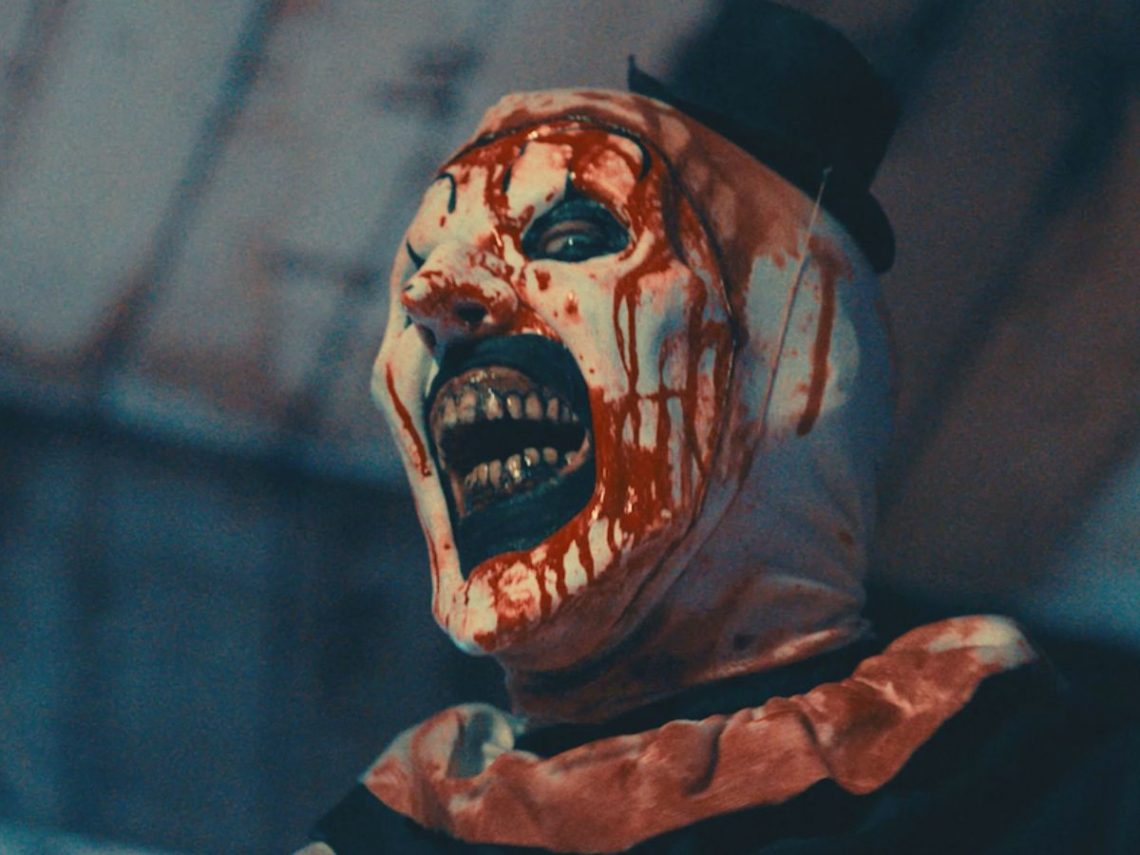
And now for our most recent entry and the film that stole all the headlines this October. Resurrected by a sinister entity after his previous blood bath, Art the Clown returns to Miles County to terrorize a teenage girl and her younger brother on Halloween night.
This film has caused headlines with stories of audience members throwing up during screenings. Terrifier 2’s killing scenes are disturbing because they are both extremely graphic and psychotic, as Art happily tortures and extends his victims’ suffering which violates humanity. When it’s made clear a character is about to be massacred, there is absolutely no idea what Art will conjure up, even then he exceeds expectations.
