


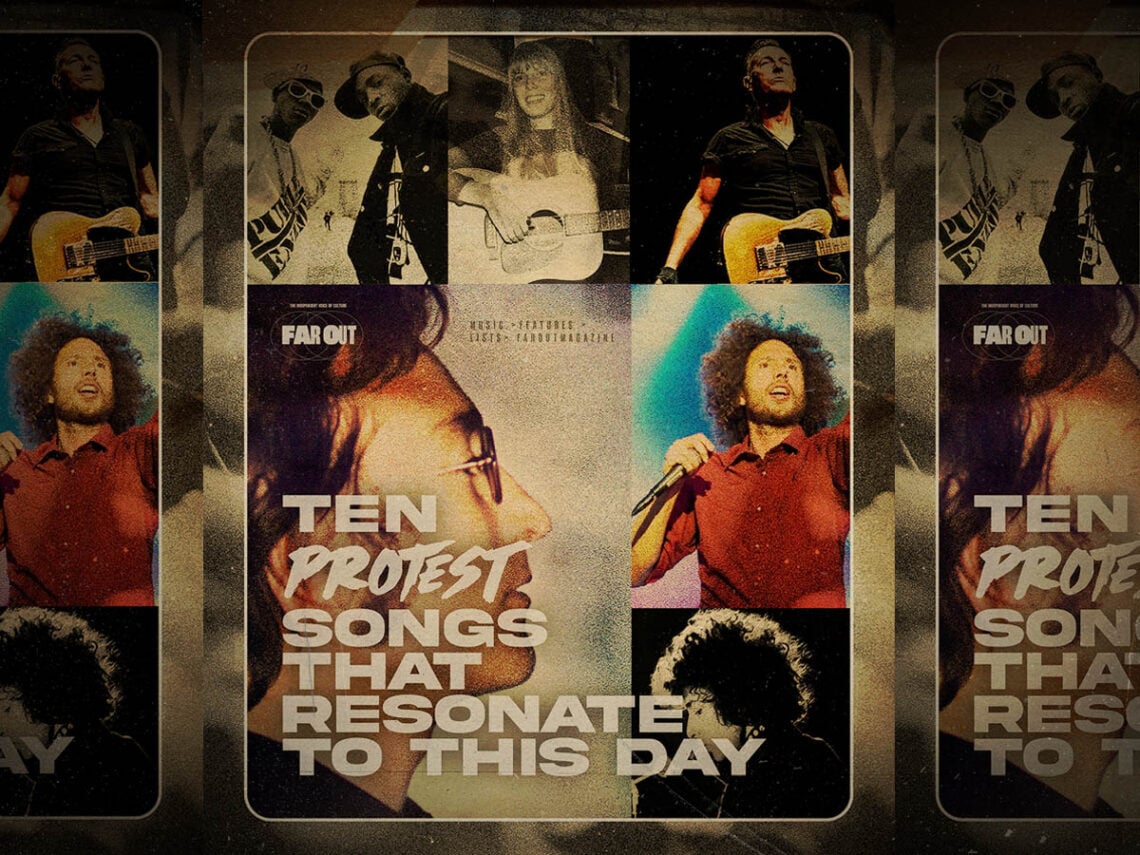
10 protest songs that resonate to this day

Rock and roll has always been a great space for speaking one’s mind. No one goes into the music business to say empty platitudes every time they make music, and the best music is something that delves into the real problems with the world rather than trying to tiptoe around certain subjects. And while some of the biggest songs of certain eras have aged like milk, there are also a handful of tunes from the likes of John Lennon that can still get people chanting in the streets to this day.
Then again, that was always rock and roll’s job to a certain extent. It started off as music that could piss your parent’s off, but for everyone who wanted to make a song that could make people dance all night long, there were others that tried their best to get people to think about the state of the world while they were moving their legs. It was a hard task, but not necessarily an impossible one.
Whether it was through the Vietnam War, the Cold War, or the unrest that goes on every single day, artists always knew that they could use their platform to help people think, and even if the people disagreed with them, it was worth it to say their piece. Despite how many times people might have had the songs rammed into their skulls, it only served to reinforce the values they had set for themselves.
And for anyone that gets started with this list and says that people should keep their politics out of their songs, allow me to offer the following note: Get over yourself. Musicians are allowed to use their voices and do whatever they want with them, and even if you might not agree with what they are saying, nothing can top someone singing from a place of passion for the greater good.
10 protest songs that still resonate today:
‘Gods of War’ – Def Leppard

Hair metal isn’t normally the first place people go for social commentary. Looking through the entire Sunset Strip scene, there wasn’t much that the genre covered other than sex, drugs, and maybe the occasional song that meant absolutely nothing but sounded halfway coherent when sung over loud guitars. But since Def Leppard never totally fit into the hair-metal category to begin with, their critique of war and all those who partake in it is a lot more thought-provoking than whatever Cinderella was putting out at the time.
Then again, it’s not like Joe Elliott is one of the greatest pacifist lyricists of all time. A lot of the song was meant to be nothing more than a man on the street discussing the problems surrounding nuclear war, but compared to every other political song, the Sheffield natives weren’t afraid to hit the nail on the head, even playing audio of Ronald Reagan talking about blowing others to smithereens as an acoustic guitar plucks away in the background in the vein of ‘Goodbye Blue Sky’.
And yes, this is the same band that a few songs before on this same album was making songs about wanting someone to pour some sugar on them. It’s enough to give someone audio whiplash if they were played in rapid succession next to each other, but for a genre that seemed to be allergic to any kind of musical development, it’s nice to see the 1980s get their own chrome-plated version of ‘War Pigs’.
‘New Year’s Day’ – U2

It doesn’t take a rocket scientist to tell that Bono likes to talk about politics whenever U2 plays a show. Most people are at those shows to have a good time, but whenever the frontman puts down the persona and gets up on the soapbox, that’s either a sign for people to pay attention to what their musical messiah is saying or their signal to grab a drink before they go into the next tune. And while Bono can get pretty heavy-handed with everything he says, not everything had to be spelt out during the War era.
Whereas most songs during this period of the group had them going in hard on corporations and corrupt politicians, ‘New Year’s Day’ is a more universal truth about politics. ‘Sunday Bloody Sunday’ may have been about a very direct event in history, but this feels like the cold and calculated reaction you see all too often from politicians who couldn’t care less about whose lives they jeopardise in the name of patriotism.
They can give all of the impassioned speeches and cry all the crocodile tears they want, but Bono knows as well as anyone that nothing ever really changes if they don’t believe it in their heart. His plea to be with his other half may be entirely genuine, but if there’s any resolution to this song, it’ll come when everyone learns to put their guard down. And as long as there are backstabbers in the world, it’s not getting any easier to adopt this kind of lesson.
‘Alright’ – Kendrick Lamar

Towards the end of the 2000s, rock and roll had stopped being the voice of the people. Oh, there were still plenty of rock acts clogging up the charts, but they seemed more for show than anything else, almost like they were trying to fill up a playlist of half-decent tunes to play on rock radio half the time. And since all that people had to go on were bands like Nickelback, it didn’t take long to start redirecting to hip-hop, and Kendrick Lamar had already come out ready for war from the first time he got on the mic.
Although many of Lamar’s tales of struggling through the crack epidemic and life in Compton have strong social commentary, ‘Alright’ is exactly what the country needed in the wake of the Black Lives Matter movement. The air seemed a lot more tense once Freddie Grey and Trayvon Martin were killed, but Lamar isn’t looking for riots in the streets. He only wants to have a dialogue with the people who would have turned a blind eye to him, and even if he doesn’t get it, he knows that he will be fine as long as God is on his side.
And since the protests haven’t even begun to stop in recent years, it’s easy to feel Lamar’s verses now more than ever. It’s easy to have something that someone can chant in the streets, but he knows that whatever he believes in is about more than standing up for what’s right. It’s about having God on his side, and that divine strength is more than enough to carry people through the darkest times.
‘What’s Going On’ – Marvin Gaye

It’s no secret why rock and roll has become such a great litmus test for protest songs. The guitar has been known as a weapon of choice for anyone who plays it, and even Woody Guthrie saw playing his acoustic as an act of resistance against fascists. And while not every protest song is necessarily easy to groove to, Marvin Gaye managed to hit people on both a political and spiritual level when he started witnessing the carnage in Vietnam.
Despite Berry Gordy having reservations with Gaye putting out a protest record, ‘What’s Going On’ is one of the smoothest looks at what life is like for people living on the streets. Gaye doesn’t need to be incredibly descriptive in talking about the people in his life, and that’s because every single person at the time could relate to the kind of brutality that was coming out of Vietnam War and the lawmakers who were doing absolutely nothing to stop all of the carnage.
It’s easy to look at ‘Inner City Blues’ as the bolder critique, but ‘What’s Going On’ is only here to ask questions about the state of the world. And since there have been far too many more people crying in the wake of what has happened since the days of Gaye, it seems that his lessons about compassion and being to relate to your fellow man need to be put into context every single day.
‘Masters of War’ – Bob Dylan

Anyone could throw a dart at half of Bob Dylan’s early catalogue and come away with a veiled political message. Dylan wasn’t known to pull many of his punches, but whenever he made something that overtly targeted someone, he made sure that there was a certain veil so as not to put anyone in jeopardy. No one knows who Mr Jones is in ‘Ballad of A Thin Man’, for instance, but it’s pretty easy to picture the kind of figure Dylan has in mind when he sings ‘Masters of War’.
He had already been through the end of World War II, so as the Vietnam War continued to rage on, Dylan wrote this as a condemnation of those who get a kick out of sending soldiers off to die. From the first few lines, Dylan seems to be keeping all of his anger inside, almost taking every line as an opportunity to cry out in anger about even more atrocious crimes that these people down in Washington are doing, often turning a blind eye to the man on the street and only look to serve themselves.
So while Dylan’s critique of them as he looks over their grave might seem a bit callous and cold to look back on, it’s absolutely necessary in times of trouble. It’s one thing to show compassion for someone who has wrong you in the past, but someone’s ability to forgive doesn’t mean excusing their crimes, either.
‘Big Yellow Taxi’ – Joni Mitchell

For every artist who complains about violence against their fellow man, protest songs don’t always have to be paved with blood. There are far greater issues happening in the world other than war, and if no one else is going to talk about the greater problems with the world, it’s up to the artists themselves to take charge and speak their minds about their concerns for humanity. And while Joni Mitchell did a great job quoting her own heart, ‘Big Yellow Taxi’ is her looking at the natural beauty in the world slowly slipping away.
Despite it being one of Mitchell’s best-known songs, a lot of the message seems to get lost when talking about the chorus. Anyone can dwell on the verse about the titular taxi taking her old man away from her, but looking at the trees that are being put into museums and all of the manufacturing going on, a lot of the beauty that most people take for granted is being paved over with asphalt and becoming a thing of the past.
Mitchell may have eventually moved on to her more personal affairs, but it’s not like anyone forgot about the values she spoke about, either, with Don Henley offering up his own version of that philosophy with Eagles on ‘The Last Resort’. Most people like to think of a place where they can live in Paradise, but none of them really bother to look at the price tag that utopia comes with.
‘The Rising’ – Bruce Springsteen

Not every protest song is necessarily meant to have people rallying in the streets. Songs can be used to enact real change in the world, but they also have the power to heal, and some of the greatest songs of all time help mend the pieces of a broken heart rather than stoke the flames. And for all the claims that Bruce Springsteen is far from a patriot, ‘The Rising’ proves how much he cares about this country and how he would hate for any of its values to be stripped away.
Despite going in hard at the government’s treatment of veterans on ‘Born in the USA’, none of that mattered once 9/11 happened. Everyone thought that side of history was behind them, and when everyone saw those buildings falling over the New York City skyline, Springsteen was determined to make a song to help heal people. And while The Rising served as a nice dissection of everyone’s post-traumatic feelings, the title track was a way for everyone to rally together and support one another through the tough times.
At a time when everyone in America was seething with anger and wanted to do unspeakable things to those who tore down those towers, ‘The Boss’ knew better than anyone that violence was never the answer in these situations. It was about dealing with those feelings and emerging even stronger as a result of them, and judging by how much fire Springsteen still has to this day, he has no problem talking about people who represent the greater problems with the world.
‘Fight the Power’ – Public Enemy

As hip-hop quickly took over the cultural conversation, there seemed to be a dividing line between the rockers and rappers. Everyone with a guitar in their hand wanted to have a good time or rally around a kick-ass riff, but it wasn’t clear whether hip-hop was anything more than party music when people like Run-DMC were breaking down doors. If their version of ‘Walk This Way’ proved that rap had a place in music history, Public Enemy arrived to outdo rock at its own game.
Every punk rocker had been raised on songs all about alienation and wanting to rally against corporations, but none of them had spoken about it with such gusto as Chuck D. Flavor Flav may have been the ultimate hype man behind the scenes, but listening to Chuck’s booming voice, he was a megaphone for everyone growing up on the streets, taking the same kind of stance that Marvin Gaye had merely suggested years before and giving the same kind of attitude that Joe Strummer had back in the day.
And looking back on the entire history of rap, this is still one of the most gripping moments for the genre. The Clash may have made this kind of rebellious attitude look cool for rock and rollers, but as long as Chuck had a decent beat behind him, nothing was stopping him from dropping some of the most crushing bars that any emcee had ever laid down. And judging by where rap rock would go later, a lot of people were willing to listen.
‘Bulls on Parade’ – Rage Against the Machine

Before Rage Against the Machine, the idea of rap and rock working together wasn’t anything more than a novelty. Sure, Run-DMC and Aerosmith were fun while that song lasted, but as soon as Zack de la Rocha started spitting over Tom Morello’s infectious grooves, everyone listening was practically thrown up against the wall the minute they heard ‘Killing in the Name’. That tune may have been all about the racist pigs with police badges, but ‘Bulls on Parade’ touches on something a lot more universal.
Despite the hard-hitting tunes on their debut album, ‘Bulls on Parade’ sounds like Zack de la Rocha’s writing his manifesto as he sees it from the streets of Los Angeles. He had grown up witnessing racism and corrupt politicians at every corner, and with Tom Morello’s guitar booming behind him, Rocha is out for blood against the people that kept him oppressed, whether that’s those who value aggression in the Pentagon or those who would rather burn books that are deemed to dangerous for mass consumption.
Then again, seeing politicians eager to ban whatever they see as offensive or damaging to their reputation only proves Rage absolutely correct. This was the version of 1984 that they saw coming, and when politicians started walking the walk, it wasn’t long before the rest of the world began to rebel against the system.
‘Give Peace A Chance’ – John Lennon

For the first half of The Beatles’ career, any kind of political talk was almost taboo in the press. Each of them had views on where the world was going and would have loved to speak their minds, but Brian Epstein wasn’t willing to damage that moptop reputation by dividing the band right down the middle with their fan base. Once they didn’t have to worry about touring around the world, John Lennon was the first to say his piece, and he was never afraid to hide his stance on non-violence.
While ‘Revolution’ toed the line of being in favour of or against destruction, Lennon saw ‘Give Peace A Chance’ as his way of making a better world. The chorus is dead simple playing over two chords, but hearing someone’s desperate plea for a peaceful world was something everyone needed to listen to both at the time and right now, where everyone’s sense of understanding seems to be flying out the window every single day.
Lennon may have gone too far in a handful of places and got the FBI to launch an entire investigation into his practices, but no songwriter gets in that much hot water if they didn’t have something pertinent to say. And judging by how many people are willing to give peace a chance to this day, Lennon certainly fulfilled his dream of making a song as universal as ‘We Shall Overcome’.

Never Miss A Tale
The Far Out Bob Dylan Newsletter
All the latest stories about Bob Dylan from the independent voice of culture.
Straight to your inbox.