


10 musicians who lied about their backstories

What is it that makes us fall in love with our favourite artists? It’s an impossible question to answer, but one thing is for sure: it isn’t because of their talents. In the era of pop culture, an artist’s competency goes out of the window; we’re not bothered about whether Bob Dylan is the best singer or if Nina Simone’s compositions are up there with Chopin; our interest stretches beyond that. The best artists have a pervasiveness that adds colour to our days even when we are in the act of listening to them.
Mythologies are a huge part of modern art; they increase our degree of empathy with creative work, but mythologies are also subject to fabrication, embellishment, and little white lies. This is actually increasingly prevalent today. Recently, by means of an experiment, a friend pitched a song and their unembellished written profile to a music management company.
Not much was made of the music itself bar a complimentary comment; the song had seemingly passed muster, however, there was a call to drum up the working-class element of their history a little more in order to satisfy what was termed as the need for a unique selling point. Despite the jargon of today, this is merely an amplified version of the importance of marketing that first dawned on blues stars when their music was called ‘The Devil’s Music’, and they quickly understood that being an outlaw isn’t the worst thing.
From then on, many contemporary stars decided to cook up their own fictional USP. Sometimes, this can be a quirky falsehood to imbue their work with added character in a very artful fashion, but other times, it can be an insidious dupe. We’ve collated a collection of these below.
10 musicians who lied about their backstories:
Bob Dylan
One of Dylan’s first recorded appearances on radio saw him tell Cynthia Gooding, “I was with the carnival off and on for six years. [I was doing] just about everything. I was a clean-up boy. I used to be on the main line on the Ferris Wheel, just run rides.” In truth, he was actually raised just about as normally as it gets. Working-class but very comfortable, schooled, fed and free to play. Hell, it’s not even clear whether he even went to a carnival as a punter.
Nevertheless, he ran with this travelling narrative until he found out it was high tide he’d get found out. The whys and wherefores often get put down to a young kid having a bit of fun. But it seems pertinent that some 13 years later in his professional career, the ‘voice of a generation’ tag now an achievement he had long since surpassed (imagine that), the great Sam Shepard would venture out onto the road as part of Dylan’s own travelling carnival with The Rolling Thunder Revue and write about the great storyteller in his midst.
“Myth is a powerful medium because it talks to the emotions and not to the head,” he eventually wrote when he made it to the other side of the tumultuous roving folk show. “It moves us into an area of mystery. Some myths are poisonous to believe in, but others have the capacity for changing something inside us, even if it’s only for a minute or two.”

Marvin Pontiac
Marvin Pontiac is not a real man. Although he has a biography, an album, and testimonies from the likes of David Bowie to his name, he is merely a figment of the fevered imagination of John Lurie. He created the outsider musician, filling him with the tropes that we all lap up; they serve as a vehicle for his first singer-songwriter-style record.
The liner notes to that record revealed that his creation “was hit and killed by a bus in June 1977, ending the life of one of the most enigmatic geniuses of modern music. He was born in 1932, the son of an African father from Mali and a white Jewish mother from New Rochelle, New York. The father’s original last name was Toure, but he changed it to Pontiac when the family moved to Detroit, believing it to be a conventional American name.”

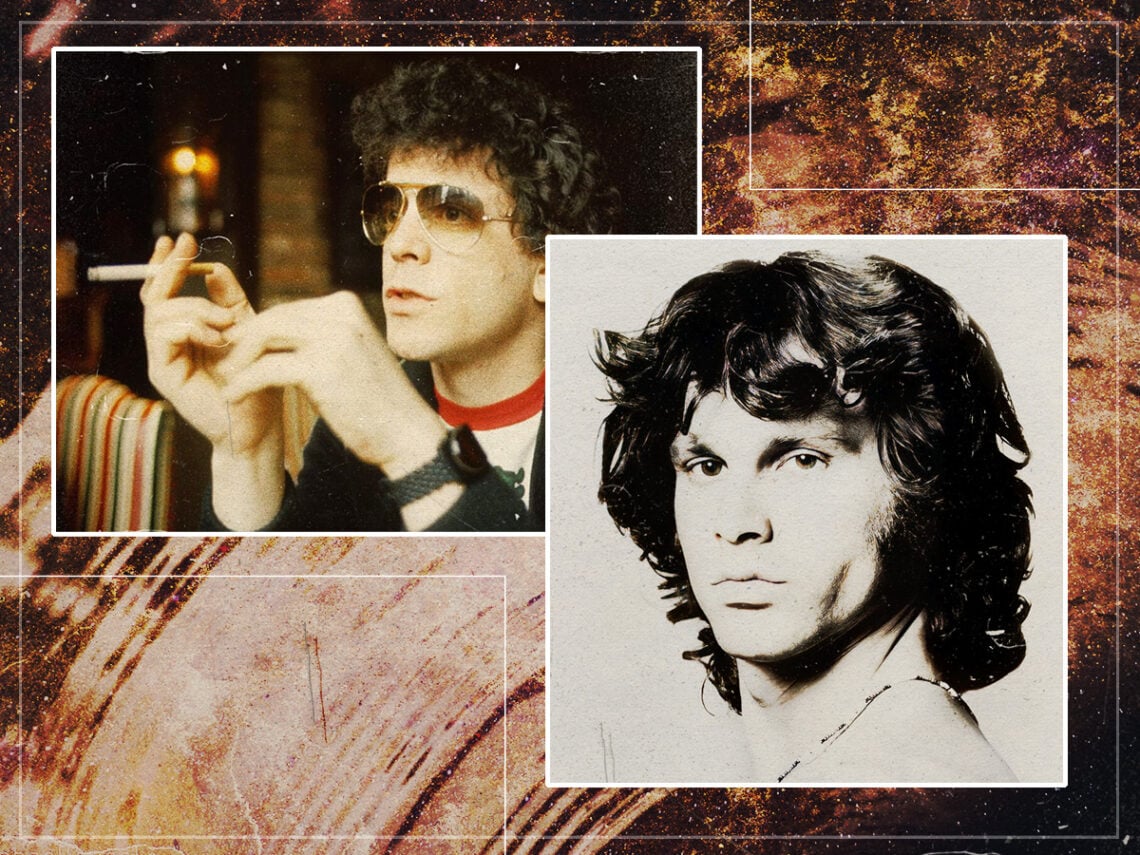
Jim Morrison
Inexplicably and somewhat cruelly, Jim Morrison spun a yarn that his parents were dead. They weren’t. The tale of why he lied about the passing of his parents, however, is emblematic of the antics that followed and underpins his cannon of art. You see, his father, George Morrison, who passed away in 2008, was in the Navy, which meant that his childhood saw him move from state to state. This idea of a wandering existence and the bowels of great big America is key to many of his songs, such as the nomadic anthem of ‘Riders on the Storm’.
Aside from the wayfaring lifestyle of his father’s job, his mother and father ran his house with immense discipline and handed out military-like punishments known as “dressing down”. Once he got into UCLA in 1964, Morrison cut ties with most members of his family, perceiving a lack of empathy and support from them. When people asked about his background, rather than tell the truth and explain that he was estranged, Morrison claimed that his parents and siblings were dead, which seems a stretch for simply being the victim of strict discipline and stern emotions, but then there is a lot about him that still begs questions.
Morrison’s cover-up wasn’t just a lie that he told to friends either; Elektra Records even published that Morrison was an orphan as part of the materials distributed with The Doors’ self-titled debut album in 1967. His family had no idea he was even in a band, let alone that The Doors were capturing hearts and minds all over America and beyond. His father would later comment in the book The Doors by The Doors: “He knew I didn’t think rock music was the best goal for him. Maybe he was trying to protect us.”
His sister, Anne, added: “He liked mystique, too. He didn’t want to be from somewhere.”

Lou Reed
”I’ve lied so much about the past I can’t even tell myself what is true any more,” Lou Reed once told Mojo. This makes him unique in this list in that he never really settled on a singular backstory; he just continually spun yarns to throw off journalists and imbued his tale with a badass aura. In fact, he didn’t see the point of accurately knowing an artist’s backstory, explaining, “I think in an interview what they essentially want to know is how big is your dick.”
Reed himself was born amid the gaudy chaos of New York City. He would shut out the world and slink into the art around him by means of salvation from the endless panic attacks he suffered through. Albeit Reed was dyslexic, books were an appealing escape for him. As a teen in the late 1950s, this invariably meant Jack Kerouac and the beat literature craze.
It is Kerouac, in fact, who illuminates a very similar pastiche to Lou Reed’s opening ‘Berlin’ stanza when he wrote: “A pain stabbed my heart, as it did every time I saw a girl I love who was going the opposite direction in this too-big world.” On both counts, we have, of course, a self-absorbed fantasy. So, Reed often brushed over details about leaving The Velvet Underground to go and work at his father’s accountancy for a while from his public history.

Lucia Pamela
Outsider music is the real realm of manufactured fantasies. “We’re taking off for the moon,” Lucia Pamela excitedly exclaims like a captain overly eager to spend some time with their secret second family in Crete before regaining composure and demanding that passengers fasten their seatbelts. It then takes four seconds for her to announce, “Oh, we have landed on the moon”, following the vague sense of an ascending note. And that’s where the whole album takes place thereafter.
To Pamela, this was literal. Throughout her life, the outsider star insisted that the album was recorded on our lunar neighbour, evidenced by the fact it clearly transposes the different air up there. Anyone who scoffed or pointed out that there isn’t actually any air up there were deemed cynics, too stuffy to understand her Apollo art.
As far as Pamela was concerned, she had built a rocket, explored the Milky Way, stopped off on the moon, and put her classical training to use by recording every instrument available to her and then reciting the sights she was beholding. The grain of truth is that she received some classical training as a child because her mother was a noted concert pianist. However, it’s doubtful that her claim that Ignacy Jan Paderewski, legendary composer and Polish prime minister, pronounced she would one day be the greatest musician in the world was true. But Pamela kept on insisting that her fallacy was true.

Seasick Steve
When the reality surfaced regarding Seasick Steve’s apparently contrived personal narrative, it sparked widespread outrage. Despite his portrayal of working-class authenticity, right down to his appearance, it was unveiled as a calculated ploy to exploit both the music industry and his loyal fan base.
In reality, Seasick Steve was born ten years after many originally thought and didn’t come from homelessness. He wasn’t new to the industry and wasn’t named Steven Wold. His name is Steven Leach, and he played in a handful of bands before becoming a producer in the 1980s. Most people bought into the ideology that he had been a migrant worker, busking on the streets and in a park until he was discovered. While he may not have had a lot of money, the truth of the situation reads a little different.

The Clash
There were many aspects of The Clash’s Paul Simonon and Joe Strummer’s lives that played into their punk-rock facade during their peak of fame. For starters, Simonon seemed to struggle to fit in when trying his hand at art school, while Strummer felt his background didn’t exactly suit the part of the working-class punk rocker. As a result, Simonon claimed he didn’t know very much at art school, while his bandmate left out the part about coming from a seemingly well-off background.
Simonon was surrounded by art growing up, his bedroom walls resembling a vibrant tapestry adorned with both his father Gustave’s paintings and works by renowned British and Dutch masters. Following The Clash’s dissolution, he found his way back to the world of art, carving out a niche for himself as a painter and designer.

The White Stripes
The memory of The White Stripes’ Jack and Meg White being brother and sister isn’t just another Mandela Effect; they actually claimed this to be true. From the beginning, Jack White was so eager to stop this aspect of their lives from becoming a distraction that he actively denied it.
“When you see a band that is two pieces, husband and wife, boyfriend and girlfriend, you think, ‘Oh, I see…’ When they’re brother and sister, you go, ‘Oh, that’s interesting,’“ he told Rolling Stone. “You care more about the music, not the relationship – whether they’re trying to save their relationship by being in a band.“

David Bowie
In 1972, just before Ziggy Stardust, David Bowie famously proclaimed, “I’m gay, and always have been. Even when I was David Jones“. Then, in 1976, he was bisexual, something that he said “was the best thing that ever happened to me”. By the time the 1980s and 1990s came around, however, the Starman changed his tune.
“I wanted to imbue Ziggy with real flesh and blood and muscle, and it was imperative that I find Ziggy and be him,“ he told Rolling Stone, explaining his decision to adopt a queer label. Although this angered many fans who felt his back-peddling was a betrayal, the singer embraced queer culture during eras when most people turned their back on it. Through his music and characters, Bowie became a shining beacon, one who told others that being different was something to celebrate.

Killing Joke
The 1980s witnessed significant societal upheaval and heightened cultural anxiety. It was a decade overshadowed by the infamous Satanic panic, the devastating AIDS epidemic, and a pervasive sense of impending doom. Seeking to create an ideal refuge amidst this turmoil, Jaz Coleman of Killing Joke purportedly relocated to Iceland for what he portrayed as the best chance of survival. Or so he claimed at the time.
“I told everybody the end of the world was coming, but that was to get people off my back,” Coleman said. However, while the real reason behind his relocation may have been to get a break from the bustle of everyday life, he, along with Geordie Walker, set up a record label and sold drugs.


Never Miss A Tale
The Far Out Bob Dylan Newsletter
All the latest stories about Bob Dylan from the independent voice of culture.
Straight to your inbox.