


10 brilliant movies featuring two incredible performances

Some films feature more than one glorious example of acting. There are some movies that show two stellar actors performing to the best of their abilities, in a story that allows – even encourages – depth and commitment from its actors.
Some actors, the likes of Timothy Dalton, Al Pacino, Peter O’ Toole, deliver their best work when they are working across from other artists, and there are other actors who give their best work when they are working on their own, as is the case with Robert De Niro, Daniel Day-Lewis, Jonathan Pryce and others. In some cases, the actors on this list did both.
It’s as much an art to collaborate with another actor as it is to chew the scenery entirely by yourself. The artists on this list showed that they were more than capable of making themselves heard in an art form that showed other heavyweight artists.
More and more the actors that best benefit from collaboration are the artists who carry on working throughout their lives. In many ways, the artists that make up this list have shown a malleability that goes beyond the professional into the intimate.
10 movies featuring two incredible performances:
10. The Irishman (Martin Scorsese, 2019) -Al Pacino and Joe Pesci
A dream project for Martin Scorsese fans, the film not only saw the director reunite with Robert De Niro and Joe Pesci, but it also saw him working with Al Pacino for the first time in his career. Pacino acquits himself well in the film, and although he only has one scene with Pesci, it’s an argument of high distinction.
The two men demonstrate each other’s truths, one fighting for the sanctity of the union, the other speaking for the mob. Both men were nominated for Academy Awards for Supporting Actor, and it’s hard to say who is superior, as they are so different. Pacino sparkles and crackles, while Pesci plays it uber-cool.
9. Flash Gordon (Mike Hodges, 1980) – Brian Blessed and Timothy Dalton
Forget Star Wars, Flash Gordon is the science fiction spectacle of the 1980s. Brimming with bonhomie, good wit and reverence to the genre it wishes to uphold, the film also boasts a supporting cast that is infinitely more enjoyable to watch than the more sanguine leads. Timothy Dalton plays Prince Barin, and he would be the loudest and showiest actor in the movie if Brian Blessed didn’t happen to make an appearance.
They couldn’t look less different – Dalton is long and spindly looking, while Blessed is more rugged – but together they boom and shout as if singing to the back end of the West End in London. It’s like seeing two Shakespearian actors at the Royal Albert Hall.
8. The Long Good Friday (John Mackenzie, 1980) – Bob Hoskins and Helen Mirren
In 2014, Helen Mirren chose to pay tribute to the recently departed Bob Hoskins. “Bob was a great actor and an even greater man,” she said. “Funny, loyal, instinctive, hard-working, with that inimitable energy that seemed like a spectacular firework rocket just as it takes off.”
The two worked together on The Long Good Friday, one of the seminal East End gangster films of the 1980s. Hoskins gets many of the shower lines, but Mirren provides the emotional muscle of the two, and in one blinding moment, she encourages Hoskins Harold Shand to do what he can to end the war between the rival gangs.
7. The Lion In Winter (Anthony Harvey, 1968) – Peter O’Toole and Katharine Hepburn
This lavishly filmed epic is one of the great alternative Christmas movies. Centred around a family dispute, the film demonstrates the royal discussion over who should take over the crown when Peter O’Toole’s King Henry dies. His greatest opponent isn’t the charming King Philip of France, but someone much closer to home; his wife.
Katharine Hepburn gives O’Toole a good run for his money, and the two spark off one another, like two tango dancers trying to outmanoeuvre the other one. It’s impossible to imagine the film without either of them, but the same could be said for the ensemble – Anthony Hopkins and Timothy Dalton make their film debuts here – as such is the standard of the cast.
6. Amadeus (Milos Forman, 1984) – F. Murray Abraham and Tom Hulce
F. Murray Abraham and Tom Hulce were both nominated for Best Actor at the 1985 Oscars, but in a strange twist of fate, Abraham walked away with the trophy. The money was on Hulce who played Mozart, the headstrong composer who was determined to show the world his tremendous gift, but Abraham had the more difficult role, showcasing his immense rage as Salieri, hiding in plain sight, gasping at every note his rival produced.
The film depended on the men getting the motions right, and both of them play it as the script intends: Hulce is buoyant, bouncy and full of life, while Abraham is stern, stoic and focused on revenge he is plotting behind Mozart’s operas. It’s a shame they couldn’t split the award in two.
5. The Man Who Would Be King (John Huston, 1975) – Michael Caine and Sean Connery
Yes, John Huston managed to bag James Bond and Harry Palmer in a film together, and Sean Connery is as roguish as you imagine, just as Michael Caine is as hard-hitting as you might predict. The pair have electricity that was genuine, precisely because they were such good friends in real life. The film depicts two British soldiers who manage to convince a town that they are Gods, only for one of them to bleed, and to show their mortality.
It made an impression on many directors, one of them being Kingsman mainstay Matthew Vaughn. “I think one of Sean Connery’s finest performances,” he recalled. “[It had] Michael Caine, the original Kingsman. It had pathos — important messaging, comedy, fantasy. Had everything. And I was like, ‘Wow, why don’t we…’ and I jokingly said, ‘We should make ‘The Man Who Would Be Kingsman'”.
4. Rain Man (Barry Levinson, 1988) – Tom Cruise and Dustin Hoffman
Dustin Hoffman walked off with the plaudits, but Tom Cruise is every bit as impressive as the brother who is getting to know his autistic older brother. Indeed, Cruise is technically the leading actor, since he’s the one who dominates the screen, but his partner is entirely based on the work he delivers with Hoffman. Together the duo has a sincerity that feels like it comes from a place of great trust.
Director Barry Levinson was impressed with Cruise. “I was impressed with his work,” he recalled. “What I gave him is the thing that he hasn’t often had the opportunity to do: work with a full character. His props get stripped away. He doesn’t have a pool cue. Tom is sharp enough to know that he’ll always have movies like Cocktail, but I don’t think he wants to sit still and just keep playing glamour, guys.”
3. Jean de Florette (Claude Berri, 1986) – Yves Montand and Gerard Depardieu
This is the one and only non-English speaking language film on the list, but that’s precisely the power of Jean de Florette, which crosses borders based on the power of the lead actors. Gerard Depardieu plays the world-weary titular hunchback, who is being taunted by the local villagers. With no one to aid him, he resorts to the advice of some dubious people who think he is sullying the reputation of the town.
And then there’s Yves Montand who plays Cesar, a pillar of wisdom in the pastoral air, throwing himself into the local gossip, spinning town’s people against the new prosperous hunchback who comes searching for a new lease of life. He’s wonderfully understated, but he’s as menacing as Depardieu is humbling to watch.
2. The Godfather Part II (Francis Ford Coppola, 1974) – Robert De Niro and Al Pacino
Robert De Niro has worked with Al Pacino on three occasions: First, they squared off against each other in Heat; then they acted as partners in the risible Righteous Kill. More recently, they embodied the roles of two historical characters in The Irishman, a film that was deeply indebted to The Godfather Part II, a film that starred Pacino and De Niro in two disparate time zones.
Naturally, they never see each other, but they share narrative beats, not least during the film’s impactful climax. Unlike Vito Corleone (De Niro), Michael Corleone (Pacino) seems destined to bring everything to ruins, including his family. De Niro shows the glorious beginnings of a crime industry, while Pacino plays it more pathos, as he watches the mosaic come crumbling down to its knees. Both men were nominated for awards, serving as a strong indication as to where they would go next with their work.
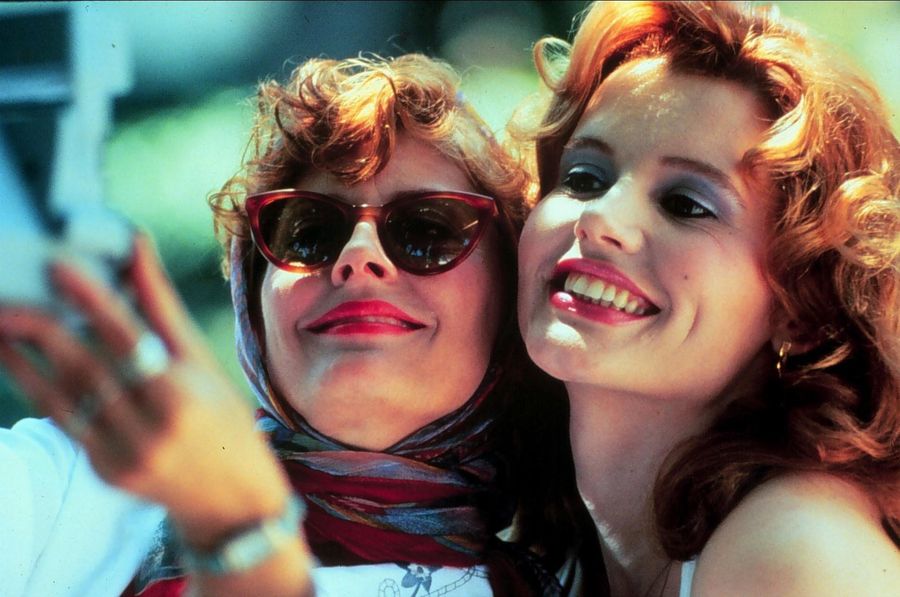
1. Thelma & Louise (Ridley Scott, 1991) – Geena Davis and Susan Sarandon
There could only be one winner. From the driving montage to the glorious closing shot of the two women thrusting themselves into the great wilderness ahead, Thelma & Louise stands with the best of Ridley Scott’s work. He chose the leads wisely, and Geena Davis has genuine chemistry with co-star Susan Sarandon. The pair are among the most impassioned and most trusting of women, as they come together to present a portrait of the price of freedom.
Barely apart from each other for a minute, the two needed the chance to create a new form of dialogue that goes beyond the realm of verbosity into something more kinetic and full of life. The two women flesh the characters as they appear on the stage, giving a new voice to the world of indie cinema. Tremendous.
