


10 movies that feel like springtime

With the arrival of spring just around the corner, we can look forward to lighter nights, warmer days, and an increased sense of cheeriness. After a cold, slow winter, spring is the perfect antidote, welcoming a renewed sense of hopefulness and growth reflected in the natural events that take shape. Lambs are born, fruits ripen, and cheery flowers such as daffodils and sunflowers emerge.
Spring is one of the most visually stunning periods of the year, and cinema is one of the most excellent mediums to capture its vibrancy. Watching a film set among luscious green fields and blooming flowers is always a pleasure. By inviting us into an enticing dream-like world, many springtime films remind us of the natural beauty we often take for granted.
The films listed below fall into two categories. The first is movies that possess an inextricable springtime feel, perhaps due to their bright cinematography and natural settings, as reflected in the backdrops of Pride and Prejudice or Picnic at Hanging Rock. The second category consists of films dealing with spring themes, such as regeneration and growth, inspiring a similar feeling in the audience.
Thus, from Eric Rohmer’s A Tale of Springtime to Roger Mitchell’s classic rom-com Notting Hill, here are ten films that feel like spring.
10 films that feel like springtime:
A Tale of Springtime (Eric Rohmer, 1990)
Eric Rohmer was one of the few directors to emerge from the French New Wave that consistently released films for decades after the movement ended, producing some of his best work in the later years of his career. Although he found acclaim with his Six Moral Tales series, which included the Oscar-nominated My Night at Maud’s, Rohmer also released a successful quartet of films in the 1990s as part of the Tales of the Four Seasons.
A Tale of Springtime is a comedy-drama that follows a teacher who, after finding herself unable to go home due to her sister occupying her apartment, ends up staying with a new friend. She quickly finds herself attracted to her new pal’s father, who already has a girlfriend. Rohmer stays true to his title and prioritises breathtaking scenes of blossoming flowers and greenery as the drama unfolds.
Blow Up (Michelangelo Antonioni, 1966)
If you’d like to indulge yourself in Swinging Sixties-era London, look no further than Blow Up. The mystery drama, helmed by Italian director Michelangelo Antonioni, follows a sleazy photographer, played by David Hemmings, who becomes obsessed with the idea that he has captured a crime scene on film. He indulges in shameless sexual romps, smashes the neck of Jeff Beck’s guitar following a performance by The Yardbirds, and watches a mime troupe perform imaginary tennis. In essence, Blow Up condenses the period’s attitudes, music and fashion like no other film.
The cultural upthrust of the 1960s was a time of newness and looking forward. People embraced hedonistic attitudes and ditched post-war angst in favour of modernity and progression. Blow Up reflects these ideals, making it a solid entry to your spring watchlist.
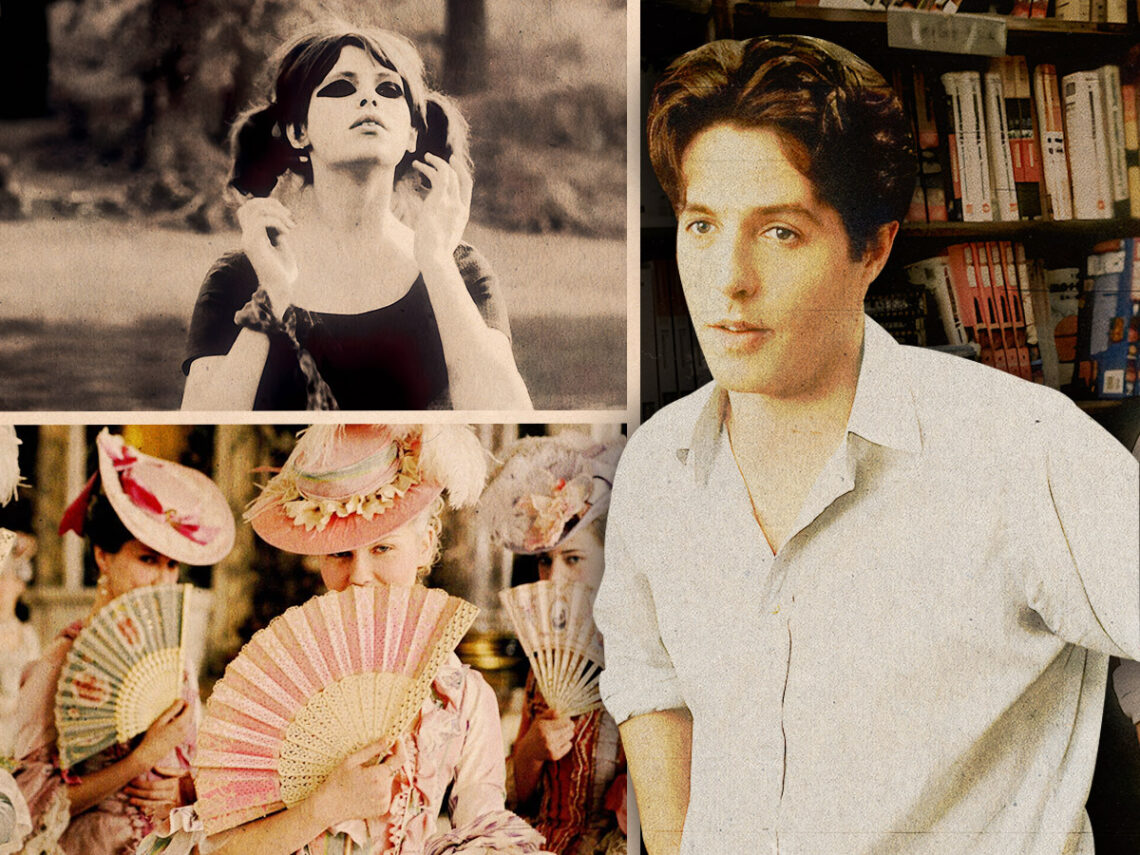
Daisies (Věra Chytilová, 1966)
Although Daisies is now considered one of the most important works of feminist cinema and a staple of the Czech New Wave, Věra Chytilová’s experimental film was condemned by many American critics and contributed to her eventual domestic filmmaking ban, which was cemented after she released 1970’s Fruit of Paradise. Daisies‘ unapologetic themes of female disobedience, anti-authoritarianism and critiques of gender stereotypes and consumerism make it a revolutionary piece of cinema.
Much of the movie’s themes are conveyed through strong utilisation and manipulation of the form. Kaleidoscopic imagery, sped-up scenes and visual effects are prominent features of the film. However, it also makes for an ideal springtime watch due to its rich natural imagery of pleasant fields, trees, flowers, and a pastel colour palette.
Donkey Skin (Jacques Demy, 1970)
Jacques Demy is best known for his films The Umbrellas of Cherbourg and The Young Girls of Rochefort, yet his 1970 musical fairytale Donkey Skin is a severely underrated gem. The movie stars Catherine Deneuve as the daughter of a king who is keen to marry the princess following the death of his wife. Eager to escape his incestuous ways, a fairy godmother (Delphine Seyrig) advises the princess to disappear by disguising herself with a donkey’s head.
The film is as bizarre as the premise sounds, yet Demy revels in psychedelic imagery and garish, over-the-top costume and set design that make Donkey Skin utterly delightful. The bright colours and theme of new beginnings make Demy’s film the perfect choice to watch during the brighter months.
Le Bonheur (Agnes Varda, 1965)
Best known for her seminal French New Wave entry, Cleo from 5 to 7, and her documentary work, such as The Gleaners and I, Varda has many narrative films under her belt that fail to receive ample appreciation, despite the sheer beauty they possess. One of Varda’s most striking films is easily Le Bonheur, a tragic tale of married life that morphs from an idyllic romance into a horror film disguised by lucid blues, greens and yellows.
Although Le Bonheur is far from optimistic, it’s hard to resist Claude Beausoleil and Jean Rabier’s framing of bright fields of sunflowers, bouquets, and scenes of people dining outside amongst vivid greenery. However, if you want to retain a spring in your step, you might have to turn the film off before it ends.
Marie Antoinette (Sofia Coppola, 2006)
Following her Oscar-winning film Lost in Translation, Sofia Coppola made her French Revolution-era biopic Marie Antoinette, exploring the loneliness felt by the young queen, played by Kirsten Dunst. The film remains one of Coppola’s best outputs, thanks to her dedicated vision that brings the decadence of royalty to life.
Marie Antoinette is almost entirely painted in pastel colours akin to the imagery of Picnic at Hanging Rock, making it quite the visual feast. One of the film’s most endearing moments comes when the protagonist plays in the tall grass with her children surrounded by sheep – the perfect encapsulation of spring.
Notting Hill (Roger Mitchell, 1999)
As far as romantic comedies go, there’s not much to dislike about Notting Hill, which features all of the staples of the genre. A meeting between a bumbling British heartthrob (Hugh Grant) and a famous American actor (Julia Roberts) makes for the perfect slice of entertainment, even if it is wholly unrealistic. But that’s the beauty of Notting Hill – it revels in the unlikeliness of its story, which makes it utterly charming.
The breezy setting in the heart of the eponymous location, where Grant’s character runs a little bookshop, gives the film a springlike feel, emphasised by scenes of the two hanging out in green parks and walking through market stall-lined bustling London streets.
Picnic at Hanging Rock (Peter Weir, 1975)
Peter Weir’s 1975 film Picnic at Hanging Rock is one of the dreamiest-looking pieces of cinema ever made. Although the Australian mystery drama doesn’t occur in the springtime – it takes place on St. Valentine’s Day – it certainly feels like it does. The pastel colour palette, rich pastoral landscapes and the uniform white dresses worn by the characters all contribute to its springlike atmosphere.
Based on the novel by Joan Lindsay, Weir’s film became a cornerstone of the Australian New Wave. Moreover, the movie’s beautiful, hazy imagery has been a significant source of inspiration for Sofia Coppola, its influence apparent in The Virgin Suicides, Marie Antoinette and The Beguiled.
Pride and Prejudice (Joe Wright, 2005)
Similarly to Marie Antoinette, Joe Wright’s Pride and Prejudice – the most faithful adaptation of the classic Jane Austen novel – paints a gorgeous picture of spring through its emphasis on natural landscapes, filmed in the heart of the British countryside. The tale of Elizabeth Bennett and Mr Darcy is well known, yet Wright brings it to life through studied performances from Keira Knightley and Matthew Macfayden.
It’s hard to watch Pride and Prejudice without wanting to book a trip to a quaint countryside location and frolic in the long grass as the sun sets, just like Elizabeth. Wright’s film helped pave the way for more classic adaptations, marketed with a youthful and attractive appeal.
The Worst Person in the World (Joachim Trier, 2021)
Norweigan black comedy-drama The Worst Person in the World was one of 2021’s most celebrated releases, establishing Joachim Trier as one of the most important voices in contemporary cinema. The film follows Julie, an aimless woman in her late-20s, unsure of her position in life. She floats between relationships and comes face to face with life-changing experiences and decisions. The movie charts her progress towards self-discovery and explores the continuum of time, depicting the ups and downs of adulthood.
Not only does The Worst Person in the World contain spring-adjacent themes of discovery and renewal, but it also includes an inexplicably fresh feeling evoked through its clean and bright cinematography.
