


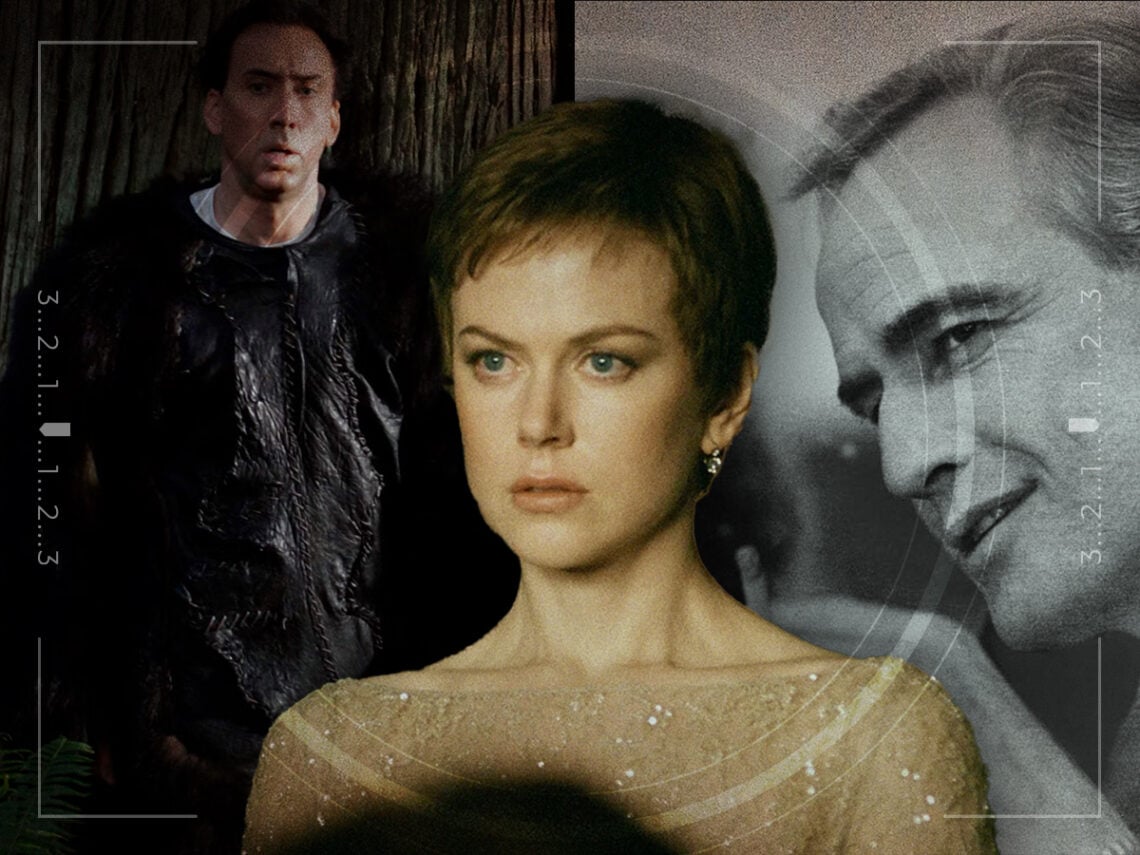
The 10 most controversial performances in cinema history

There are many performances that have irrevocably shaped the history of cinema, demanding new limits from actors as they bend themselves to fit the vision of their director. Whether it be a grungy independent drama that requires you to lock into a dark inner psyche or a physically demanding role in a commercial action thriller, countless actors have reached fame through sacrificing every inch of themselves for their performance.
However, there are some who have reached notoriety through this quest, sparking debate and endless analysis through portraying explicit material, divisive characters or real-life figures, subjecting them to increased public scrutiny as people discuss the ethics of recreating these moments on screen.
While some have found success through managing to accomplish seemingly impossible feats like portraying Princess Diana, Bob Dylan or Malcom X, there are some whose careers were damaged in catastrophic ways through tackling controversial characters, being left with a ruined reputation or shattered mind after delving into the psyche of someone who should be left alone.
With that being said, let’s look at the ten most controversial performances of all time, which are enough to generate heated conversations among film fans.
The 10 most controversial performances in cinema history:
Stanley Tucci – ‘The Lovely Bones’ (Peter Jackson, 2009)

For those who know Stanley Tucci from his camp and light-hearted performances in The Devil Wears Prada and Big Night, his performance in The Lovely Bones was a stark shock to his persona in real life. While he has played morally ambiguous characters over the course of his career, whether it be the charismatic yet morally corrupt talk show host in The Hunger Games or a cheating and sexually confused husband in The Daytrippers, nothing quite came close to his truly harrowing portrayal of a murderous pedophile in Peter Jackson’s unnerving horror film.
Starring alongside a young Saoirse Ronan, Tucci evolves into a steely-eyed and cold-blooded killer, with a lifeless yet scrutinising look behind his eyes as he begins obsessively following a young girl in his neighbourhood before eventually murdering her. Tucci himself spoke about the damage that this did to his mental well-being in real life, reflecting on how horrific it was to perform such disturbing scenes with a young girl. Understandably, he wasn’t in a rush to return to roles of this nature and hasn’t touched another character like it since.
Nicolas Cage – ‘The Wicker Man’ (Neil LaBute, 2006)

When an incredible movie is remade, we’re often left asking why, and that couldn’t have been more true than when Nicolas Cage joined the cast of a remake of The Wicker Man. Why? The classic British folk horror film was released in 1973 by director Robin Hardy, with Edward Woodward and Christopher Lee starring in the terrifying tale of religious devotion and community. For the remake, Cage starred as a police officer whose ex-fiancée asks him to help her search for her missing daughter, leading him to an island near Washington home to a cult that draws him in.
Cage’s performance was lambasted. Despite the fact he had earned an Oscar ten years prior for Leaving Las Vegas, the actor gave a performance that suggested he’d never acted before. With poorly delivered lines like “Not the bees,” the movie became a laughing stock and a viral meme as the internet became more popular. It remains an iconic bad performance, not just in Cage’s filmography, but in the entire history of cinema.
The 2006 version of The Wicker Man is proof that not all good films need remaking, as well as demonstrating how an actor can truly go from good to terrible.
Harry Styles<em> – </em>’Don’t Worry Darling’ (Olivia Wilde, 2022)

There has recently been a trend in which singers, influencers and people with no acting experience have been cast in high-profile movies, with the likes of Charli XCX being rumoured to play the White Witch in Greta Gerwig’s Narnia adaptation and Emma Chamberlain starring in her first feature film. Perhaps we can thank Justin Timberlake for forever ruining the credibility of casting directors through these cheap and lazy ploys to attract more bums on seats, something that also came to haunt audiences through Olivia Wilde’s 2022 film, Don’t Worry Darling, in which she cast Harry Styles in the lead role.
This project was under scrutiny from day one, with rumours of a feud between Florence Pugh and Wilde, the highly questionable choice to initially cast Shia LaBeouf despite his sexual assault allegations and the notorious relationship that blossomed between Styles and Wilde. As a result of all the on-set drama, people were expecting a masterpiece that would warrant all these tumultuous stories, only to be met with a mediocre story that fell flat in the hands of Mr Styles.
He might be a good singer, but his performance was flat and completely unconvincing, with his role in the film becoming subject to endless mockery online as people ridiculed the casting directors who ever thought it would be a good idea for him to star across Pugh, who is arguably one of the most talented performers of her generation.
Monica Bellucci – ‘Irreversible’ (Gaspar Noé, 2002)

Gaspar Noé is widely known as a provocateur and master of shock cinema, simultaneously devastating and disturbing audiences through his explosive commentaries on sex, love and all the murky grey areas in between. However, while he reached notoriety for the unsimulated sex scene in Love, it was his 2002 film Irreversible that proved to be most controversial due to Monica Bellucci’s performance and the scene that takes place in the red tunnel.
After its screening at the prestigious Cannes Film Festival, audiences stormed out of the cinema and spat at the director for his inclusion of a graphic sexual assault scene towards the film’s midpoint, with Bellucci’s harrowing performance and incomprehensible vulnerability in this moment becoming a sore subject of debate as people questioned the ethics of what she was asked to do on camera.
While Bellucci spoke highly of Noé and her experiences of working with him, it was rightly questioned and is still talked about today when discussing moral boundaries of cinema and what should and shouldn’t be asked of actors on screen.
Faye Dunaway – ‘Mommie Dearest’ (Frank Perry, 1981)

Hollywood icon Joan Crawford was accused of abuse and cruelty by her daughter, Christina, in the memoir Mommie Dearest in 1978, which was adapted into a film by Frank Perry in 1981. The movie was quickly labelled a piece of camp cinema – something that was not the intention – with Faye Dunaway playing an incredibly overdramatic and exaggerated version of Crawford.
While Dunaway was known for giving great performances in movies like Bonnie and Clyde and Chinatown, Mommie Dearest saw her embroiled in controversy. Who can forget the “No wire hangers” scene? Or the “Don’t fuck with me fellas! This ain’t my first time at the rodeo.”
While some people stand by the fact that Dunaway was terrible in the role and that the movie is a mess, others believe that her performance was actually Oscar-worthy. Needless to say, it stirred up plenty of mixed opinions, with the actor taking home ‘Worst Actress’ at the Golden Raspberry Awards.
Kevin Bacon – ‘The Woodsman’ (Nicole Kassell, 2004)

God knows why the world thinks we need to sympathise more with pedophiles and rapists, but the 2004 film The Woodsman did exactly that through its portrayal of a convicted child sex offender who struggles to rejoin society after being released from prison. The film is almost comical in how far it goes to convince us that this is a person in need of our sympathy, with Kevin Bacon playing the lead role and showcasing the struggles of a pedophile living next to a children’s playground.
While the film attempts to highlight his redemption arc as he tracks down another child molester in his neighbourhood, it also jumps through hoops to make us feel pity for a man who has rightfully been ostracized for committing a truly monstrous crime, with Bacon being questioned for lending his voice to this story and the murky intentions behind trying to make his pity a paedophile who understandably, doesn’t have any friends.
Jodie Foster – ‘Taxi Driver’ (Martin Scorsese, 1976)

Jodie Foster earned significant praise for her role in The Silence of the Lambs in 1991, which won her an Oscar, but 15 years prior, she had shocked audiences with her portrayal as a child prostitute in Martin Scorsese’s Taxi Driver. People couldn’t believe that the 12-year-old was given such an intense role, donning high-waisted shorts, a cropped top, and chunky sandals to play the character who acted far beyond her years.
The actor has since recalled being able to handle the part well — arguably better than the adults on set who felt “awkward” about getting the child to play such a mature role. By this point, however, she had acted in countless shows and movies, and she has claimed that she felt well-equipped to take on the challenging part.
She told Yahoo! Entertainment, “I don’t think it was uncomfortable for me; I think it was uncomfortable for other people,” adding, “To me, it was another role, and I understood the difference between making movies and actually being a person. So it wasn’t really impactful for me.”
Nicole Kidman – ‘Birth’ (Jonathan Glazer, 2004)

Jonathan Glazer has proved himself to be a master of versatility and creating controversy, with his recent film The Zone of Interest sparking conversations around our approach to tragedy and the ethics of spectatorship, with the director being one of very few to have his Oscars acceptance speech censored after mentioning his support for Gaza and rightfully relating the films message to the conflict.
However, this wasn’t the first time the director’s work was censored, with one scene from his 2004 film Birth being cut in the United States for its depiction of Nicole Kidman’s character having a bath with a child. After the film’s release, Kidman was endlessly criticised for her participation in this scene, with the film following a woman who believes that her dead husband has taken over the body of a ten-year-old boy.
People labelled Kidman and Glazer as ‘pedophilic’, slamming the actor for appearing naked next to a child. While it was cut and censored at the time of its release, the film has found a new audience in recent years, despite the divisive bath scene that once nearly ruined Kidman’s reputation.
Jeremy Irons – ‘Lolita’ (Adrian Lyne, 1997)

In 1997, Adrian Lyne, known for his erotic films like Indecent Proposal and 9 ½ Weeks, decided to adapt the highly controversial novel Lolita for the big screen, several decades after Stanley Kubrick’s rather sanitised version. Lyne opted for an approach that wouldn’t censor the most inappropriate parts of the book, even though it tells the story of a manipulative paedophile who grooms and engages in sexual acts with a 14-year-old. Jeremy Irons, who was 48 then, signed up to play Humbert, while 15-year-old Dominique Swain played the titular character.
While the young actor was replaced by a body double for the film’s most explicit scenes – and a cushion was placed on Irons’ lap when she was required to sit on him – the pair are still seen kissing and being intimate, which made many viewers uncomfortable. Irons knew that the movie would cause backlash, and he almost refused the role, stating (via South Coast Today), “For a long time I wasn’t going to do it. But when Adrian said I was just being politically correct, I thought, ‘Aha!’”
He added, “I then spoke to Glenn Close, a great friend, and she said you’ve got to work with the best directors on the best scripts playing the best roles. ‘Well,’ she said, ‘you’ve got Adrian Lyne, you’ve got an excellent story and a fantastic character. Why are you saying no?’”
Marlon Brando – ‘Last Tango in Paris’ (Bernardo Bertolucci, 1972)

Bernardo Bertolucci’s Last Tango in Paris is dubbed by some as one of the sexiest films of all time, with Marlon Brando playing an American man who begins a purely sexual relationship with a young French woman following the death of his wife. The 19-year-old Maria Schneider played Brando’s lover, although there was significant controversy surrounding the esteemed actor’s performance in the film, which saw him do something that left Schneider “crying real tears.”
In one sequence, Brando’s character anally rapes Schneider’s Jeanne using butter, but the young actor was not adequately informed of how the scene would play out before filming. Bertolucci claimed in 2013 that he didn’t tell Schneider “what was going on, because I wanted her reaction as a girl, not as an actress.” The actor told The Daily Mail in 2007, “I felt humiliated and to be honest, I felt a little raped both by Marlon and by Bertolucci. After the scene, Marlon didn’t console me or apologise.”
The controversy surrounding the scene made it Brando’s most divisive performance, although that didn’t stop him from being nominated for an Oscar for the role.
