


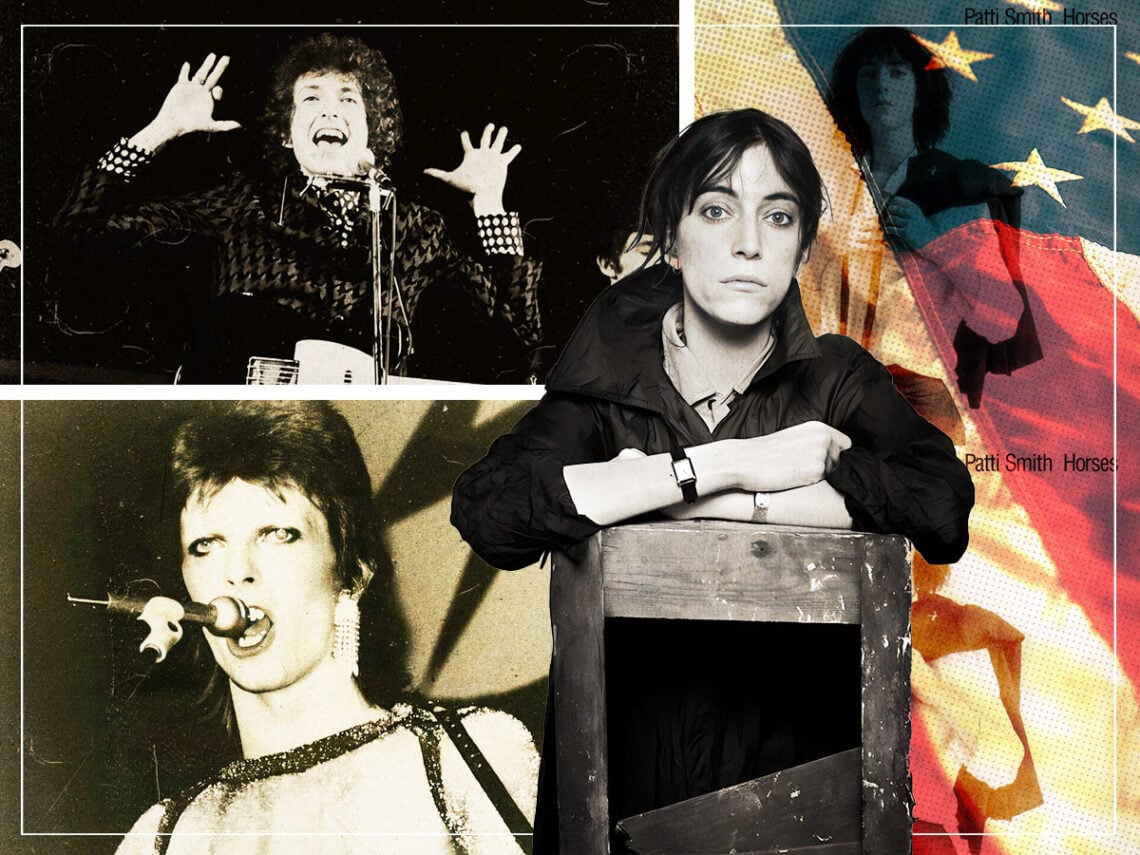
10 masterpiece albums that failed to break the top 20 in the US charts

The music chart is a big fat liar that has laid waste to masterpieces from Bob Dylan, David Bowie, and many more. Yes, it’s a hell of a lot further away from art than a mere ‘ch’. While we are all fairly well aware of the fact that fads and trends can manipulate brief moments in history and that commercialism is a world away from reverence, sometimes you simply have to look back with bemusement.
Firstly, you find yourself aghast at the robbery – the daylight sacrilege – at hand, but moreover, you wonder why you’ve been fed a lie by history for so long. Ask any critic, cynic, auntie or earthworm and all of them would indicate that David Bowie and Bob Dylan are two of the most influential musicians in recent history. This particular critic would go one step further and wager that they are arguably two of the most important artists ever. Their narratives, however, rightfully incorporate a slow uptake—a sort of struggle out of the gates before they blitzed to the front of the pack in the home straight and blazed a trail for others to follow.
In many ways, this seems natural. Society expands from the edges, so when an artist is actively looking to push boundaries, it stands to reason that often, they will be missed by the mainstream. The flip side is just as apparent. The records on the all-time global best-sellers list are inherent oddities. They are artefacts that have surpassed usual levels of popularity and entered a weird phase of becoming a cultural phenomenon. More so than reflecting tastes or the arc of culture, they seem to me to reflect a mental anomaly that commercial strategists, psychologists and anthropologists alike should study in-depth.
In order to prove just how peculiar the charts prove to be, we’ve looked at some of the finest albums in history and found the ones that failed to break the top 20 in the US – even Pet Sounds only initially got to tenth. This oddity is pertinent to remember today, in an era where a content overload is making it harder for artists to get noticed, it is vital for tastemakers and the likes to be impartial, which is why we remain entirely independent at Far Out because even this year our 20 best albums so far list features many masterpieces that need way more attention.
10 albums that failed to break the US top 20:
Black Sabbath – Black Sabbath (1970)
The narrative of rock history claims that metal came along to plant its flag in the ground that The Beatles had just departed, heralding a new chapter of rock ‘n’ roll. However, Black Sabbath scraping to 23 in the US charts hardly represents a changing of the guard. I mean, can you hazard a guess at who is currently 23 in the charts today?
Perhaps a fair chunk of the public was too perturbed to wade in right away. As Geezer Butler writes on the reissue liner notes: “I’d been raised a Catholic, so I totally believed in the Devil. There was a weekly magazine called Man, Myth and Magic that I started reading, which was all about Satan and stuff. That and books by Aleister Crowley and Dennis Wheatley, especially The Devil Rides Out … I’d moved into this flat I’d painted black with inverted crosses everywhere. Ozzy gave me this 16th Century book about magic that he’d stolen from somewhere. I put it in the airing cupboard because I wasn’t sure about it. Later that night, I woke up and saw this black shadow at the end of the bed.” With much that took such spooky inspiration, you can see why 23 was its limit.
Bob Dylan – The Freewheelin’ Bob Dylan (1963)
Bob Dylan’s The Freewheelin’ Bob Dylan inspired every artist around to take a more spiritual route, changing the world like the antidote to Oppenheimer’s work. But it didn’t prove half as explosive, peaking at a disappointing 22 in the US charts. How do you reconcile those two supposed facts? Why is it that Dylan’s outing is dubbed as ground-breaking while Andy Williams’ Days of Wine and Roses, which held the title of the chart’s number one spot at the time (and for 16 weeks in total), is all but forgotten in the retrospective history books?
Interestingly, however, over in dear old Blighty, Dylan’s downbeat vagabond ways rightfully rose to the top of the charts. The subsequent records ranked as follows: The Times They Are a-Changin’ peaked at 20 in the US and fourth in the UK, Another Side of Bob Dylan wallowed at 43 in America and eighth in the UK, and it wasn’t until Dylan went electric with Bringing It All Back Home that he finally broke the US top ten, scoring sixth place Stateside and reclaiming his rightful top spot in the UK once more.
Bruce Springsteen – Greetings from Asbury Park, N.J. (1973)
When Bob Dylan heard ‘the next Bob Dylan’ he said, “He better be careful, or he might go through every word in the English language.” Aside from that quick-fire style, there was more than enough to separate the two. Nevertheless, Bruce Springsteen’s verbose debut was presented to the world with the PR tagline of ‘the next Dylan’. The issue was that Dylan had hardly gone anywhere.
This failed attempt to sell the record’s all-American heart through comparison to others rather than championing the LP’s originality led to a poor chart position. It peaked at a moderate 60 in the US and failed to travel well overseas. Fortunately, the likes of Bowie heard it, and thanks to that, ‘The Boss’ didn’t stay quiet for long. The album might capture as many headlines as Born to Run and others, but it is certainly one of his best, harnessing the raw folk power of some of his heroes.
David Bowie – The Rise and Fall of Ziggy Stardust and the Spiders from Mars (1972)
Of course, music is wildly subjective and individual opinions must be respected, but if you don’t think Ziggy Stardust is one of the greatest records ever, then in the words of Chris Morris, “You’re wrong, and you’re a grotesquely ugly freak.” Aside from the start-to-finish brilliance of the album, its chameleonic creative intent has had a lasting influence on music that’s hard to ignore, exulting it towards a more filmic height.
The very fact that the album initially only peaked at five in the UK is dementing enough, but over in the US, this seismic masterpiece climbed to 75 in the Billboard charts upon release and not a single place above it, representing yet another blot on US foreign policy record. The only explanation is that something so otherworldly takes a little while to seep into our consciousness. After all, aliens are so often only spotted by the rarified few.
Joni Mitchell – Song to a Seagull (1968)
The fact that Song to a Seagull hit a shocking peak of 189 in the US charts is surely a symbol of the prejudices that Joni Mitchell faced when trying to break the folk scene. Hell, it even had the backing of a notable name in David Crosby as producer. However, her current legacy and the revered status of the album remain a symbol of hope for artists struggling to make it everywhere.
Speaking to Rolling Stone about the greatest guitarist of all time, Crosby was quick to point out just how talented Mitchell was and how she needed no extra help in the studio. “The strongest thing I did for Joni as a producer on Song to a Seagull, from 1968, was keep everybody else off of that record,” confessed the Byrds man. “She was a folkie who had learned to play what they call an indicated arrangement,” continued Crosby in his glowing assessment of a star like no other. “Where you are like a band in the way you approach a chord and string the melody along. She was so new and fresh with how she approached it.”
Patti Smith – Horses (1975)
Punk, by definition, can’t be pinned on a single person; it crawled from the plashy depths that rock ‘n’ roll landed in after the prelapsarian slip of the 1960s and snarled up like a straggly dirge to that loss of innocence. It came clad in drainpipe trousers and copious leather, and it needed a grand nurturing hand. Patti Smith was that nurturing hand. And Patti Smith is nothing if not grand. You’d imagine that would make her record the most accessible of the new punk wave, but sadly it peaked at 47.
Perhaps it was simply too grand to be fully comprehended from the get-go. The opening stanza to Smith’s memoir concludes, “Men cannot judge it, for art sings of God and ultimately belongs to him,” and the first lyric she ever put forward to the world in the opening rap to her 1975 debut album, was “Jesus died for somebody’s sins, but not mine.” Maybe this rehashing of Albert Camus was just too much of a wallop to climb up the charts outside of New York City, in a country famous for housing a wild concatenation of cultures that can often prove hard to unite.
Ramones – Ramones (1976)
Ramones are the quintessential New York punk band that spawned as many copycats as they have T-shirt sales. A symbol of rock ‘n’ roll iconography, we’re still reeling from them today, with their self-titled opus still proving their most singular work. However, they leapt off the ground like an anchored slug. Punk was in its infancy, and clearly, not enough of the public was tuned into the new zeitgeist.
How many copies did this iconic album sell in its first release? A measly 6000 in its entire first year. Admittedly, the band did have a lot of external factors to contend with, from sex work to drug addiction; thus, the promotion campaign was always going to be hampered, but 6000! There are videos of people taking pictures of ten years worth of lunches on YouTube that amass more views than that in a day.
The Band – Music from Big Pink (1968)
The Band consisted of Rick Danko, Richard Manuel, Garth Hudson, Levon Helm and Robbie Robertson. They could aptly be described as a pariah group of musicians equivalent to boxing journeymen. The group garnered as much mystique as they did musicianship from 16 years travelling the rough roads with Bob Dylan and the likes, eventually infusing their own music with everything they had learnt while holed up in a big pink abode.
The album Music from Big Pink is the culmination of all this experience, both in terms of the highs and hard knocks of a touring musician and the cacophonous howl of everything they had learnt musically along the way. It was the boxing band’s hard-earned title shot, and it might be rightfully revered as a knock-out these days, but upon release, it hit the canvas at 30 in the charts.
The Stooges – The Stooges (1969)
A little while back, we chatted with Charlie Steen of Shame, who described The Stooges as sounding like a band treating rock ‘n’ roll as a venture with nothing to lose. “Only three albums to their name,” he stated, “And these three records seem to have altered the fate and direction of so much that came after them.” But the most notable quote he attributed to The Stooges was, “They had no willingness to sacrifice their sound in hopes of achieving a high rank in the charts.”
The rank that their self-titled debut achieved in the US charts was a pitiful 106. Apparently, 105 better albums were kicking about in record shops in the summer of ’69. This flop was mainly due to a critical lambasting of the album. Rolling Stone called it “loud, boring, tasteless, unimaginative and childless” – the word ‘boring’ in there sticks out like The Rock in a jockey’s locker room. Fortunately, tracks like ‘I Wanna Be Your Dog’ and ‘Real Cool Time’ are the surviving middle finger to the diatribe it was met with by a press too confounded by its punk ways to properly purvey it.
The Velvet Underground and Nico – The Velvet Underground and Nico (1967)
There are some albums that have attained such a phoenix-like narrative that they serve as a life ring to any struggling artists whose reverence is not always immediate. Let us consider for a moment the quintessential iconic flop: the literal potential banana skin for public taste to slip up on. As Brian Eno once said, “I was talking to Lou Reed the other day, and he said that the first Velvet Underground record sold only 30,000 copies in its first five years. Yet, that was an enormously important record for so many people. I think everyone who bought one of those 30,000 copies started a band!”
While Eno’s figures might not be exact, his point certainly remains. One of the most important albums ever peaked at number 171. The prophetic album seems like a prognostication of where music would go, but upon release, the perceived image we have of the liberal swinging sixties obviously wasn’t liberal enough to celebrate overt tales of sex, drugs and rock ‘n’ roll. Likewise, by the time of the follow-up, the populous was still behind the curve as White Light/White Heat performed even worse, charting at 199. And Loaded, a masterpiece that now seems beautifully accessible, failed to chart entirely.

Never Miss A Tale
The Far Out Bob Dylan Newsletter
All the latest stories about Bob Dylan from the independent voice of culture.
Straight to your inbox.