


10 essential films from the Romanian New Wave

Although Romanian cinema has existed since the very early days of the art form, it has achieved global recognition in recent years through the works of the burgeoning Romanian New Wave filmmakers. Combining the artistic sensibilities of minimalism, realism and black humour, Romanian New Wave films attempt to provide valuable insights into the country’s socio-economic realities and the impact of the Communist regime.
A pioneer of the Romanian New Wave, Cristian Mungiu said: “I think that we need to be as close as possible to reality and this means that when things are not so focused you need some structure in the films that you make. However, on top of this there is a balance that you need to keep and to let people speak as they speak.”
Continuing, “People don’t give information to one another about things that they know, so there’s a technique of writing the dialogue in which, even if you as a writer know that you need to pass this information, you can’t really do it because I wouldn’t tell you something that you know already just so you can hear this. You need to find a way of advancing with all of these things that you respect; the necessity of your plot; and at the same time, reality itself.”
In this latest edition of our weekly spotlight on world cinema, we take a look at some of the finest works from the Romanian New Wave in order to analyse this relatively new and exciting cinematic movement.
10 essential films from the Romanian New Wave:
The Death of Mr. Lăzărescu (Cristi Puiu – 2005)
Named by the New York Times as one of the greatest films of the 21st century, The Death of Mr. Lăzărescu is certainly one of the better known products of the Romanian New Wave. The winner of the Un Certain Regard at Cannes, the film follows the Kafkaesque tale of an old man who keeps getting rejected by doctors.
“There’s a verse by William Blake that I like: ‘All the infinity in the palm of your hand and eternity in an hour.’ That line has stayed with me from the moment I first read that poem, when I was into painting and I didn’t dream of becoming a filmmaker. I thought it was an extremely strong idea, if you can get to the point of shooting or taking a photo of this fragment, to have the whole building in this fragment,” Puiu revealed.
The Way I Spent the End of the World (Cătălin Mitulescu – 2006)
Mitulescu’s debut remains an indispensable part of the oeuvre of the Romanian New Wave. The critically acclaimed drama paints a compelling picture of the Ceaușescu regime, told through the story of two siblings living in Bucharest at the time.
“I haven’t spoken about this film in a long time, but looking back and watching other debut films – as a producer, I can say it’s a very classical kind of debut, you can feel the director’s need to tell his own story, his adolescent experiences, his childhood memories – in my case the entire period of Ceausescu’s reign,” the filmmaker reflected.
Adding, “It was a long shooting, with a team that was very motivated to represent the world that we had lived in. Back then there was still a lot of anger, a lot of hate towards the communist era, so I felt the need to tell a story though which I made peace with that part of the past, and I think this process was very good for all of the people that worked on the film.”
12:08 East of Bucharest (Corneliu Porumboiu – 2006)
Corneliu Porumboiu’s brilliant 2006 comedy chronicles the story of a group of characters who decide to celebrate the anniversary of the end of the communist regime. Championed by the likes of A. O. Scott in the US, 12:08 East of Bucharest received the Caméra d’Or at Cannes.
Porumboiu once said: “For me, first it’s important what I want to say. Then I figure out how I want to say it. I’m always open to the way I conceive as the best form. I like to try other things; not being in the same vein all the time. Cinema has had 100 years and has gone in all different directions, so when I figure out what I want to say, I like to be as open and free as the medium lets me.”
4 Months, 3 Weeks and 2 Days (Cristian Mungiu – 2007)
Another bonafide modern masterpiece and quite possibly the most accomplished entry on this list, 4 Months, 3 Weeks and 2 Days is a feminist investigation of female liberty in the final days of the communist era in Romania. For its unflinching artistic bravery, it managed to nab the Palme d’Or.
While speaking about the film, the director explained: “There are classes even in communist society and they don’t belong to the same class. It becomes a comment about why, at the end, they wouldn’t stay together—as much as that society claims that people are equal, their inequality drives them apart. There is a lot of subtext in all of those interactions.”
California Dreamin’ (Cristian Nemescu – 2007)
Set during the Kosovo war, California Dreamin’ is based on real events which involved the NATO Bombing of Yugoslavia. Structured as an investigation of clashing cultures, California Dreamin’ was named as one of the best films of the year.
This was the final addition to Nemescu’s growing filmography which ended up winning the Un Certain Regard at Cannes among other coveted prizes. Sadly, the promising filmmaker’s life was cut short in 2006 when he passed away in a tragic car accident in Bucharest.
Morgen (Marian Crișan – 2010)
Marian Crișan’s satirical film conducts a marvellous treatment of the subject of immigration, told through the story of a security guard who runs into a Turkish man trying to cross the border. It won the Special Jury Prize at the Locarno Film Festival among several other awards.
“My intention was not to make a film about immigration. My intention was to make a film about a normal guy living in Salonta, a small town on the Romanian-Hungarian border where I am from. I wanted to show that region of Romania,” Crișan elaborated.
“In the film, we follow the daily life of the Romanian most of the time. That’s why we didn’t follow the immigrant in the beginning of the film. Of course, the arrival of the stranger interferes with his life. We wanted to ask ourselves how an encounter like that can change the life of that man.”
If I Want to Whistle, I Whistle (Florin Șerban – 2010)
This compelling 2010 drama follows a young boy in prison who learns that his mother has finally returned home after abandoning him and his brother. While dealing with emotional turmoil, he falls in love with a student who works at the facility as an intern.
“For me it is the story of a kid, of a teenager and his turmoil, more than anything else. And I’m insisting on this. I really don’t see my movie as a ‘prison’ movie at all.” Șerban explained. “For me this movie is more about love than anything else. And it’s about several different types of love: the love of this teenager toward his brother; love and hate toward his mother; love for this young girl. For me this is more a love story than anything else.”
Child’s Pose (Călin Peter Netzer – 2013)
The winner of the prestigious Golden Bear at the Berlin Film Festival, Child’s Pose is an interesting socio-political drama about an upper-class woman who does what it takes to keep her son out of prison. It was also selected as the country’s entry to the Oscars.
Netzer described the film as “a psychological drama about a domineering mother and her adult son and the main drive of the film, for me, is the Oedipus complex. It’s about a dysfunctional family, and specifically the dysfunctional relationship between a mother and son.”
Touch Me Not (Adina Pintilie – 2018)
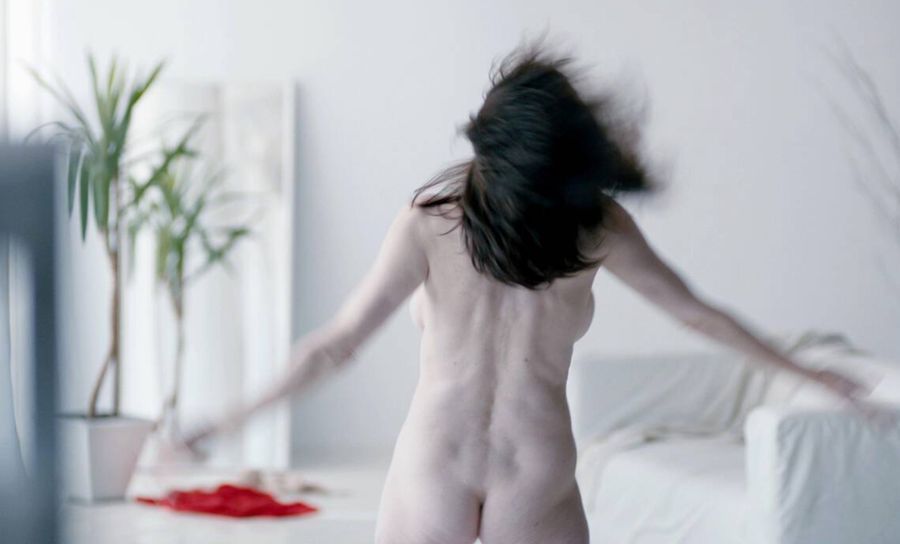
Adina Pintilie’s beautifully experimental 2018 project is a metafictional meditation about a filmmaker and characters who try to reach the roots of intimacy. Pintilie picked up the Golden Bear for a fiercely original work of art that conducts an exigent investigation of sexuality.
The director revealed: “We were very careful not to bring national specificities into the process, because I think we’re talking about something that is close to all of us no matter which country we come from. Unavoidably, by bringing people from different national backgrounds you will feel the luggage there. Some people who come from different countries have a different approach to borders and to touch, and to relating and negotiating.”
I Do Not Care If We Go Down in History as Barbarians (Radu Jude – 2018)
A cinematic exploration of the infamous Odessa massacre of 1941 in which Jewish populations were wiped out, Radu Jude’s black comedy follows an ambitious artist who wishes to recreate history for the sake of art. Provocatively intellectual, this film provides undeniable evidence that Jude is one of the most talented filmmakers in the world right now.
Jude claimed: “My intention was to insert lots of different things into the film. Apart from the main topic, the participation of Romanians in the Holocaust in 1941 and its aftermath, it is also a reflection on what it means to make a film, or more specifically, to make so-called political art.”
