


10 classic songs that feature famous backing singers

It’s challenging to make a name for yourself in the music industry. For as much time as artists put into making the most incredible music possible, just as many have to take on session work and play on songs they aren’t enamoured by. Although most artists begin their careers looking to any song that will have them, music legends like John Lennon and Stevie Nicks have made a living from fading into the background.
While artists tend to have a trademark sound that they’re known for, they lent their skills to the background of other famous songs, making tracks that much better by filling out the sound. Since they don’t have to rely on the spotlight, these vocal cameos allowed artists to toy with their sound that much more, creating music that might not have worked in their solo careers or their respective bands.
Even a handful of sessions previewed where the background vocalists would go next. As much as they wanted to lend their talents to someone else’s recording, working outside their comfort zone led them down different avenues that were a bit left field, eventually turning those sounds into the next half of their career.
Granted, that’s not to say that the big star in the back took away from the person behind the song. Session work like this is about serving the song, and half of these singers know when to fade into the background while adding the perfect moment to let it rip in the studio. They might not have wanted to remove the spotlight from the main draw, but once the fans hear their favourite artists in the mix, it’s impossible not to get them out of their heads.
10 songs with famous backing singers:
10. ‘Whatever Gets You Thru The Night’ – John Lennon (Elton John)
After becoming one of the biggest stars in the world with The Beatles, John Lennon was one of the only members of the group without a significant hit. Although he had started to move towards political matters once he moved to New York City, that never resulted in songs reaching the top of the charts, with his solo opus, ‘Imagine’ only reaching number three in the US. Although Lennon would get there with ‘Whatever Gets You Thru the Night’, he did have some assistance from a glam-rock legend.
In the middle of the sessions for the album, Lennon invited Elton John to play keyboards on the track, after which he added the high-pitched backing vocals heard throughout the song. While John was more than happy to play for the former Beatle, he made Lennon a bet that he would have to perform the song onstage with him should it hit number one. Once it landed the top spot, Lennon kept his word, playing with John at Madison Square Garden in 1975 for what would be his final public performance.
9. ‘Everlong’ – Foo Fighters (Louise Post)
Of all the songs in Foo Fighters’ repertoire, nothing cuts to the bone more neatly than ‘Everlong’. Written as Dave Grohl was picking up the pieces of his failing marriage, his reminiscence on the happy times feels like euphoria whenever it’s played out of a gargantuan stadium. Although Grohl claimed to have sung most of the track, he did get help from one of the queens of 1990s rock.
In the middle of the recording, Grohl thought having a female sing the backing vocals between the verses would be better. After contacting Louise Post of Veruca Salt, Grohl had her sing a backing vocal for the final track, recording it over the phone since she was across the country then. Given the song’s context, the initial crackle of Post’s vocal through the phone speaker gives the track more character, as if she’s the sound of those happy memories slowly slipping away.
8. ‘Money For Nothing’ – Dire Straits (Sting)
In the era when MTV was at its height, there weren’t too many bands more normal than Dire Straits. With no gimmicks to their name, the appeal of songs like ‘Money For Nothing’ was for Mark Knopfler to let his guitar do the talking for him, all while recounting a story about a department store employee yelling over MTV. Although Knopfler’s smooth voice was the foundation of all Dire Straits songs, the top of the tune featured a familiar face before he even showed up.
Singing the MTV jingle ‘I Want My MTV’, The Police frontman Sting was responsible for playing off of Knopfler’s lead vocal, usually popping up throughout the song to sing the jingle. Granted, Sting did get a songwriting royalty for his trouble, with his melody being identical to the verse melody he used for The Police’s hit ‘Don’t Stand So Close To Me’ from a few years before. Dire Straits may have had more than enough hits off of Brothers in Arms, but the power of Sting turned them from classic rock mainstays to an MTV staple.
7. ‘Code of Silence’ – Billy Joel (Cyndi Lauper)
Billy Joel isn’t one to collaborate well with others. Although many notable guests have appeared at his shows over the years, Joel’s strength always came from writing his material by himself, drafting mini symphonies into just a few minutes on the radio. While he never wanted to co-write any of his material, ‘Code of Silence’ became the one exception when he got stuck writing the verses.
Unable to figure out the lyrics, Joel worked alongside Cyndi Lauper in the studio, who helped get the final track together by filling in the verses. Not completely satisfied with a co-write, Lauper laid down backing vocals on the song, bringing a New York edge to Joel’s traditional straight-ahead singing style. While Joel claimed to be satisfied with the final product, he suggested that it would be one of the only times he worked with another musician to complete a song.
6. ‘You’re So Vain’ – Carly Simon (Mick Jagger)
‘You’re So Vain’ may be the ultimate kiss-off song by rock standards. Although Carly Simon may have been known as one of the mothers of singer-songwriters, her send-up to a man looking out for no one but himself has been therapeutic to anyone who has had a scorned lover do them wrong. As if to add salt to the wound, though, Simon had the help of rock royalty to deliver the final blow.
Throughout every chorus, Rolling Stone Mick Jagger lent his talents in the background, delivering his signature vocal whine usually reserved for Stones classics like ‘Dead Flowers’ or ‘Wild Horses’. While Simon has usually been coy as to who the song was written about, the swagger behind Jagger’s delivery is enough to put the fear of God into whatever sorry sap broke her heart.
5. ‘Right Turn’ – Alice in Chains (Chris Cornell, Mark Arm, Ann Wilson)
When Alice in Chains first got started, no one was expecting them to go the acoustic route. After playing the heaviest music they could think of on their debut album Facelift, the band ducked into a recording studio with acoustic instruments for SAP, a bite-sized EP with a handful of mellow material. While the band would keep songs like ‘Brother’ in their setlist for years, ‘Right Turn’ is a who’s who of talent from the Seattle area.
Recorded in a famous studio downtown, the various verses of the song are sung by different grunge titans, with Mark Arm of Mudhoney taking the final verse and Chris Cornell of Soundgarden screaming his brains out on the outro and second verse. Outside of the mainstays of grunge, Heart vocalist Ann Wilson also provides bellowing harmonies in the background. For all of the doom and gloom in Seattle at the time, this song feels like everyone getting together and having fun.
4. ‘Peg’ – Steely Dan (Michael McDonald)
It would take years before Donald Fagen was happy with his voice in Steely Dan. Although the rest of the band prided themselves on having the best session musicians to complete their essential tracks, Fagen’s off-kilter approach to vocal performance always worked perfectly off the starstudded cast of backup singers behind him. Although every session musician had to be able to sing on a certain level, one legend of yacht rock left his mark before he went off on his own.
Across Steely Dan’s masterpiece, Aja, the various musicians deliver a clinic on making a blend between rock and jazz fusion. Setting the song ‘Peg’ to a blues, the massive backing vocalists on the final product come from Michael McDonald, who was just starting to make inroads to working with The Doobie Brothers. While Fagen’s voice typically holds most Steely Dan songs together, McDonald might steal the show on this tune.
3. ‘Games Without Frontiers’ – Peter Gabriel (Kate Bush)
For most Peter Gabriel songs, nothing seems to be off the table. Ever since leaving Genesis, Gabriel has made it a point to make the most forward-thinking music he can, whether making political advocations in ‘Biko’ or turning his signature brand of progressive music into pop songs on ‘Sledgehammer’. Although ‘Games Without Frontiers’ made for one of Gabriel’s more avant-garde singles, the voices in the background came from baroque pop royalty.
Before she had lent her skills to the song ‘Don’t Give Up’, Kate Bush added her voice in the background of this tune, sounding like a disembodied spirit in the background of the verses before Gabriel’s voice comes in. Instead of the comforting voice from her duet, Bush’s voice adds an extra element of mystery as Gabriel’s lyrics about dystopia rise to the surface. While progressive music was in for a shakeup in the early 1980s, Gabriel and Bush were one of the few still trying to expand their musical palettes.
2. ‘Don’t Come Around Here No More’ – Tom Petty (Stevie Nicks)
Throughout the recording of Tom Petty’s Southern Accents, no one seemed to be having fun. Being deep into the throes of cocaine addiction, most of the band spent weeks at a time working with nothing to show for it. Although the group initially planned to make a concept album about the south, Petty had a hit on his hands when working with Dave Stewart of Eurythmics on the electronic-tinged ‘Don’t Come Around Here No More’.
Adopting an Alice in Wonderland style to the video, a handful of backing vocals behind the song were done by Stevie Nicks of Fleetwood Mac, who had just started her solo career with the Petty-penned ‘Stop Draggin My Heart Around’. When talking about her time with Petty, Nicks said she would happily quit Fleetwood Mac to join the Heartbreakers. Although Nicks would keep to her solo career and ‘The Mac’, her various appearances alongside Petty have turned her into an honourary Heartbreaker.
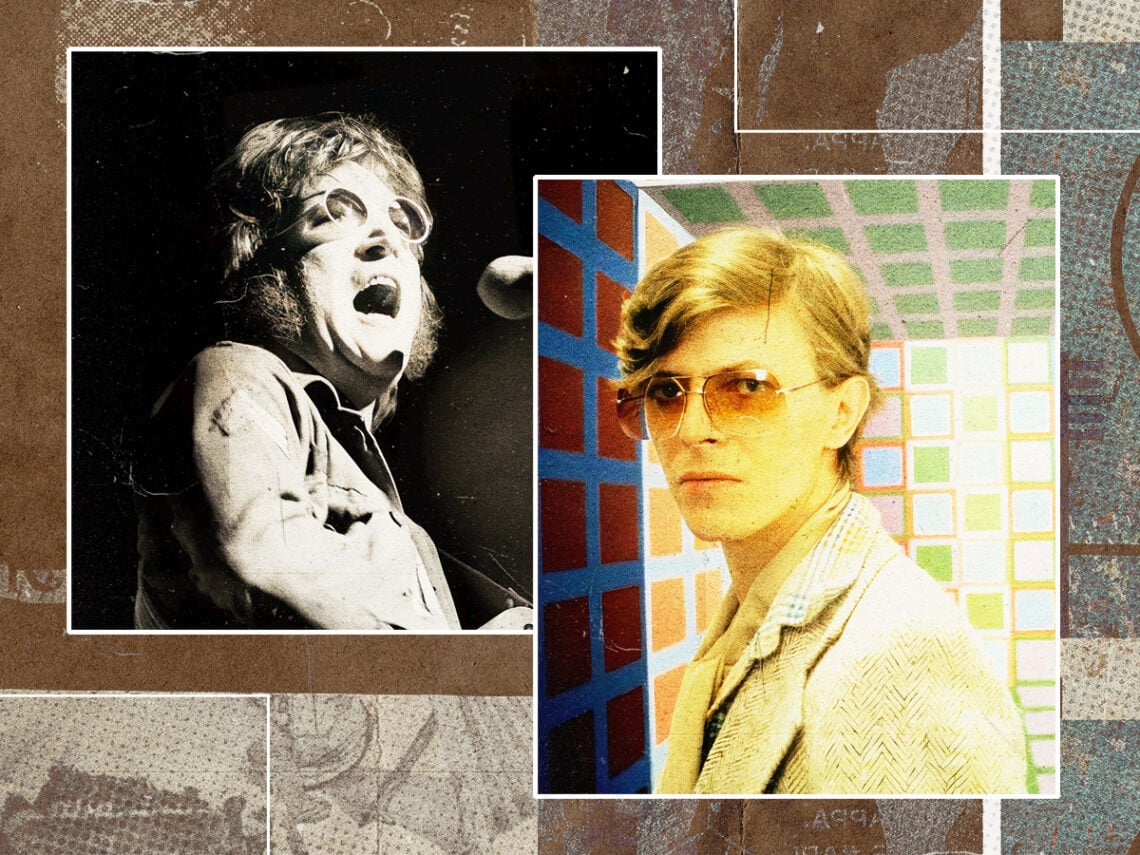
1. ‘Fame’ – David Bowie (John Lennon)
In the wake of The Beatles’ breakup, each member wasn’t looking to rest on their laurels. Despite losing the pedestal as one of the biggest bands in the world, John Lennon was curious about toying with his sound even further, making songs that were emotionally vulnerable on albums like Plastic Ono Band. When he settled down in New York City in the early 1970s, Lennon found a musical partner in David Bowie.
When working on his blue-eyed soul record Young Americans, Bowie had asked Lennon to come down to perform rhythm guitar on his version of ‘Across the Universe’. Between takes, though, a riff from Carlos Alomar triggered an idea in Lennon, which resulted in him and Bowie creating the song ‘Fame’ with the former Beatle echoing Bowie’s main vocal line. Lennon would stick to his guns throughout most of his solo career, but ‘Fame’ is an example of what could happen when he decided to try something weird.
