


10 books that teach essential life lessons

Reading a great book ought to bring several things to us. For starters, we should want to continue turning the page, even when the page has become somewhat tedious, if not utterly boring. In fact, those dense, difficult texts are probably the ones that we should push through with, even when the going gets tough, for there are evidently rich secrets buried deep beneath their layers of complexity.
We often want to feel entertained when we read a novel; we want to be wrapped up in its narrative, and it is always a delight when an author successfully combines the feeling of excitement and simply having to continue reading well into the night with a sense that we are actually learning something, whether it be a scientific discovery or, even better, something morally enriching.
After all, it is novels that can best teach us how to live, as per the insistence of American philosopher Martha Nussbaum. Fictional stories place us into situations whereby we can begin to refine our moral judgment before we might actually experience them in our own lives, and when we do finally arrive at such a genuine moral conundrum, the line of reasoning is that we are better suited to deal with that situation had we not already “experienced” it in a fictional setting.
As the old adage goes, “learn from other’s mistakes”, and it seems like novels (as well as films, and even the more narratively leaning songs, such as those of Bob Dylan and Leonard Cohen) are the perfect place for us to develop our moral refinement. In doing so, we can live better, happier and more productive lives in a direction we actually want to face rather than being pulled from pillar to post in this terrible, morally ambiguous world.
So let’s take a look at ten novels that can show us how to live and teach several lessons truly essential to living in these bags of flesh and bone we are wont to call a mortal human body. From the rich soil of the Salinas Valley in California to the vast expanse of the Pacific Ocean via the humble stretch of the Tennessee River in Knoxville, let’s get moral.
10 books that teach essential life lessons:
John Steinbeck – East of Eden
One of John Steinbeck’s two masterpieces, East of Eden (the other is The Grapes of Wrath), is one of the most morally rich novels you will ever read. It concerns two Californian families’ entire history and is based on Steinbeck’s own family and his experience growing up and living in the Salinas Valley.
Reading the novel will provide readers with several moral lessons, from the importance of family, to learning the kinds of people to distrust, to the disastrous consequences of love’s absence. Quite simply, East of Eden will forever change the hearts of those who dive into its secrets.

Yukio Mishima – The Sailor Who Fell From Grace With The Sea
Several of acclaimed Japanese author Yukio Mishima’s novels contain within them messages of how to live correctly, though normally it is suggested that one should live with the discipline of the patriotic samurais of old. His 1963 novel The Sailor Who Fell From Grace With The Sea differs in that it tells the perspective of a 13-year-old-boy.
Young Noboru Kuroda is part of a gang of boys who perceive the adult world as sentimental, hypocritical and generally lacking in truth and goodness. However, the consequence of their beliefs are disastrous, and through the novel, we learn what happens when children are left to their own devices, urging us to take care of teaching them properly.

Cormac McCarthy – Suttree
When it comes to the work of Cormac McCarthy, his masterpiece novel Blood Meridian often takes the limelight, as well as his later works The Road and No Country for Old Men. However, his 1979 text Suttree should definitely be considered one of his best novels.
It tells the semi-autobiographical tale of a middle-aged man who leaves his former life as an academic to live a simpler existence as a fisherman on the Tennessee River in Knoxville after experiencing a tragic loss. Suttree tells us that we can always heal from tragedy by returning ourselves to our most base existence and sharing a drink or two with the lower rungs of society, who themselves have undoubtedly lost.

Richard Powers – The Overstory
Richard Powers’ 2018 novel The Overstory was awarded the Pulitzer Prize the year after its publication. It tells of nine different American citizens who all have profound experiences with trees, which brings them together in a mission to prevent the destruction of the world’s forests.
Environmental concerns ought to be at the top of every human’s moral priorities right now, and we certainly owe much to the world on which we dwell, having done so much damage to it over the last 200 years or so. The Overstory is a prescient novel that urges us to take responsibility for our actions.

Christopher Isherwood – A Single Man
Christopher Isherwood’s novel A Single Man was later made into a film adaptation directed by Tom Ford. It tells of a single day in the life of an English professor at a university in Los Angeles who is in the midst of a deep depression following the death of his lover.
It is believed that the novel was influenced by Isherwood’s own relationship with portrait artist Don Bachardy, and from reading it, we learn that, even when we lose our closest companions, there are still things in the world worth living for, even if there do not appear before us straight away.

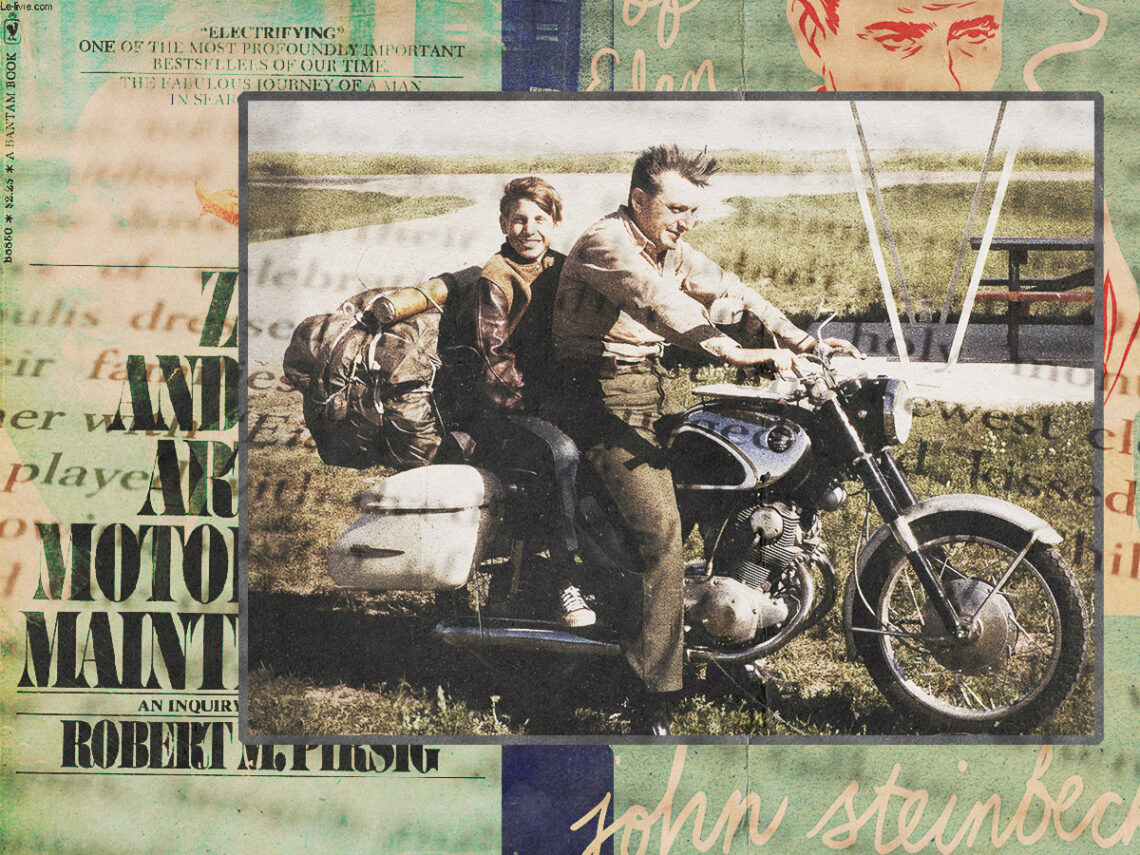
Robert Pirsig – Zen and the Art of Motorcycle Maintenance
Zen and the Art of Motorcycle Maintenance is a work of genuine importance, part biography, part philosophical treatise, and part road trip story. Robert Pirsig’s book tells of the narrator’s motorcycle journey he takes with his son, Chris, and also explains to us several philosophical concepts, from epistemology to moral reasoning.
The narrator is also highly critical of modern technology and how it forces us to take the easy route to problem-solving rather than learning why the problem arose in the first place. So reading the novel urges us to take matters into our own hands, as well as suggesting that we should abandon modern technology in favour of taking a trip through the great wilderness instead, where we might just learn a thing or two.

Herman Melville – Moby Dick
Widely considered one of the most crucial novels of all time, Herman Melville’s 1951 text Moby Dick tells of a spurious sailor called Ishmael, who joins the good ship Pequod captained by Ahab, who has been on the trail of the massive titular whale since he bit off both his legs.
Moby Dick teaches us many things, from the importance of following what is in one’s heart rather than what is prescribed to us whilst simultaneously suggesting that blindly following that motive without prior consideration can lead to disastrous consequences. Check out our article about Moby Dick’s effect on Darren Aronofsky’s The Whale for more detail.

Fyodor Dostoyevsky – The Brothers Karamazov
The Brothers Karamazov, like Moby Dick, is a truly essential work in the realm of moral literature. Legendary author Fyodor Dostoevsky had it published throughout the years 1879 and 1880 as a serial, dying just four months after its final issue. The novel tells of three sons who all have different worldviews and who naturally conflict with one another.
Dmitri is something of a “sensualist” and loves to gallivant around drunk with women, while Ivan is the academic brother, wildly intelligent and stout in his belief that God does not exist. This view is, of course, contrasted with the beliefs of Alexei, who is a novice in the Russian Orthodox Church. The Brothers Karamazov is brimming with too many moral lessons to list here, but it shows us how to deal with conflicting views, which should be of prime importance in this day and age.

Dave Eggers – A Heartbreaking Work of Staggering Genius
Dave Eggers’ brilliantly titled A Heartbreaking Work of Staggering Genius is a memoir of his early adulthood, published in the year 2000. While the ‘Staggering Genius’ part of the title should be viewed with a pinch of salt, the ‘Heartbreaking Work’ part is fitting. Eggers’ book tells of how he raised his younger brother Toph after both of their parents died from cancer-related illnesses.
Like Suttree and A Single Man, A Heartbreaking Work of Staggering Genius shows readers that one can still live a morally rich and meaningful life even when in the depths of great loss. Even though Eggers was in his early 20s when he began raising his brother as though he were his parent, he shows us that we still have more inside than we might initially believe.

Ottessa Moshfegh – My Year of Rest and Relaxation
While most of the novels above show us “how to live”, there are some texts that can show us “how not to live”, and Ottessa Moshfegh’s 2018 book My Year of Rest and Relaxation is certainly one of the latter. It tells of a young woman’s decision to sleep for an entire year through means of heavy doses of medication, so she can avoid dealing with the problems that life naturally throws up.
We begin Moshfegh’s novel with an air of sympathy for her narrator, but this is quickly diminished when we see how her reprehensible actions affect her kind yet a somewhat irritating best friend, Reba. My Year of Rest and Relaxation ought to show us the dangers of reliance on medication and urge us to confront the problems in our life rather than hide from them.

