


The 10 best movie adaptations of critically acclaimed plays

Cinema is ripe with adaptation projects. Novels, comic books, video games, and even board games have been taken, reworked, packaged, and displayed in all their glory on the silver screen. Seeing our favourite characters from another medium rendered by real-life actors or our favourite fictional settings displayed on luminous – there’s nothing quite like it.
An often-forgotten adaptation, however, is the one based on a play. On the surface, it may not seem so exciting; it’s a work of art involving actors, after all. Seeing Macbeth on the screen isn’t quite so tantalising as the prospect of having, say, Harry Potter, who previously existed solely in our imagination, brought to life before our very eyes.
Nevertheless, the world of theatre is so rich with varied stories and vividly imagined characters that it would be a shame not to transport them to the screen for a wider audience. Playwrights have been using the medium to tell electrifying, thought-provoking and mind-bending narratives that deal with some of the most exciting themes audiences can wrap their heads around. Some of our greatest actors often have a particular stage character as their dream role.
And what’s more – some of the greatest films of all time were adapted from plays, and you may not have even known it. From Pulitzer-prize-winning tales of gothic romance to tightly wound chamber pieces about faith and fear, the stage has yielded some of the most compelling films imaginable. Here’s a look at…
The 10 best movie adaptations of plays:
10. Killer Joe (William Friedkin, 2011)
Killer Joe was the second time the late, great William Friedkin collaborated with actor and playwright Tracey Letts, having worked together on Bug five years earlier. Dark, sweaty and seedy, it follows a family of rednecks in Dallas who employ the services of Joe, a local cop who moonlights as a hitman, to whack their cheating stepmother so that they can collect the life insurance.
When they come up short on his request for an advance, the family has to give Joe their sister Dottie as a ‘retainer’, and things go horrendously downhill from there. Killer Joe boasts a legendary director at the top of his game, a knock-out role from the then-up-and-coming Matthew McConaughey, and a scene described by critics as “doing for fried chicken what Jaws did for the ocean”.
9. Incendies (Denis Villenueve, 2010)
Long before he gave us epic IMAX vistas of desert alien planets or bravely continued the Blade Runner story 30 years later, Denis Villeneuve made thought-provoking and powerful dramas that usually focused on the French Canadian community. After three small-scale indie features, it was this that put him on the map.
Incendies, adapted from Wajdi Mouawad’s celebrated 2003 play, charts the journey of two Canadian twins to their late mother’s homeland of the Levant. Each equipped with letters intended to be read after her death, they seek new personal connections with their estranged father and a brother they never knew they had. Poignant, gut-punching storytelling that heralds a cinematic genius we now recognise.
8. Frost/Nixon (Ron Howard, 2008)
This electrifying double-act features Martin Sheen as David Frost, the highly esteemed British journalist and interviewer, and Frank Langella as President Richard Nixon. Based on the 2006 play by Peter Morgan, we’re given an incredibly suspenseful character(s) study that focuses on the famous Nixon interviews conducted in 1977.
The bulk of the play and the film, really, is two men in a room talking. The excitement comes from the tentative relationship they develop, the moments of verbal ‘wins’ and ‘losses’ for both men – and the nail-biting tension that arises as Nixon presses more firmly and digs deeper into the most scandalous President ever to govern America.
7. A Streetcar Named Desire (Elia Kazan, 1951)
Martin Scorsese revered Elia Kazan so much that, upon the director’s death, he made a feature-length documentary about him called A Letter to Elia. Watching any of Kazan’s films, it’s easy to tell why, and it would be simply sacrilegious to talk about Kazan or adaptations without mentioning A Streetcar Named Desire.
Based on the 1947 gothic southern play by acclaimed playwright Tennessee Williams, the story follows a rich girl who has fallen from grace and must move in with her sister and brother-in-law (played by Brando). It’s a masterclass in melodramatic tension and perhaps the most classic example of Golden Age cinema anyone could give you.
6. Woyzeck (Werner Herzog, 1979)
Adapted from the unfinished play by Georg Büchner, partially written in 1836 and then not performed for the first time until 40 years later, Werner Herzog‘s Woyzeck is the perfect marriage of text with talent. Following the slow mental deterioration of the titular soldier stationed in a middle-of-nowhere German town, we’re presented with a meditation on solitude intercut with searing visions of the Apocalypse.
Bored out of his skull and terribly poor, Woyzeck volunteers for medical experiments conducted by the Doctor – whether these are responsible for his descent into madness or not, we’re never truly sure. In a classic Herzog manner, we have Klaus Kinski in the lead, giving one of his most maniacal performances yet.
5. Doubt (John Patrick Shanley, 2008)
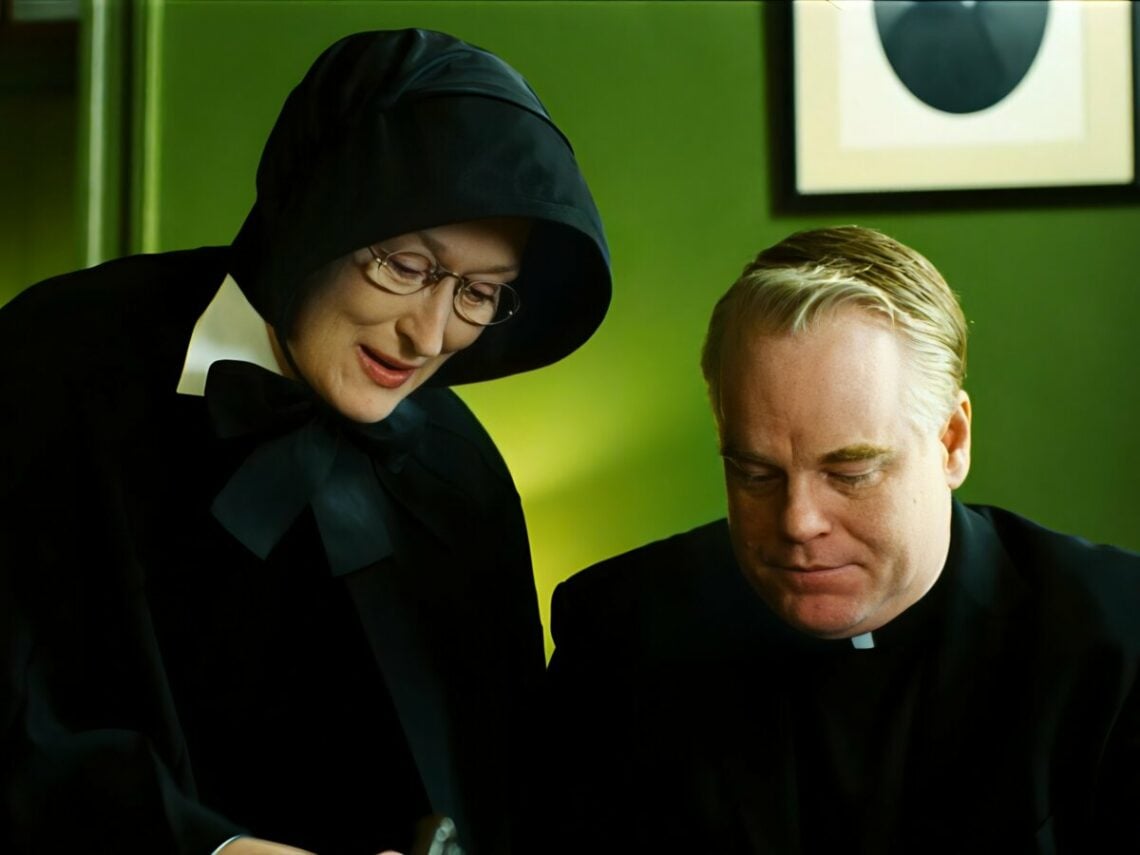
Written and directed by John Patrick Shanley, who also wrote the award-winning play Doubt: A Parable, this 1960s-set religious drama nabbed Academy Award nominations for all of its principal cast, and for very good reason. Taking place in a Catholic elementary school, Doubt follows the investigations of Sister Aloysius (played by Meryl Streep) into the charismatic Father Flynn (Philip Seymour Hoffman).
Accused of paying “too much attention” to one of the only Black students at the prestigious school, the charming Father Flynn is subject to a campaign of sly interrogation and questioning by the disagreeable Sister Aloysius. Slowly but surely, we start to doubt everything we thought we knew about the characters — but never the sheer excellence of performances.
4. Glengarry Glen Ross (James Foley, 1992)
David Mamet, an undisputed heavyweight in both playwriting and screenplays, adapted this from his own 1984 play about real estate salesmen led by Alec Baldwin‘s Blake. A warning for those not fond of swear words: this adaptation features possibly some of the highest levels of profanity to ever grace a screen.
The story is nevertheless a masterpiece, and James Foley adds a distinct visual flair to warrant the move to celluloid. The cast is staggeringly star-studded: Alec Baldwin, Al Pacino, Ed Harris, the late Alark Arkin and the indomitable Jack Lemmon – to name a few. A glimpse into the world of low-level real estate reveals very high tensions, punctuated by relentless yet exquisite reams of dialogue.
3. The Connection (Shirley Clarke, 1961)
Shirley Clarke may not be a name that registers with every cinephile’s brain, but she damn well should be – hopefully this might change that. A bold, pioneering, visionary director who experimented with the very notion of form and narrative, Clarke’s film work culminated in The Connection, her only feature film.
Based on Jack Gelber’s 1959 play of the same name, it documents the exploits of a group of heroin-addled jazz musicians in 1960. Expressionistic, raw and messy, the film is unlike any other adaptation of a play that’s come since – and it made history as being the very first ‘found footage’ film, with a fake title card at the beginning that fooled audiences into thinking the film had been ‘discovered’.
2. 12 Angry Men (Sidney Lumet, 1957)
The king of all courtroom dramas and one of the finest films of all time, 12 Angry Men is a movie that gets better and better with every viewing. Adapted by Sidney Lumet and Reginald Rose, who also the teleplay in 1954 and then the stage play a year later, this legal mystery plays out like a bonafide thriller – all from the confines of one stuffy room behind the court.
Twelve jury members must decide on the innocence of a murder suspect. Irritable, tired, and hot due to unprecedented temperatures in the city that summer, all the men want to get home and immediately vote guilty – except for one man (played marvellously by Henry Fonda). What follows is an astonishingly well-paced exploration into the morality of men, matched only by Lumet’s later work, Network.
1. Amadeus (Miloš Forman, 1984)
Christopher Nolan cited this classic as a direct inspiration for the relationship between Cillian Murphy’s Oppenheimer and Robert Downey Jr’s Strauss. Based on the 1979 play by Peter Shaffer, Amadeus follows a fictional rivalry between Antonio Salieri and… you guessed it: Wolfgang Amadeus Mozart.
Described by Schaffer as a “fantasia on the theme of Mozart and Salieri”, the adaptation is just that: a sumptuous, decadent fantasia that lasts for nearly three hours, with every second worth it. Stunningly shot, sensationally designed and featuring arguably the most compelling performances in cinema history, Amadeus will forever remain the pinnacle of adaptations.
