


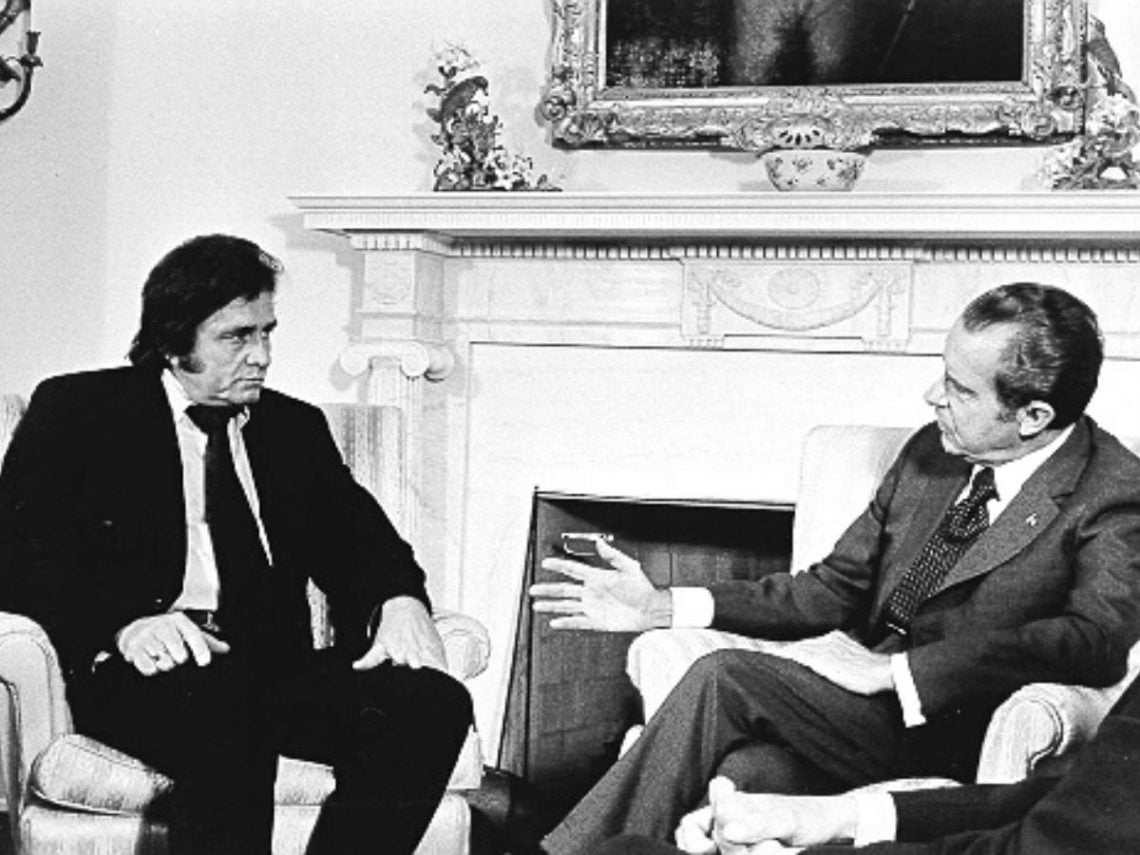
Richard Nixon’s attempt to “neutralise” Johnny Cash during White House visit

The late Richard Nixon is arguably the most controversial President of the United States throughout the 20th century, even eclipsing the likes of Warren G. Harding and Ronald Reagan. This point centres around the Watergate Scandal, a situation which unfolded after the 1972 break-in at the Democratic National Committee headquarters in Washington, D.C. Whilst Nixon did some good in his tenure, such as reducing the country’s involvement in the Vietnam War and promoting détente with the Soviet Union, he is primarily remembered in a malign way.
Nixon’s stint lasted from 1969 to 1974, and for those who weren’t alive during this period, it’s hard to imagine just how bleak things were. Economically, the world was in dire straits, with cultural and political movements such as civil rights, feminism and hippiedom raging on in the hope of changing the world for the better.
It was a wholly tense time; the Cold War continued and had bloody global flashpoints, including the war in Vietnam. Compounding this tension was the threat of total nuclear destruction, a persistent spectre in the background. Unsurprisingly, paranoia filled the air with Alan J. Pakula’s ‘Paranoia Trilogy’: Klute, The Parallax View and All the President’s Men offering the most clinical representation of the day’s spirit.
Revisionists would tell you that Nixon’s stint in office wasn’t a wholly terrible one and that it would have been regarded in a much different light if it wasn’t for the Watergate Scandal and all the murky information it exposed. However, this isn’t so. In actuality, it ultimately symbolises how deeply embedded subterfuge is in American politics.
The period of time was so paranoid that even ‘The Man in Black’, country legend Johnny Cash, found himself in the crosshairs of the powers that were. Nixon’s advisor Murray Chotiner, a former Democrat, felt that Cash might upset their plan for Nixon’s re-election in 1972. As an unearthed memo suggests, Chotiner hoped that Nixon would “neutralise” Cash during a White House event.
Due to Cash’s standing as one of the most successful musicians of the time, some politicians feared he would throw his support behind country music pioneer Tex Ritter who was running for Tennessee’s Republican Senate primary. Typically, Cash kept his cards close to his chest and never endorsed Ritter, who eventually lost in the contest by a landslide.
The memo from Chotiner to Nixon aide H. R. Haldeman – who was later involved in the Watergate Scandal – dated April 2nd, 1970, reads: “Johnny Cash is great with a certain block of voters in Tennessee. Obviously, he will not say or do anything against Tex Ritter, who is running for the U.S. Senate against Congressman Bill Brock, for the GOP nomination.”
The note continued: “At the Johnny Cash Evening at The White House, it will be most helpful if privately the President can neutralise Johnny Cash so that he does not campaign for Tex Ritter. It will also be helpful if he could come into Tennessee after the primary.”
It is uncertain what occurred that evening. However, when Cash revisited the White House two years later, in 1972, to discuss prison reform, he clarified his thoughts on Nixon. Despite the President requesting Merle Haggard’s classic satire, ‘Okie from Muskogee’, Cash famously responded by playing three anti-war songs, ‘What Is Truth?’, ‘The Man in Black’, and ‘The Ballad of Ira Hayes’.
