


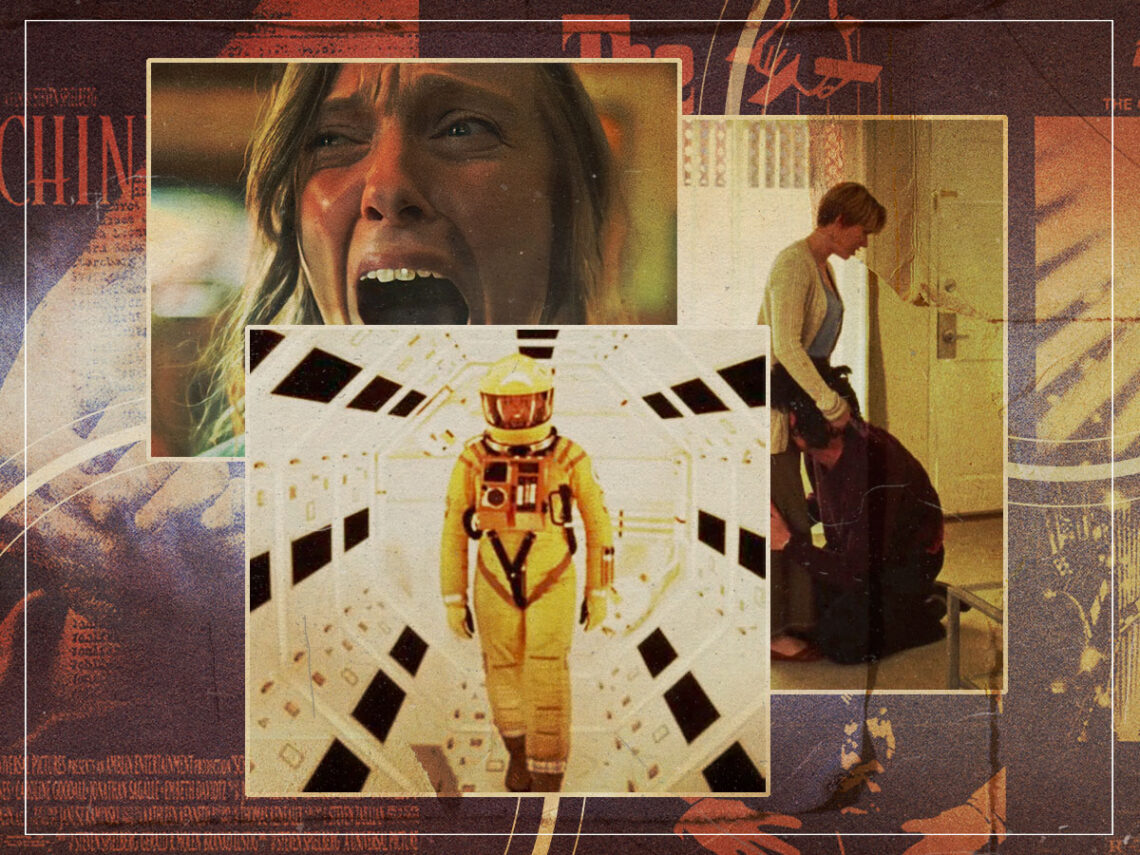
10 astonishing movie moments that stun you into silence

Cinema often has the power to take the breath away, but creating a scene that plunges an audience into a stunned state of silence is exponentially more difficult to achieve.
While it can happen through a variety of methods, whether it’s a rug-pulling twist or a revelation that recontextualises everything to have come before and unfold after, it isn’t necessarily tied to sweeping spectacle, showstopping set pieces, or iconic monologues.
Many of the greatest filmmakers have mastered the art of weaponizing a solitary scene in order to bludgeon viewers into a stunned submission, and the following ten illustrate just how eclectically it can be accomplished.
Whether it’s heated conflicts, war stories, revisionist history, existential reflections, or pure unadulterated nihilism, the commonality between all of these scenes is that when playing to a packed house or watched in numbers, the instant reaction is stone-cold, almost haunting silence.
10 movie moments that caused stunned silence:
10. Marriage Story (Noah Baumbach, 2019)
The gradual breakdown of a relationship is something most people will experience at least once throughout their lives, but rarely has it been rendered quite so viscerally on-screen as in the signature set piece of Noah Baumbach‘s Marriage Story.
Adam Driver’s Charlie and Scarlett Johansson’s Nicole are losing their individual senses of self as they try to work through a bitter split through official channels, but the first time they’re completely alone together with nothing but their baggage for company, tensions explode in a staggering tour-de-force from two stars working at the top of their game, both of whom deservedly landed Academy Award nominations for their work.
Two people yelling at each other in a sparsely-decorated apartment doesn’t read as though it’s got the potential to stun an audience into silence, but Baumbach had other ideas. By the time the exchange draws to a close, even hearing a pin drop would sound deafening, such is the way Marriage Story unleashes every fibre of its pent-up frustrations.
9. Inglourious Basterds (Quentin Tarantino, 2009)
There was some criticism in the build-up to Inglourious Basterds of its marketing campaign, with many finding the tagline of ‘You haven’t seen war until you’ve seen it through the eyes of Quentin Tarantino‘ to be disrespectful to anyone who served in a real-world conflict.
As it turns out, there was a reason for the shill beyond hyping up the filmmaker’s revisionist World War II epic because it transpired that he was planning to completely rewrite the rules of history by having Adolf Hitler and his closest confidants brutally massacred in a blood-soaked orgy of destruction.
Heading into Inglourious Basterds, nobody was entirely sure how the story would pan out. But they still didn’t expect the leader of the Third Reich to wind up as a bullet sponge. It was bold, and it was ballsy, leaving viewers shocked that Tarantino had the temerity to go through with it at all.
8. The Deer Hunter (Michael Cimino, 1978)
Intensity is a difficult thing to manufacture, but Michael Cimino made it appear effortless when The Deer Hunter delivered one of the most excruciating, nail-biting, anxiety-inducing, and haunting scenes ever committed to film.
Framed and shot almost like a horror movie, Robert De Niro’s Mike tries his best to get through to Christopher Walken’s heroin-addicted Nick by evoking memories of their time spent together as lifelong friends, but he’s too far gone, dead behind the eyes, and willing to pull the trigger.
In and of itself, the Russian Roulette scene was controversial, but in isolation, it takes the breath away to such an extent upon first viewing that a funereal silence instantly envelops the room when Mike wrings out one final smile, pulls the trigger, and is declared the loser by default.
7. Saving Private Ryan (Steven Spielberg, 1998)
In purely technical terms, the D-Day assault in Steven Spielberg‘s Saving Private Ryan is one of the most staggering set pieces cinema has ever witnessed. It never forgets to place the consequences at the forefront of the action, creating a cacophony of sound and fury that’s as harrowing as it is iconic.
It’s a well-worn saying that war is hell, something Spielberg never considers sacrificing as he plunges both his characters and the audience into the thick of the Normandy landings, creating a level of heart-pounding immersion that’s rarely been bettered in not just the war genre, but film history.
Daring to breathe even feels like a transgression waiting for the scene to end, with Spielberg extracting every shred of tension from an extended sequence that remains seared into the memory long after Saving Private Ryan‘s main narrative thrust begins to take shape.
6. Blade Runner (Ridley Scott, 1982)
Rutger Hauer’s Roy Batty may be the erstwhile villain of Ridley Scott‘s seminal sci-fi masterpiece, but his final monologue chills right to the bone. It carries several significantly deeper meanings than the final swansong for Rick Deckard’s adversary.
Nostalgia isn’t something replicants are capable of, but Batty’s shortened lifespan and ruminations upon it hark back to some of humanity’s basest impulses. Everyone only has one life to live, and as it reaches the end, every single person will be left wishing they had more time.
It’s often said that life flashes before the eyes at the moment of death, and Batty echoes one of the biggest unanswered existential questions of them all. Gazing back at memories with wistful regret, longing, love, and beauty, Blade Runner‘s most iconic slice of dialogue opens the door for the viewer to look internally and re-evaluate their own life up until the present, something that doesn’t get spoken out loud.
5. Hereditary (Ari Aster, 2018)
Horror has always been fond of a major twist or two, but the gut-punching decapitation from Ari Aster‘s Hereditary doubles as not only a hammer blow for Alex Wolff’s Peter Graham and his continued descent into madness but a sign that all bets are well and truly off for what’s to come.
As a general rule of thumb, kids don’t die in horror movies, but Aster upends that notion – only a third of the way through the story, too – to lop the head clean from the shoulders of Milly Shapiro’s Charlie. It ties into the climax, but at the time, it was borderline impossible to comprehend what had just been witnessed.
From then on out, every single frame of Hereditary was approached with untold levels of caution because if a filmmaker is willing to decapitate a child, then there’s no telling what could come next. By the time the credits started rolling, unyielding heart palpitations were among the least of concerns.
4. The Godfather Part II (Francis Ford Coppola, 1974)
In the space of just six words, Al Pacino‘s Michael Corleone crossed a line he could never come back from, cementing his transition into the cold-blooded, remorseless, and ruthless figure of the criminal underworld it transpired he was always destined to become.
Following an earlier assassination attempt, Michael is convinced somebody close to the family was involved, but Fredo’s exchange of nervous glances with Johnny Ola is only meant to be seen by the audience, with Michael completely unaware they’re lying about having never met before.
In one of the greatest scenes from one of the greatest movies ever made, Michael grabs his brother, pulls him close, and whispers into his ear: “I know it was you, Fredo.” Just like that, the complexion of the entire Corleone clan has changed forever, quietening a stunned audience to a standstill.
3. Schindler’s List (Steven Spielberg, 1993)
Steven Spielberg’s monochromatic masterpiece Schindler’s List is a difficult watch as it is, but the sole fleck of colour spotted throughout the Academy Award-winning 195-minute epic hits ten times harder because of what it means beyond the aesthetic effect of a bright red coat standing out amidst the aesthetic.
Liam Neeson’s Oskar Schindler spots her from a distance but later sees her coat lying on a cart transporting dead bodies away from the ghetto. It underlined the horrific actions of the Nazi regime, while the singular nature of the bright red coat hammers home how every person killed in the Holocaust was an individual treated by their murderers as little more than a number.
There was a life waiting to be lived by the girl, but it was ripped away from her during one of history’s worst atrocities, and zeroing in on that one item of clothing deepens the emotionality of a film that was already one of its era’s most powerfully resonant.
2. 2001: A Space Odyssey (Stanley Kubrick, 1968)
The ending of Stanley Kubrick’s 2001: A Space Odyssey has been debated and dissected for over half a century, but all of the unpicking in the world hasn’t diluted the jaw-dropping impact of Dave Bowman being reborn.
Such is the way it’s become part of the pop culture fabric. The scene has been lampooned and parodied with reckless abandon, with the enigmatic and intentionally ambiguous final shot leaving multiple generations of first-time viewers stunned into silence at the existential sci-fi classic concluding on a note that only serves to raise more questions.
2001 begins with the evolution of apes into man and ends with its flesh-and-blood protagonist transcending everything humanity thought it ever knew about life and the cosmos to become something else entirely. In the grand scheme of things, we know next to nothing beyond our own plane, though, and Kubrick was more than happy to point it out.
1. The Mist (Frank Darabont, 2007)
A movie that many can only watch once and never again because they don’t want to subject themselves to the trauma all over again, Frank Darabont deviated from the ending of Stephen King‘s source story to craft an ending that’s as bleak as they come.
It’s a creature feature at heart, but dig a little deeper, and The Mist is about the lengths ordinary people will go to in order to endure extraordinary circumstances. This is what convinces Thomas Jane’s David Drayton to make one of the most difficult sacrifices imaginable.
Deciding that nobody should be forced to continue on with the ordeal of trying to survive the monsters that terrorise them at every turn, David shoots and kills the four remaining survivors, including his own son. Moments later, the mist lifts and the cavalry appears, causing him to break down and scream in anguish. It’s the stuff of absolute nightmares and a moment that shocked everyone to their very core.

Never Miss A Take
The Far Out Quentin Tarantino Newsletter
All the latest Quentin Tarantino content from the independent voice of culture.
Straight to your inbox.