


Both Sides Now: 10 artists with the best and worst albums of their genres

Consistency can be both a blessing and a curse for musicians. As much as people like to talk about wanting to please their audiences in whatever way they can, no listener knows what they want until they have it in their headphones, so you might as well take a swing and see wherever a song takes you when you’re in the studio. Diversity isn’t inherently a bad thing, but it did lead to acts like Metallica having the most lopsided discographies of all time.
But it’s hard to really be too critical of any of these artists. For all of the petty gripes that are thrown at them, their greatest moments have been etched in stone and will probably be studied by the great historians as to what this era sounded like. When they did strike out, though, they would do it in spectacular fashion.
Regardless of the golden-plated vinyl each group was known for spitting out, there were also outright dogs in their discography that would make the bottom five of any casual fan of their genre of music. Despite being one of the supposed legends, some of the albums in question are enough for casual listeners to question whether they truly deserve that kind of title.
Still, that doesn’t take away from the highlights from being so high. It just makes for a little bit of a drastic tonal shift flipping through records, but you can’t say that the musical joyride didn’t remain interesting. There might be some sore spots, but it’s important to understand those all-time lows to appreciate the legendary material.
Artists with the best and worst albums of their genre:
10. Travis Barker: Enema of the State and Tickets to My Downfall
Pop-punk was never known as a genre that burdened the listener with intricate topics or anything. This was the kind of lighthearted take on traditional punk that was less suited to CBGBs but fit right in either a late 1990s teen comedy or at a middle school pool party. And while Travis Barker spent most of his time putting together relentless drum grooves in Blink-182, he lands on this list because of the work he spread across his work with Machine Gun Kelly.
Because, in theory, Barker deserves a place on the musical Mount Rushmore for Enema of the State. After Blink-182 started as a ratty punk outfit, having Barker put some finesse behind their sound was what made ‘What’s My Age Again’ and ‘All the Small Things’ leap out of the speakers. Despite that being an example of fostering potential in upcoming artists, Tickets to My Downfall is Barker desperately trying to get something worthwhile out of the former rap star.
Machine Gun Kelly certainly wasn’t going to show his face again after Eminem decimated him, but his attempt to become a rock star is arguably even worse, especially his hoarse voice trying to sound like a teenager in his 30s. Barker didn’t deserve to sink this low, but for all of the goodwill that he threw at this project, here’s hoping that he at least got a worthwhile payday out of the deal.
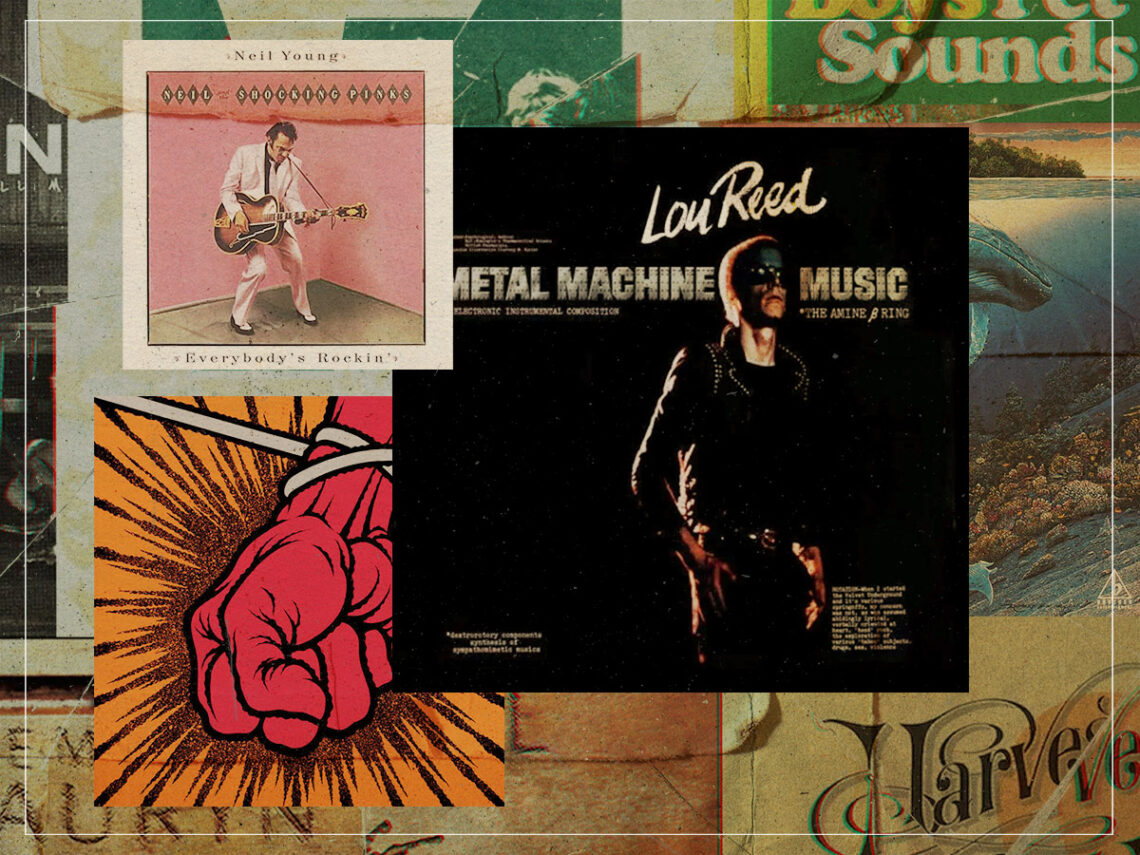
9. Neil Young: Harvest and Everybody’s Rockin’
There’s a good chance that Neil Young doesn’t care about how he’s looked at in the grand scheme of songwriters. He was more than happy to please himself before anyone else, so in his mind, who really gives a shit if the fans don’t care for it? The muse should always come before the suits, but if you make him angry, that either means that anger will come out on record or we will get something funny.
When Young is in his element, though, Harvest is probably the best of what he has to offer, taking the sounds of Nashville and incorporating them into his folksy sound on ‘Heart of Gold’. Whereas that album had high-stakes drama in every performance, Everybody’s Rockin’ is the kind of project that Young quickly pumped out just to satisfy his higher-ups for messing with him.
Even though the result is probably the last thing his fans were expecting, the fact that he made an album deliberately retro, almost as a way to spite his label, is one of the most punk moves that anyone has ever done. Everybody’s Rockin’ should really change the way someone sees an artist, but given its checkered backstory, the fact that it sounds rough is almost a compliment.
8. The Beach Boys: Pet Sounds and Summer in Paradise
Throughout the 1960s, The Beach Boys just seemed to be on a consistent upward path. The surf songs and odes to cars were getting played out, and when Brian Wilson locked himself away in the studio, tracks like ‘California Girls’ signalled something big on the horizon. While The Beatles were still the kings of rock and roll, Pet Sounds shifted the entire musical paradigm in just 13 songs.
After making miniature symphonies for every single, hearing Wilson pouring his heart out on this opus made for the most sophisticated left turns any rock act has ever taken, like on ‘God Only Knows’ and ‘Wouldn’t It Be Nice’. So, when comparing the terrible entries in The Beach Boys’ catalogue, it is possible that Wilson didn’t join the party.
Since ‘Kokomo’ became a huge chart-topper without their leader, Mike Love figured that it was time to make his version of Pet Sounds with Summer in Paradise, which was the equivalent of a bunch of granddads who got their hands on some new-fangled recording equipment and wanted to do karaoke. Borrowing from the seaside imagery here, if Pet Sounds is the pure bliss of the summer sun hitting your face, Summer in Paradise is the chaotic monsoon that comes during the offseason.
7. Lauryn Hill: The Miseducation of Lauryn Hill and Unplugged 2.0
Okay, so maybe this is a little bit of a cheat here. Yes, technically Lauryn Hill only has one complete album to her name, and outside of her notable guest appearances, The Miseducation of Lauryn Hill remains her magnum opus and stands among the great neo-soul records of the 1990s. Ms. Hill did have at least one more sample for her fans, though, and Unplugged 2.0 is the kind of memory that many of us want to forget.
Because after being put in a great mood listening to her debut, this live record is nothing but droning on about how she’s feeling with only one acoustic guitar and half-finished songs. Maybe someone like Prince could manage to make this kind of approach work, but Hill was not nearly prepared to perform this material, especially towards the end, where she starts having an emotional breakdown in the middle of playing.
Then again, the reason why Unplugged 2.0 fails as a proper follow-up to The Miseducation of Lauryn Hill is because of how it was presented to us. Her first outing saw her out in full force and virtually unstoppable, but after the dust settled, seeing her not being able to handle herself feels incredibly exploitative in retrospect.
6. Van Halen: Van Halen and Van Halen III
In the era of stadium-sized rock and roll, Van Halen invented the new school. There had been the era of progressive music and punk getting ready to take over, but as soon as the needle hit on the first track on Van Halen, they held the entirety of the music scene, and especially guitar players, in the palm of their hands, with Eddie being toted as the next guitar god. A lot can happen in a decade, though, and Van Halen III saw them rebirthing themselves into a facsimile of their former selves.
The main reason why Van Halen worked so well is because it felt like capturing lightning in a bottle. With David Lee Roth strutting his stuff across every song, there’s no doubt that you’re listening to an all-time classic act in their prime. Roth was not just a journeyman frontman, and even when they settled in nicely with Sammy Hagar, doing everything again with Gary Cherone made for an absolute mess.
Since Roth and Hagar helped develop their material into fleshed-out tracks, having no one in control led to the record running far too long and some of the worst singing to come from a hair metal act. Van Halen were always the exception to the rule when it came to the glammified era of rock and roll, but it’s hard to defend their glory if all you’ve got to work with is ‘Without You’.
5. Eminem: The Marshall Mathers LP and Revival
By the late 1990s, hip-hop was already in a state of change. The era of Bad Boy Records was about to become a thing of the past, and more pop-centric approaches to rap started to creep into the conversation with new producers like The Neptunes. But as soon as Eminem showed up, we were given the kind of harrowing stories that no mother wanted their children to know about.
Even though much of Eminem’s early work is considered a bit too crass today, The Marshall Mathers LP is still a classic for a reason. After becoming Public Enemy No. 1 around the nation, this is where he showed his true colours on ‘Marshall Mathers’ and gave us vivid portraits of what life is like at the top on ‘Stan’. But when discussing the worst Eminem project, it would be understandable if someone were to throw a dart at a random album and have it land on something questionable.
Outside of the accents on Relapse and the metaphorical middle finger he gave everyone on Encore, Revival fumbles the hardest, if only for the sonic quality. It’s easy to forgive some subpar bars, but having him go into full dad mode with his similes, as well as collaborate with Ed Sheeran and X Ambassadors, just made him look like he was getting angry in the middle of a toy store. Music that relies on shock tends to age very poorly, and despite its attempts, Revival wasn’t going to compete with the Tyler the Creators of the world.
4. Madonna: Like a Prayer and American Life
There are still pop music fans who believe that Madonna was all flash. While she did have a lot of attention on her due to her thirst for headlines, we wouldn’t still be talking about her if tracks like ‘Holiday’ and ‘Like a Virgin’ didn’t stand the test of time. Although Like a Prayer is getting a bit more of a boost these days thanks to Deadpool, maybe that will help us wipe the taste of the 2000s era out of our mouths.
When Like a Prayer debuted, it put a firm stamp on the end of the 1980s. The decade always had a cinematic aura to it, and seeing the videos for the title track and ‘Express Yourself’ made for one of the last curtain calls for the larger-than-life era of Madonna. The minute that she tried to put that flashiness over real-world problems, though, it wasn’t just the political naysayers giving her funny looks.
Throughout American Life, her plan to put revolutionary imagery on top of the Iraq War was laughably pretentious, especially when she raps the title track and then moves on as if she didn’t sound like some mom at a PTA meeting trying to sound hip. Madonna’s entire existence relies on using image as substance, but in trying to get in tune with the times, she ironically both dated herself and made the most faceless tracks of her career.
3. Lou Reed: Berlin and Metal Machine Music
It’s hard to think of Lou Reed’s music as strictly rock and roll. He used all of the tools that the genre has, but his mission as an artist was to create abstract pieces that just so happened to sound like songs whenever he went into the studio. But when someone builds their career off of being abstract, you can’t be surprised when they go beyond the realm of rational thinking every now and again.
Then again, Berlin should be revered for how many chances it takes. The idea of making a Shakespearean tragedy works incredibly well and can move everyone with a half-functional heart, but to go from that to Metal Machine Music is where even a few diehard fans drew the line.
Because rather than give us the building blocks of a tune and leave everything up to interpretation, hearing a two-disc project of nothing but guitar feedback is either an example of Reed’s head inflating way too much or some elaborate plan for him to get out of a record deal. The world of art rock is known to be incredibly generous when it comes to strange premises, but it’s really stretching when you make an album the audience has to risk a migraine in order to hear.
2. Metallica: Master of Puppets and St Anger
For a brief time in the 1980s, it looked like metal had lost its way. The legends of the 1970s had come and gone, and the latest music coming out of LA was just a pop-flavoured amalgamation of acts that wore metal like a costume. But Metallica walked the walk when they arrived on Master of Puppets, and their resilience in the studio is both the best and worst that happened to them.
By their third outing, the thrash legends had turned into a well-oiled machine, making eight-minute exercises with hooks spread throughout every movement. While they eventually bit the bullet and crossed into poppier territory on The Black Album, it boggles the mind how they managed to turn in the final version of St Anger as their finished product.
Yes, the group was going through extensive therapy, but even with producer Bob Rock guiding them along, their plan to return to sounding heavy made for the same long songs but with zero hooks, James Hetfield phoning in most of his vocals, and Lars Ulrich playing the drums as if he’s deliberately trying to hurt you whenever he hits a busted snare. Whereas Master of Puppets was this unstoppable force slowly rising from the underground, St Anger took all of those same ideas and somehow made every wrong step.
1. John Lennon: The White Album and Two Virgins
The Beatles were the first ones to even suggest the idea of making artistic rock and roll. The entire reason why albums exist in their modern form is because the Fab Four reinvented the wheel with Sgt Peppers and Rubber Soul. John Lennon was known to be alternative to the mainstream, though, and even when he was pumping out solid gold with the Fab Four, he managed to release the most dissonant noise conceived by man at the same time.
Granted, The White Album was always going to be messy, no matter which way you looked at it. A double record of new material which felt closer to solo cuts wasn’t ideal, but Lennon still came through with a handful of the best tracks he ever wrote, like ‘Dear Prudence’ and ‘Happiness is A Warm Gun’. That was the right kind of experimenting, but when he met Yoko Ono, Two Virgins became the most off-putting record of his career, complete with screaming, screeching and making whatever annoying sound he could think of.
Which is crazy because when taken on their own, Lennon and Ono work surprisingly well apart, with Ono’s Plastic Ono Band having incredible gems and Lennon using her as inspiration for his greatest solo hits. They were true soulmates in every sense of the word, but the minute that they decided to make beautiful music together, fans knew to avoid future instalments like The Wedding Album like the plague.
