


From Elvis Presley to Lana Del Rey: 10 albums that changed America forever

How do you quantify the greatness of an album? Do you measure the strength of the songwriting; the use of new and pioneering technology; the number of hit singles it produced? Or, perhaps you examine the impact the album had on other musicians; tracing the DNA of an album and seeing what it morphs into.
Combined, all of these methods of measurement are bound to lead us in the right direction. But there is another important and unignorable parameter: the impact music can have on a nation. Since the 1920s, America has been one of the most important breeding grounds for musical innovation anywhere in the world. At the same time, it has absorbed a wide variety of music from elsewhere, music which has gone on to redefine the country’s image of itself.
By looking at those albums that have impacted the cultural, political, and social spheres of America, it’s possible to arrive at a selection of works that can reasonably be called some of the most historically important recordings of all time – albums that have been so powerful that they have informed the kind of music America’s people have danced to, the manner in which they have viewed the future of their country, and altered the way they treat one another.
So, without further ado, here are ten albums that changed America forever.
10 albums that changed America forever:
From Spirituals to Swing: Carnegie Concerts by Various Artists (1938–39)
Never mind The Last Waltz, From Spirituals to Swing is surely one of the most important live albums of all time. Recorded at New York City’s prestigious Carnegie Hall and curated by the great John Hammond – the A&R man who signed the likes of Billie Holiday, Aretha Franklin, and Bob Dylan – this album features some of the greatest musicians of the Harlem Renaissance performing to an integrated audience.
With performances by the likes of Benny Goodman, Sidney Bechet, Sister Rosetta Tharpe, and the Count Basie Orchestra. Bluesman Robert Johnson was also supposed to play but sadly died just before the performance. Hammond’s concert was the first to put on blues, gospel, and jazz artists (who were frequently regarded as ‘lowbrow’ by white middle-class Americans) in a formal concert setting, helping to solidify Black American music as the sound of 20th century America.
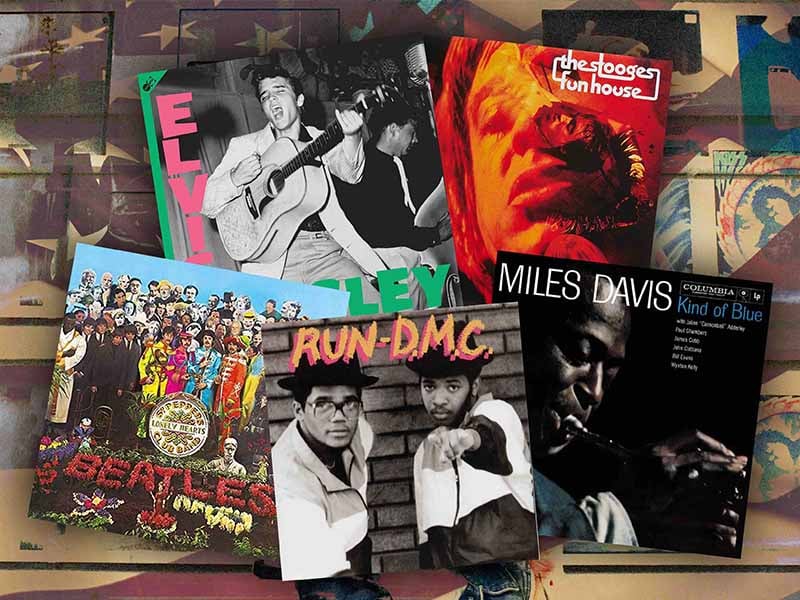
Elvis Presley by Elvis Presley (1956)
Presley’s impact on American youth culture cannot be understated. Alongside Chubby Checker’s The Twist, Presley’s self-titled debut is surely one of the most formative rock ‘n’ roll records of the post-war era.
Released in 1956 Elvis Presley saw ‘The King’ himself exploit the incredible hype symbolised by ‘Presleymania’, a full-blown teenage fan craze that was sweeping America. Seizing an opportunity to make a hell of a lot of money, the RCA label waited until the hype reached its peach and then launched a single, four-track EP and album at the same time, all featuring the same cover art of Elvis mid-howl. With his jittering legs, unrestrained vigour, and magnetic sex appeal, Elvis completely changed the game, drawing up the blueprints for the teenage rebellion that would reach fruition in the 1960s.
Kind of Blue by Miles Davis (1959)
There are few albums with the power to both subvert and redefine America’s musical character, but Kind Of Blue by jazz legend Miles Davis is certainly one of them. This slice of modal jazz not only revolutionised the harmonic DNA of the genre but also helped to do away with the stereotyped image of black jazz performers as affable clowns. Davis believed that established jazz stars such as Louis Armstrong unwillingly contributed to this stereotype.
As African American critic Gerald Early told The Guardian, Armstrong’s ‘uncle-tomism’ “made a lot of black people uncomfortable.” Adopting the 12-tone harmonics, sharp black suits, and demure countenance of modern classical composers like Stravinsky, Davis turned jazz from hedonistic party soundtrack into something intellectual, cerebral, and infinitely cool.
The Times They Are A-Changin‘ by Bob Dylan (1964)
Without Bob Dylan’s debut album, the Civil Rights movement may well have looked very different. Released in 1964, The Times They Are A-Changin offers both a preview of Dylan’s future career and a portrait of a world on the cusp of transition. The album’s title song declares something quite profound: that the world will not always be the way that it is; that progress can be made and that now is the time to work towards a better future.
That simple message helped to galvanise young and old, Black and white. As Dylan confessed in 1985: “This was definitely a song with a purpose. It was influenced of course by the Irish and Scottish ballads …’ Come All Ye Bold Highway Men’, ‘Come All Ye Tender Hearted Maidens’. I wanted to write a big song, with short concise verses that piled up on each other in a hypnotic way. The civil rights movement and the folk music movement were pretty close for a while and allied together at that time.”
My Generation by The Who (1965)
As one of the most important bands of the ‘British Invasion’ of the 1960s, The Who crossed countless divides to galvanise an entire generation of disaffected youths living in a newly-globalised world.
Their 1965 album My Generation, for example, gave voice to the ever-widening chasm between the war generation and young boomers, typified in the infamous line from the album’s titular lead single: “I hope to die before I get old.” The Who represent a wave of British bands whose art-school aesthetics and pop-driven songwriting completely altered the US’s approach to popular music, transforming it from something only to be danced to into something with revolutionary potential.
Sgt. Peppers Lonely Hearts Club Band by The Beatles (1967)
While Revolver set the trend in 1966, it was The Beatles next album, Sgt. Pepper’s Lonely Hearts Club Band (1967), that successfully united avant-garde and pop music.
In doing so, The Beatles not only turned pop into an art form in itself, but they also helped to bring the spirit of the countercultural age into the mainstream. Without Sgt. Pepper’s weaving of pop music, transcendentalism, and conceptual art, the 1960s simply wouldn’t have been the same, and, by extension, neither would the present day. Everything from the modern environmental movement to Apple computers owes something to what The Beatles did in the late ’60s, and that’s to say nothing of the way Sgt Pepper’s pioneered the new music technologies that today we take for granted.
The Stooges – Fun House (1970)
The Stooges 1970 three-track EP Fun House changed America from the ground up. On release, it was a complete commercial failure, but slowly developed a strong cult following. Those who bought it or went to see The Stooges live in concert were utterly transformed by the raw untamed energy of the group.
With its scuzzy guitar lines, DIY approach, and droning sing-talk, Fun House became a touchstone of punk. As early as the first year of the 1970s, it simultaneously offered an alternative to the bloated rock scene and marked its imminent decline, foreshadowing the arrival of hard-edged groups like The Ramones.
Pieces Of A Man – Gil Scott-Heron (1971)
Gil Scott-Heron’s Pieces of A Man has made as much impact on America as any Beatles record. Indeed, the record’s most famous offering ‘The Revolution Will Not Be Televised’ took the countercultural ideal of societal transformation via collective inner renewal and expanded it to embrace not just the anxieties of the white middle-classes, but also the struggles of African Americans.
That opening track was quickly adopted as an anthem of African-American activism at a time when The Black Panthers were exploring new ways to tackle the inequalities faced by America’s Black population. While the track is often regarded as a call to arms, Gil Scott-Heron was quick to assert that it was meant to be satirical; its lyrics referring to a mental, rather than militant revolution. Regardless, it helped to unite people hungry for a change that they had been promised decades ago, and which still had not come.
Run DMC – Run DMC (1984)
The late 1970s and early ’80s saw the arrival of a new era-defining genre: hip-hop. At the vanguard of this revolutionary blend of beats and creative MCing was the Godfather himself, Grandmaster Flash. But it wasn’t until Run DMC’s self-titled debut that the genre really hit the mainstream, sparking a craze that endures to this day.
Both musically adventurous and lyrically dexterous, Run DMC bought the poverty and crime at the urban heart of modern American life front and centre. Not only were the group’s verses intoxicatingly catchy, but they also confronted some of the most pressing issues plaguing the US’s inner cities. With lines like: “Unemployment at a record high/ People coming, people going, people born to die,” Run DMC lay the foundations for a whole generation of political rappers, Including Public Enemy and NWA.
Lana Del Rey – Born To Die (2011)
Lana Del Rey’s debut album didn’t so much change America as it got caught up in a period of transition, immortalising the nation in the process. With Born to Die, Del Rey predicted how music would eventually become completely detached from the physical universe – existing within a sort of simulated reality.
She herself participated in this, using a combination of Americana visuals and self-virtualisation to craft a model of music-making that, so many years later, has become an industry norm. It’s not clear if these things were deliberate or not. What is clear, however, is that, after Born To Die, the divisions between commercial pop music and the digital realm became increasingly blurred.

Never Miss A Beat
The Far Out Beatles Newsletter
All the latest stories about The Beatles from the independent voice of culture.
Straight to your inbox.