


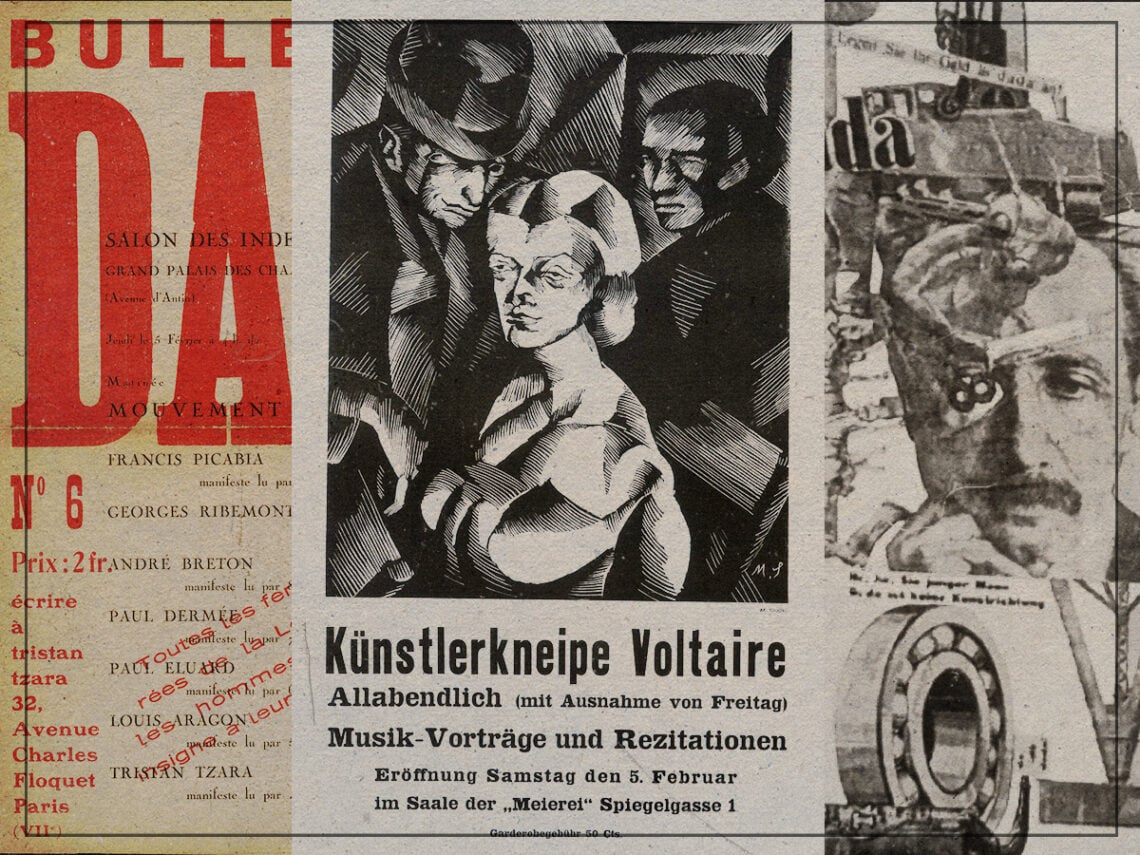
Zürich’s Cabaret Voltaire: The den of Dadaism

“The war is founded on a glaring mistake,” said German actor Hugo Ball, having witnessed the devastation of the invasion of Belgium in World War I. He had actually tried to enlist in the army but was refused. Whatever patriotic spirit remained after this rejection died after seeing the Battle of Liège. “Men have been confused with machines,” he said, horrified. He promptly flew to neutral Switzerland, settling in Zürich, where he and a group of fellow disillusioned artists would conceive of the Dada movement.
It was there he met Emmy Hennings, an actor and poet he later married. They bonded over a creative synergy and need to vent their frustrations about the state of the world. Ball felt drawn to anarchist sentiments, and alongside a collection of other artists and political figures, he and Hennings made Spiegelgasse 1 their new counter-cultural home.
“The Cabaret Voltaire,” they announced in a press release, “Under this name, a group of young artists and writers has formed with the object of becoming a centre for artistic entertainment.” Upon opening, the Cabret Voltaire became a place of respite away from the madness of war by indulging in its own kind of madness. Shows could range from strange poetry to dance and music. All of it often dissolved into crazed fights, with the audience once rushing the cabaret stage. The featured boundary pushers would later go on to electrify their art world, the likes of Wassily Kandinsky, Paul Klee, and Sophie Taeuber-Arp.
As Europe crumbled, Dadaism was born. Hall decreed it so in 1916 when he read his Dada Manifesto to an enthralled audience at the Voltaire. His speech pointedly stated that he did not want it to become an artistic movement, which was met with cries of: “Dada is anti-Dada!” from the audience. It was singular in that it was undeniably an art form, but its goal was far more political.
The movement was built on nonsense that rallied against the conformity of modern society, particularly as it was in the throes of war. Dada was not limited to any forms, spanning collage, poetry, sculpture and sound. Their work touched on a communal disgust with violence and nationalism, mostly ardently by Ball. Its wish to destroy itself mirrored its opinion of what society at large was headed for, but ultimately, it wound up creating more than destroying, having a key hand in the development of cubism, expressionism, and futurism.
Cabaret Voltaire was always the crucial meeting place Dada would orbit around until Dadaism began to outgrow its Zürich roots, reaching France, Italy, and Germany. Ball’s exit from Zürich was almost a self-fulfilling prophecy. Having left in 1917 to pursue a career in journalism, Dada fell into the hands of Tristan Tzara, a nihilistic artist who was heavily involved in Dada’s dissolution, just as Ball intended. But his anti-conformity spirit lived on, and around the turn of the 21st century, when it was announced that there were plans to close the iconic venue, a small group of neo-Dadaists inspired by Ball occupied the building, putting on shows and performances that called back to its early days.
