


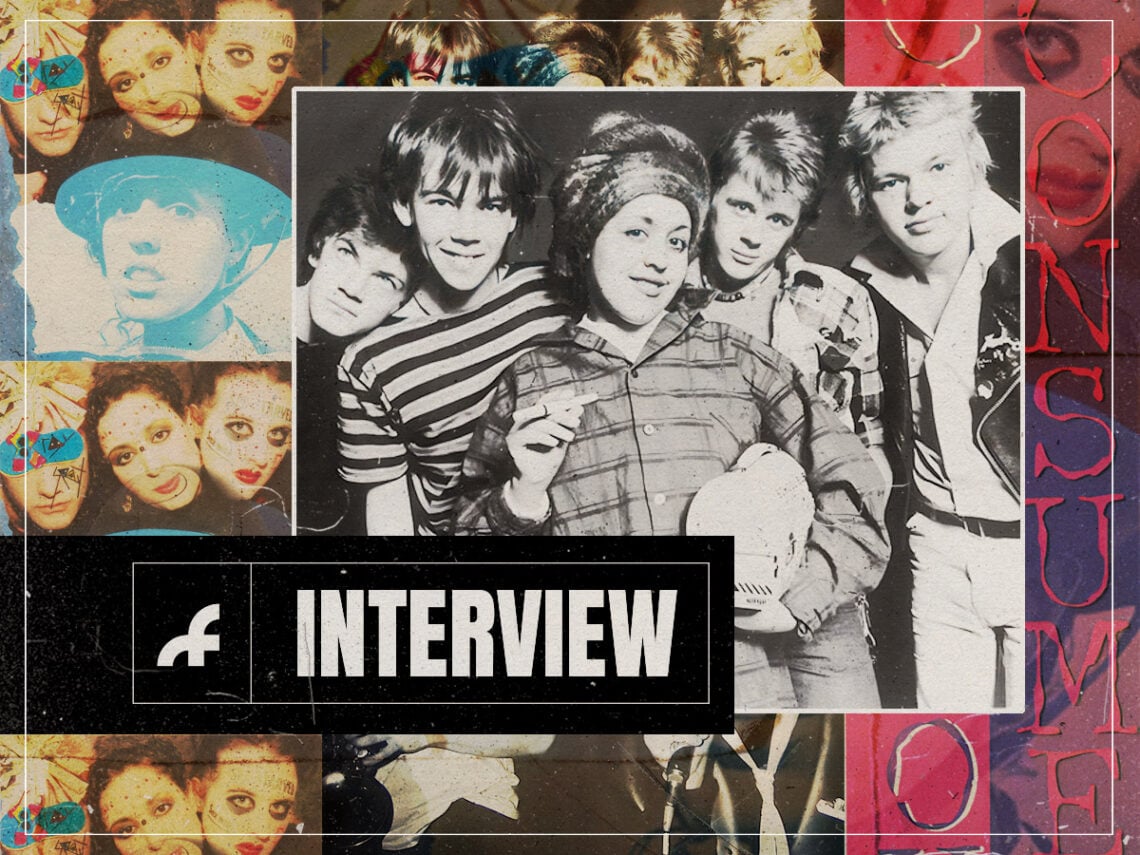
X-Ray Spex discuss on-stage anarchy, the sax revival, and the rerelease of their sophomore record ‘Conscious Consumer’

“Some people think little girls should be seen and not heard,” Poly Styrene muses in the opening moments of X-Ray Spex’s debut single. The words she uttered next would change punk music forever. “But I think, ‘Oh bondage, up yours!’” she screams with reckless abandon. Almost half a century has passed since then, but the influence of Poly and X-Ray Spex endures. It made its way into the sounds of punk peers like the Slits, it was present in the ferocity of the riot grrrls that followed, and it remains even now, somehow finding its way into the smoother stylings of FKA Twigs.
‘Oh Bondage, Up Yours!’ would rightfully stake X-Ray Spex’s claim to a permanent place in the history of punk, coining a phrase that would be borrowed and beloved for years to come. Barely a year later, the London-born band would solidify that status with Germfree Adolescents, a debut album filled to the brim with youthful anarchy and intent. Channeling the chaos of their live performance, the peculiar power of Poly’s voice, and an unexpected penchant for the saxophone, the record became an anti-consumerist cult classic.
While the band’s early years were marked by purpose and the promise of a bright future, X-Ray Spex’s flame was quickly snuffed out. By 1979, the band had lost saxophonist Lora Logic to Essential Logic and Poly Styrene to the Hare Krishna movement. In the memories of most, the story of X-Ray Spex ends there. A raucous few years of live shows and punk classics that faded into obscurity.
Those more well-acquainted with the band will know that this isn’t true. While it would never quite achieve the same success and status as their debut, X-Ray Spex would reunite 17 years later to concoct Conscious Consumer. Yet another statement against the society that surrounded them, the more refined record reunited Logic’s sax stylings with Poly’s defiant words, treading the line between politics and popular appeal. Unfortunately, it would never quite achieve the latter.
Despite containing all the DIY punk ethics and catchy qualities of their debut, Conscious Consumer went unnoticed amidst a lack of promotion and Poly’s increasing struggles with bipolar disorder. Now, almost 30 years on from its first release, the record is being given a second life, something Logic thinks Poly would be “quite chuffed” with.
When the album first came about, it was a “renewed” experience for both Logic and bassist Paul Dean, who had both settled into the constraints and comforts of family life. “I’d only played music for fun at the pub,” Dean recalls, “It was a new, or renewed, experience for me. We did it all very quickly, and it was quite painless.”

Poly contacted each of them with a phone call, recruiting them to play on the long-awaited follow-up record. For Logic, she was recruited as more than just a saxophonist, but as a roommate too, residing with Poly for the time that it took to record the album. “It was like Poly 24 hours,” she recalls, “It wasn’t just in the studio, it was in the flat as well.”
Together, they would produce a potential punk classic in just a week and a half, but the recording process was hurried and intense, exacerbated by Poly’s declining mental health. Once Conscious Consumer was completed, the band as a whole weren’t in a position in which they were able to promote the record or play gigs, meaning it would be lost to history. It received a limited CD run at the time and has never been released on wax until now.
The idea to reissue the record came from Logic’s manager and X-Ray Spex super-fan Kurt-Pagan Davies, who guided the saxophonist through her reentry into the music industry. “I hadn’t really stayed in touch,” she admits, “I hardly knew what Instagram was or Facebook was. And I felt quite lost, actually. I was fine with making the music, but what I was going to do with it, I didn’t know.”
Working with Davies to breathe new life into the record, Conscious Consumer was remastered for vinyl, a medium Dean is particularly passionate about for its capability to bring the live experience to the home. “A really good, well-pressed record can sound so live,” he suggests, “You can be in the room with them if it’s on a good hi-fi. It’s always going to have a place.”
With the advantage of hindsight and the medium of vinyl at their disposal, both the saxophonist and the bassist found that Conscious Consumer had withstood the test of time. While Dean dubbed it “not too bad,” which he suggests is praise coming from him, Logic suggests that the remaster has infused it with a renewed sense of freshness.
It’s not just the remaster that retains the freshness of Conscious Consumer. Somehow, Poly’s words still hold just as much cheek and weight as they did in the late 1990s, while Logic’s saxophone seamlessly fits into the modern post-punk movement’s obsession with the instrument. When I tell her of this preoccupation, Logic is stunned, immediately asking for recommendations.
I tell her the local Leeds scene has a fair few of its own sax enthusiasts, from the chaotic stylings of Volk Soup to newcomers trinkets, while the broader UK indie scene is bursting at the seams with love for the instrument. Black Country, New Road, Opus Kink, Crack Cloud, the list goes on. Logic takes the opportunity to gush over the instrument, which she suggests is just like the human voice.
“There’s just so much emotion in it,” she enthuses, “And it’s actually not that difficult to play because it’s not a chordal instrument. It’s a melodic instrument. There’s only a few notes you can play on the saxophone, so it’s very easy to put an individual slant on it and make it your own because, technically, it’s not that complicated. Feeling can just go totally into the note, the single notes. It’s a magical instrument.”
It certainly is magical, particularly when placed in the hands of Logic. Her contributions to X-Ray Spex, though brief in the early days, are part of what made them so influential and individual. More than our current preoccupation with the saxophone, the sounds of X-Ray Spex would be found in the likes of punk frontwomen like Siouxsie and Debbie Harry, Logic’s “second favourite band after X-Ray Spex,” The Slits, and, if we’re to accept Dean’s claims, even the Spice Girls. “They don’t realise it,” he suggests, “the antecedents of riot grrrl and punk.”

More than their studio sound, the raucous and ever-unpredictable nature of X-Ray Spex’s live presence has also maintained its grip on the DIY scenes that followed. One of their most iconic on-stage moments came at the Rock Against Racism gig in Victoria Park. Captivating a crowd of 80,000 people, Poly, against the wishes of her manager, unveiled her shaved head on-stage while playing ‘Identity’.
“It was a crisis,” Dean jokes.
But it was also a demonstration of her defiance and punk prowess. Falcon had demanded she didn’t take her turban off on stage, but she had told the bassist, “I will. I am going to take it off whatever he says.”
“She was quite mischievous like that,” he reflects. Often, the anarchy and chaos at the centre of the band’s performances were reflected in the crowds they cultivated. One phenomenon this bred was called gobbing.
“Have you heard of that term – gobbing?” Logic asks me. I inform her I haven’t, then quickly regret it when she goes on to define it for me. While onstage, she used to be subject to hordes of spit from audience members, which she suggests marked a sign of acceptance and flattery. “I started to wear a full-length raincoat, a Woolworths’ Macintosh, to protect me from the gob,” she adds.
But even torrential spit couldn’t stop Logic from basking in their early experiences of anarchy at Roxy. The sound was poor and the band barely knew the songs that they were playing, but “Nothing mattered. It was just electric,” she reminisces. Their sets were so stunning that young, budding punks were coaxed out of small villages across the UK and beckoned to the capital just for a taste of X-Ray Spex.
Despite rose-tinted reflections on their years of lawless live shows, Logic and Dean seem to have resigned themselves to the quiet. “I’m always open to anarchy and life on the road,” Dean suggests but is quickly shut down by his bandmate. “Are you Paul?” she asks, to which he admits, “Probably not.” Fortunately, they don’t need to. Fans who might have clamoured to see them at the height of their chaos can now find it in grooves of wax.
