


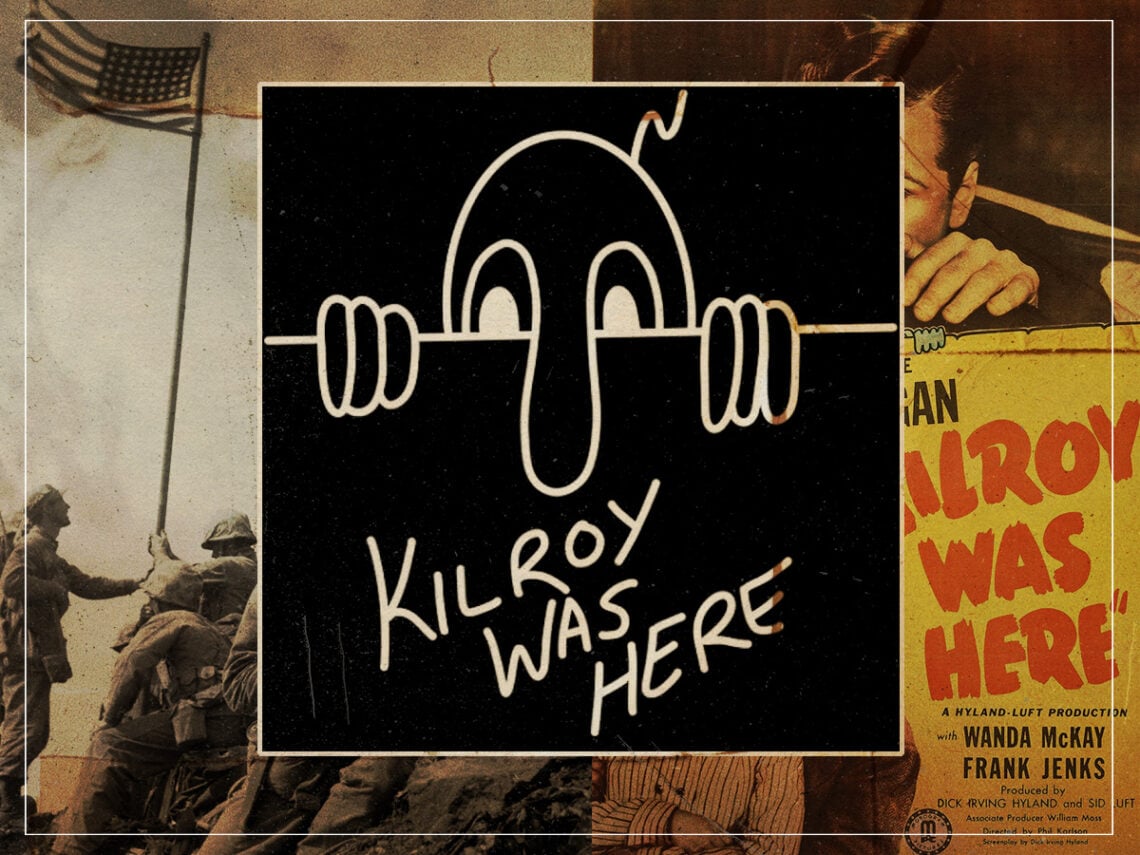
‘Kilroy was here’: the World War II-era meme that became a political statement

People replicating and sharing images across the world is basically the definition of modern meme culture. While the craze didn’t truly take off on a global scale until well into the internet age, ‘Kilroy was here’ served as its progenitor as far back as World War II.
The doodle depicts a bald-headed man with a big nose peering out from behind a wall with his fingers clutching the top of it, an innocuous enough drawing that could easily be graffitied by just about anybody capable of wielding a can of spray paint. However, as the conflict progressed, Kilroy lived up to his name by appearing just about everywhere.
Although its prevalent use was heavily attributed to American soldiers, the United Kingdom had its very own version of Kilroy, which may well have predated the most popular version. This guy was known as ‘Mr Chad’, and at some point, the transatlantic iterations crossed paths to create a common ground for the pre-meme, echoing the unified front the countries presented during the Second World War.
It was said of Kilroy that “the outrageousness of the graffiti was not so much what it said, but where it turned up,” and the bulbous-nosed caricature was known to turn up anywhere and everywhere from the schoolyard to the battlefield.
Kilroy was scrawled in bathrooms, bridges, and schools, daubed onto the interior and exterior of warships, and scribbled on the side of missiles. He was even referenced in a 1948 Bugs Bunny cartoon, where the carrot-munching rabbit mistakenly thinks he’s become the first person to land on the Moon, blissfully unaware that ‘Kilroy was here’ has been carved into a rock just behind him.
Nobody seems quite sure how Kilroy got his name, but some believe it to be the work of shipyard inspector James L. Kilroy, who had a habit of writing ‘Kilroy was here’ on various parts of the vessels being assembled under his watch during inspections. The sign was completely hidden from view when the boats were complete, which lent some credence to its potential status as the inspiration behind Kilroy’s habit of popping up in the most unexpected of places.
In the heat of World War II, many infantrymen found it to be a morale-boosting in-joke between comrades who, in many cases, had never met. Squadrons regularly saw ‘Kilroy was here’ etched into a wall or fence to let their countrymen know that the area had already been scouted or subject to reconnaissance. Eventually, it evolved into something else.
Those three simple words became a source of pride among the armed forces, indicating that no matter where it was on the map, there was no place on Earth that was beyond the militaristic reach of the United States. Whether it was a building or a bomb, ‘Kilroy was here’ didn’t have any preference over where it was seen when, at the end of the day, it was a representation of America’s unmatched global and military strength.
