


Woody Guthrie and the ‘1913 Massacre’: The practical joke that led to America’s most tragic folk songs

Woody Guthrie was the epitome of a protest musician. Even calling him a musician almost feels wrong, as it was so clear that his artistic endeavours were secondary to his purpose.
Guthrie was watching the world, and the world was giving him things to say as he purveyed the landscape of injustice he saw before him, from huge topics of inequalities or small examples, like a deadly practical joke.
It was 1913. In Michigan, mining was the major source of employment for working-class men. As we know from worldwide tales spanning decades, it was hard and dangerous work that was often handed out with a near-criminal wage. These men were low-paid but highly skilled as they worked underground, making major money for the rich men on land.
Injury was commonplace, as was death. While working down there, men would get trapped due to rock collapses, leading to loss of limbs or even life. Whole mine shafts would explode, killing entire teams and wiping out a whole class of brothers, fathers and husbands in town, and that’s not even considering the long-term effects of the dust and fume inhalation.
But in 1913, in Michigan, the mining industry proved itself deadly even on an off-day as the Western Federation of Miners decided to throw a party. On December 24th, celebrating a hard year of work before hoping to have a restful Christmas day, the miners and their families came together to socialise with their colleagues.
Imagine the mindset of working a job like that, where you know a real disaster could strike at any moment, and your survival relies on your fast reaction.
After a while, that would become ingrained in you. So when you’re at a Christmas party and someone suddenly starts yelling “fire”, you’re going to run while the jokester giggles.
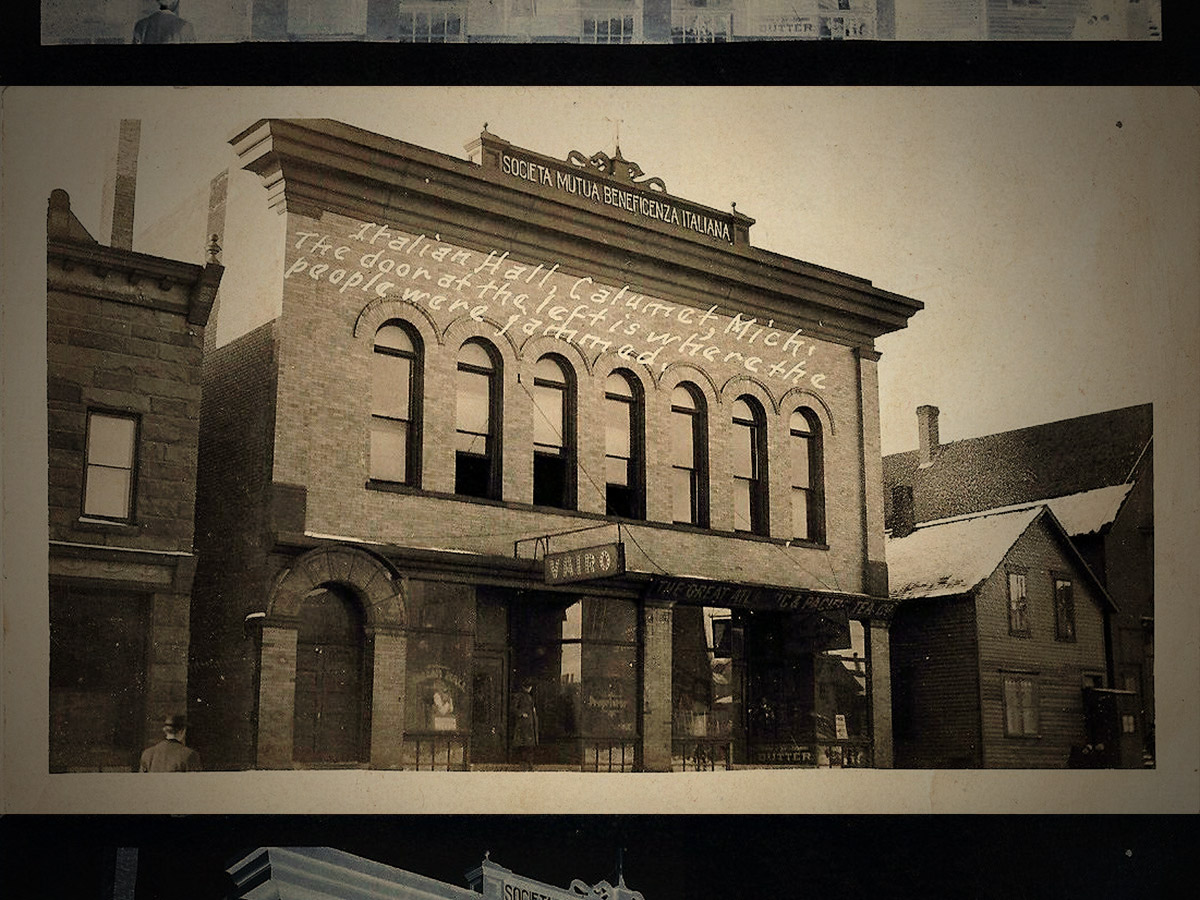
The Italian Hall disaster
Trapped on the second floor, the entire party suddenly bolted to the exit and a thin staircase. This was the setting for what would become known as the Italian Hall disaster. With too many people and too much panic, it caused a crush that led to 73 people dying, including 59 children who were merely there with their parents. There never was a fire.
In 1949, Woody Guthrie heard that story and was struck by it, and the way it epitomised the layers and layers of mistreatment workers go through. On the day they should’ve been able to feel safe and enjoy themselves, a cruel prank at the expense of their trauma cost lives. The image haunted him as he sang, “The gun thugs they laughed at their murderous joke, /While the children were smothered on the stairs by the door”.
They never found out who cried fire, but the prevailing conclusion was that it was an anti-union manager who wanted to disrupt the party put on by the WFM. Again, this struck Guthrie as a further way the establishment hurt, and in this case, physically hurt, the people. By calling this the ‘1913 Massacre’, rather than an accident or anything lighter, he makes his stance clear.
“The parents they cried and the miners they moaned, / ‘See what your greed for money has done’”, was Guthrie’s conclusion to the song as he merely recounted a decades-old story. Lending his voice to the voice of these victims in an accident that was all but forgotten to history, he saw that as his purpose.
