


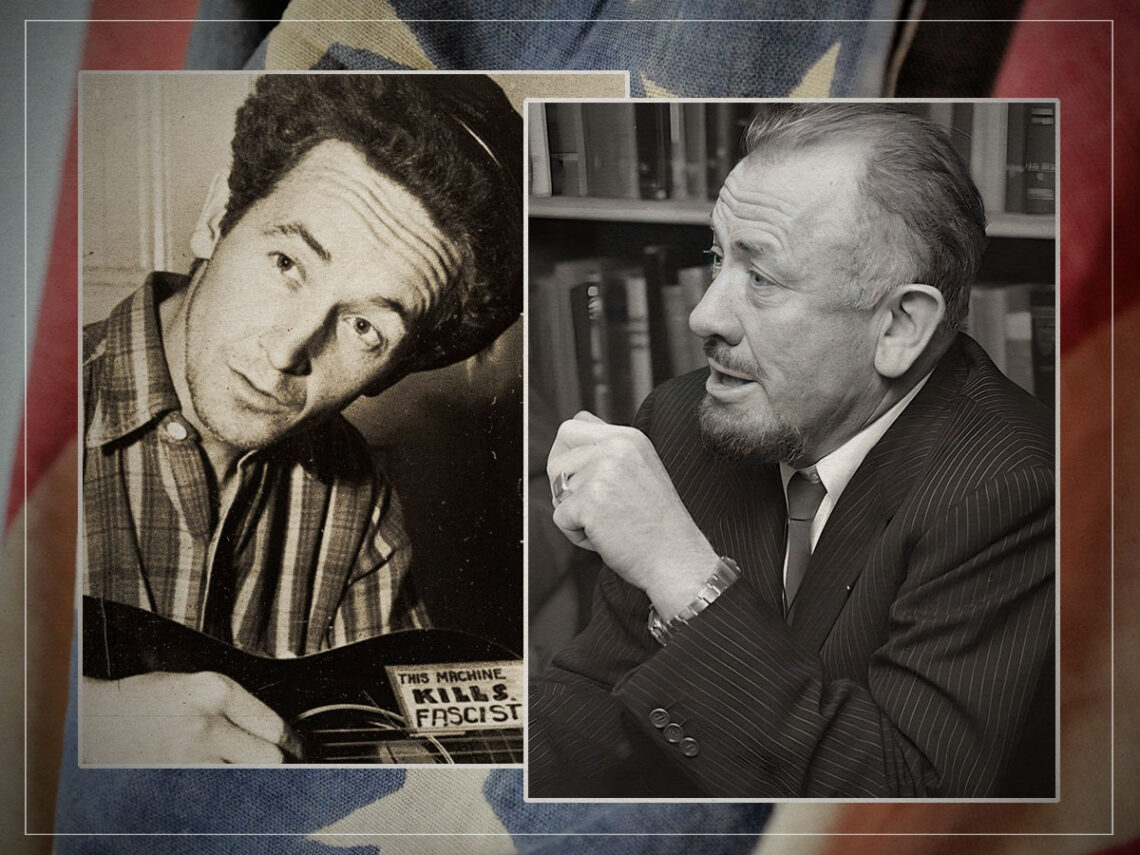
Titans of Americana: When Woody Guthrie met John Steinbeck

It’s not exactly a coincidence that Woody Guthrie’s first album, 1940s Dust Bowl Ballads, was released the same year as the film adaptation of John Steinbeck’s epic Dust Bowl novel, The Grapes of Wrath. Both artists were taking stock of a foundational moment in modern American history – the mass migration of Depression-era farmers and labourers from the Great Plains to the West Coast – and trying to communicate the nuances of that story to a wider audience still largely ignorant about these very recent events. The big difference, of course, was that Guthrie was one of those migrants himself.
Steinbeck, who was already a celebrated author by this point, given that Of Mice and Men was published in 1937, had based his writing of The Grapes of Wrath on a series of interviews he’d conducted with families who’d settled into makeshift “Hooverville” camps in California’s San Joaquin Valley during the late ‘30s. Reinterpreting their stories into the saga of Tom Joad and his family, Steinbeck’s novel became a best seller and a Pulitzer Prize winner, leading almost immediately to plans for a cinematic version.
As an advisor on the 1940 film, which starred Henry Fonda, Steinbeck believed that authentic music, rather than a grand Hollywood score, was important to telling the story. That’s what drew him to an upstart 28-year-old folk singer from Oklahoma named Woody Guthrie.
“Buried head over heels in the black old dust,” Guthrie sang on a Los Angeles radio station in 1939, “I had to pack up and go. An’ I just blowed in, an’ I’ll soon blow out again”.
These were lines from ‘Dust Bowl Blues’, just one of many tunes Guthrie had started playing—some written, some absorbed from others—during his own years travelling back and forth from California. Guthrie’s journeys were usually more of the railroad hobo variety, rather than aboard a jalopy like the Joads, but he’d nonetheless managed to harness the entire spirit of the Dust Bowl into songs that felt like they were “of” the people rather than about them.
Steinbeck happened to hear one of Guthrie’s LA radio appearances and set out to meet him. He wanted to make sure Woody was the genuine article, as he appeared, and not a play-acting Mumford, to paraphrase across generational references. In short order, the two men became friends, and by some accounts at the time, Steinbeck leaned on Guthrie as a key music consultant for the Grapes of Wrath film.
When the John Ford-directed movie arrived in January of 1940, it proved every bit as successful as the book. And while Guthrie’s name didn’t appear in the credits, the Okie from Okemah didn’t seem to mind.
“Seen the pitcher last night, Grapes of Wrath,” Guthrie wrote in his column for the People’s World newspaper. “Best cussed pitcher I ever seen”.
Guthrie was so inspired by the “pitcher” that he penned a new two-part ballad, titled ‘Tom Joad’, that would appear on his own debut album several months later. When Steinbeck, in turn, heard this song, he returned the compliment.
“Bastard!” Steinbeck reportedly said. “In 17 verses, he got the entire story of a thing that took me two years to write!”
Steinbeck’s appreciation for Woody Guthrie is better captured in another quote, which appears in Joe Klein’s 1980 Guthrie biography, Woody Guthrie: A Life: “There is nothing sweet about Woody, and there is nothing sweet about the songs he sings,” Steinbeck said, “But there is something more important for those who will listen. There is the will of the people to endure and fight against oppression. I think we call this the American spirit.”
