


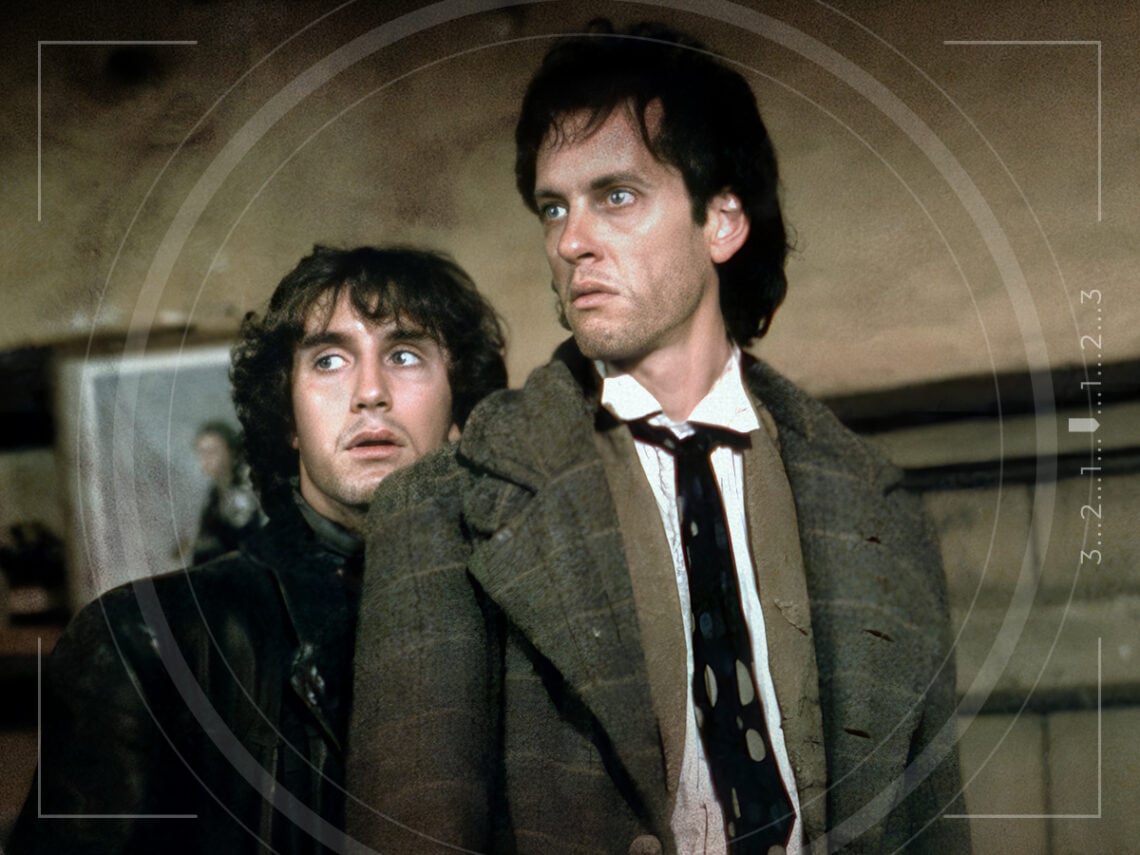
‘Withnail & I’ explained: Why does Withnail recite Shakespeare at the end?

Two out-of-work actors in the 1960s London take an accidental holiday to the Lake District and have a dismal time. It might not sound like the most promising set-up of all time, but Withnail & I is the archetypal cult film, an infinitely quotable classic that feels just as fresh and revelatory today as it did when it was released in 1987. Directed by Bruce Robinson, it stars Richard E Grant as Withnail, a flamboyant, grandiose thespian with an unacknowledged drinking problem and Paul McGann as Marwood (the ‘I’ of the title), a fellow penniless actor with whom he shares a rat-infested flat.
On a whim, the two decide that what they need is a holiday in the countryside, so they convince Withnail’s wealthy uncle Monty to give them the keys to the family’s cottage in Penrith. The bulk of the movie is the worst advert for the Lake District of all time. Low, grey skies, constant rain, a cold, damp cottage, and a persistent lack of food make for a miserable holiday, and Monty’s unexpected arrival turns things downright traumatic.
Back in London, Marwood learns that he’s landed an acting job that will require him to move to Manchester. Drunk, Withnail registers little emotion, even when they learn that they are being evicted from their flat. Marwood declines his friend’s offer of a goodbye drink, so Withnail snags a bottle of wine and walks him to the station. In Regent’s Park, they part ways, and after Marwood disappears, Withnail staggers to the wolf enclosure at the park’s zoo and recites a Shakespeare monologue in the driving rain.
The one he chooses is from Act 2 of Hamlet, in which the titular Danish prince muses about the nobility and, ultimately, the meaningless of humankind. “I have of late, (but wherefore I know not) lost all my mirth, forgone all custom of exercises […] What a piece of work is a man, How noble in reason, how infinite in faculty, In form and moving how express and admirable, In action how like an Angel, In apprehension how like a god, The beauty of the world, The paragon of animals. And yet to me, what is this quintessence of dust? Man delights not me; no, nor Woman neither.”

So, what does it mean?
On one hand, you could easily take the monologue at face value and assume that Withnail is simply using Shakespeare to channel his nihilism. And this is almost certainly part of the explanation. However, like all great stories, that ending is a poetic callback to something from earlier in the narrative, and it brings things full circle.
When Withnail and Marwood visit Monty at his stately home early in the film, Withnail reveals that his uncle had once had aspirations of being an actor, too. “I’d hardly say that,” Monty responds. “It’s true I crept the boards in my youth but I never had it in my blood and that’s what’s so essential isn’t it?” He continues, “It is the most shattering experience of a young man’s life when he awakes and quite reasonably says to himself: ‘I will never play The Dane.’ When that moment comes, one’s ambition ceases.” (‘The Dane’ is theatre shorthand for Hamlet).
Like Hamlet, Withnail is an inherently tragic figure. He might see himself as a great actor, but when Marwood lands a job and leaves him homeless, he has a moment of painful clarity. Reciting lines from Hamlet after the conversation with Monty is an admission that he has accepted ‘the most shattering moment of his life’ – that he will never be a great actor.
On the flip side, one could also interpret this moment as a show of defiance. By reciting Hamlet, he is refusing to give up on his dream, even if his only audience is a pack of captive wolves. Whichever way you choose to read this moment, it’s a poignant conclusion to a film that is often remembered for its laughs.
