


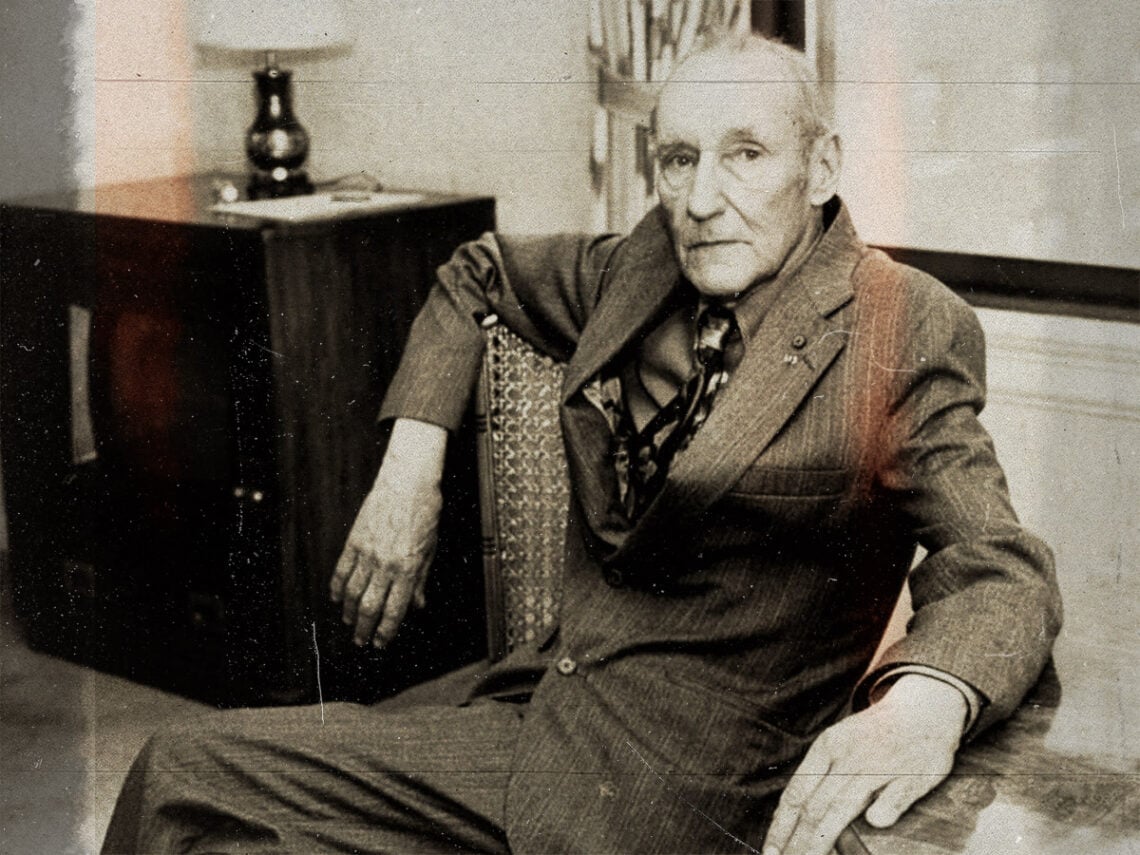
From free jazz to Kurt Cobain: Exploring the historical connection between William S. Burroughs and music

William S. Burroughs remains the most polarising figure of the Beat Generation. A globe-trotting heroin addict who fervently supported the Second Amendment and ultimately received a suspended sentence for the accidental shooting of his wife, his life was largely unbelievable, with the concept of normality appearing foreign to him and all of those around his inner circle. One of modern literature’s true radicals, there’s no surprise that a man whose work was so immensely extreme should be defined in today’s world as problematic.
Despite the evident criticisms of Burroughs as a man, his work alongside friends Allen Ginsberg and Jack Kerouac was groundbreaking, with his influence still ubiquitous today. While his efforts touched numerous mediums of artist creation, it was music that his influence stretched furthest, with game-changers such as David Bowie and Genesis P-Orridge citing him as a hero. From helping to form the countercultural ethos to the widely used cut-up technique, contemporary music would be in a drastically different environment without his convention-spurning efforts.
However, it must be noted that it wasn’t just Burroughs who changed music. The form also greatly informed his influential writings and lifestyle. Forever intertwined, in many ways, there would not be one without the other.
While Burroughs was a fringe figure for an extended time, his eventual influence on the alternative side of music is attributed to his literary experiments, as well as a host of other significant artists. Of course, the cut-up technique is considered one of the main factors that popularised his work, with The Beatles, Radiohead and Kurt Cobain utilising the method. Famously, Kurt Cobain once explained: “My lyrics are total cut-up. I take lines from different poems that I’ve written. I build on a theme if I can, but sometimes I can’t even come up with an idea of what the song is about.”
Outside of this, though, many other heavyweights would draw on the work of Burroughs. For instance, the bands Steely Dan and Soft Machine took their names from his art, with the former a steam-powered dildo in Naked Lunch. Elsewhere, The Rolling Stones, Ministry, Tom Waits and Sonic Youth are all revered proponents of his efforts.
Notably, more than Burroughs’ literature connected him to music and the alternative world. Throughout his career, he also collaborated with the likes of R.E.M., Kurt Cobain, Tom Waits and Sonic Youth. In the 1970s and 1980s, he was even known to hang out at New York’s bastion of culture, the rock club CBGBs. Demonstrating his inextricable link to music, he is mentioned as a mentor to the likes of Lou Reed, Patti Smith and Thurston Moore.
It has been noted that when rock ‘n’ roll emerged as a cultural force in the 1950s, Burroughs was still a fringe figure, despite his debut novel Junkie arriving in 1953. However, thanks to the successes of 1959’s Naked Lunch and Ginsberg and Kerouac’s efforts, the Beat Generation soon influenced the rise of the Beatniks and then the counterculture after it. The latter would prove to be monumental, effectively enabling a shift in culture and the rise of what is now known as political society.
Both the Beatniks and counterculture were hedonists living for the now. As the spectre of nuclear annihilation was constantly suspended in the background, this trio of authors changed how the younger generation thought. By the late 1960s, they were hailed as legends primarily due to the extent of their maximalism. Culture would never look back. Directly and by proxy, Burroughs and his friends changed the world, with their influence still alive today, even if artists aren’t always aware of it.
So how did Burroughs become connected to music? Jed Birmingham, a specialist on the Beats and Burroughs, offers some insights to Bebop Burroughs. He posits that it was jazz that first made an impact on Burroughs, influencing his entire outlook. It was this that then ultimately gave way to him changing the face of alternative music.
Birmingham notes the heroin and marijuana-dominated jazz lifestyle had a transformative impact on Burroughs, with him ingratiating himself in music and the drug underworld thanks to the likes of Thelonius Monk and Charlie Parker making waves in New York’s 52nd Street. Afterwards, the ethos of the scene would become a distinct part of his work, with it particularly prominent in Naked Lunch. A host of commentators have also mentioned that the organisation of Burroughs’ novels is similar to the composition of jazz music, and mainly, less structured takes on the form such as free jazz. His ‘Burroghsian’ routine, as Birmingham points out, is an outlandish improvisation on a theme, much like a solo in a bop piece.
Since the 1950s, Burroughs was closely associated with the jazz world, with his friendship with free jazz pioneer Ornette Coleman famous. Together, they appeared in the cult 1966 film Chappaqua, with Burroughs playing Opium Jones and Coleman a Peyote eater. It became a symbolic moment of the jazz era, and the Beatniks passed the baton to the counterculture. Duly, some of the most prominent radicals of the period feature in it. These include Allen Ginsberg, Moondog, The Fugs, Swami Satchidananda and Ravi Shankar.
Birmingham explains the parallels in the works of Burroughs and Coleman: “The concept of free jazz highlights more than the structured bop the formlessness, aggressiveness, and dissonance of Burroughs’ work. Such a view grants Naked Lunch and the cut-up novels their radically disorienting nature instead of demanding that the novel always make sense. Burroughs’ work, like Coleman’s music, seems to flow and move in waves washing over the reader impressionistically. Burroughs looks beyond the traditional novel structures while still trying to hold the reader’s attention. With the cut-ups, this seems a game of brinksmanship. Who will blink first — Burroughs or the reader. This seems to be exactly what Coleman was attempting in his music of the early 1970s.”
This ethos of aggression and dissonance would then be what alternative musicians would appropriate from Burroughs’ work and imbue in their own. Whether it be Bowie, Cobain, P-Orridge or even The Beatles, this ethos and structure would help artists push music into the future and suspend it and alternative culture as perennially radical forces.
