


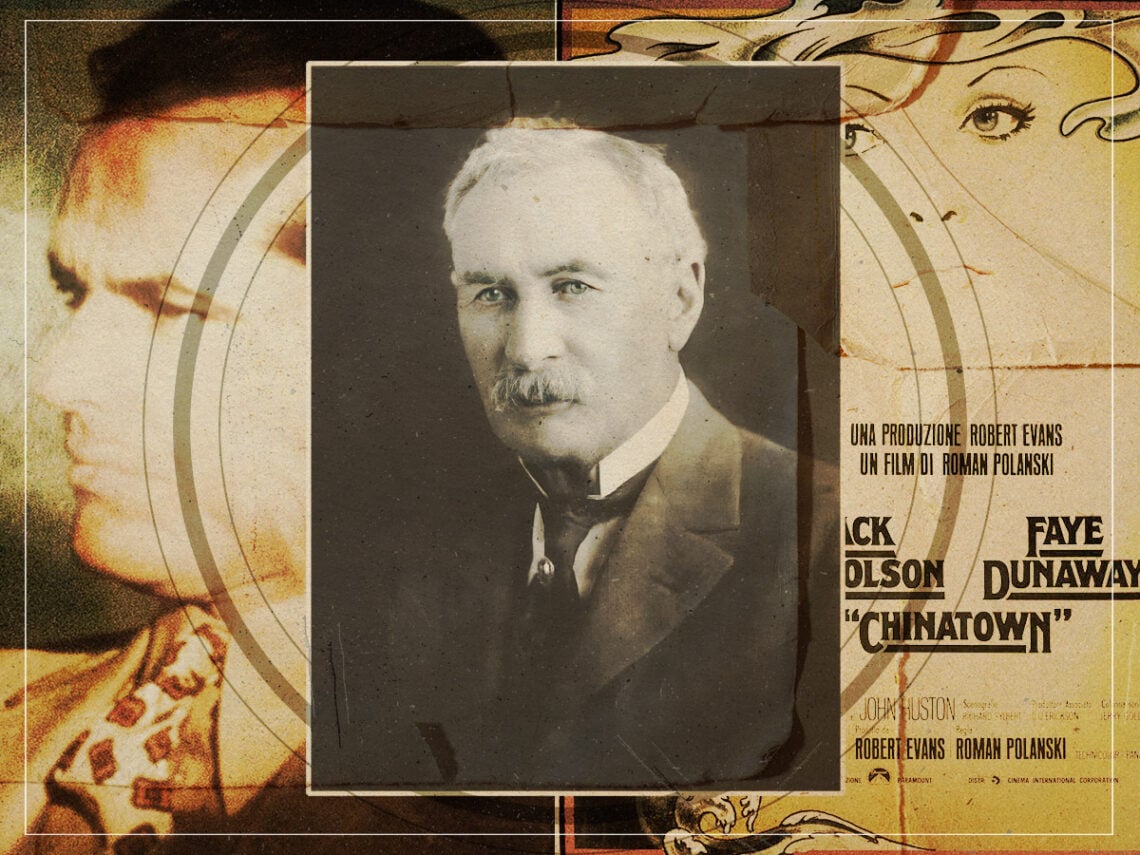
William Mulholland: The real-life inspiration behind ‘Chinatown’

In Hollywood in the 1940s and 1950s, a series of crime dramas doused in black-and-white cinematography and a mysterious air of cool were released and became widely accepted as film noir. Several decades later, the great noir works of cinema were tapped into to create a new kind of crime film known as the neo-noir.
Martin Scorsese’s Taxi Driver and Ridley Scott’s Blade Runner are undoubtedly neo-noir in their approach, but one of the most significant entries in the niche genre is certainly Roman Polanski’s 1974 film Chinatown, written by Robert Towne and starring Jack Nicholson and Faye Dunaway.
Taking place in 1937 Los Angeles, Nicholson plays Jake Gittes, a private eye who specialises in matrimonial cases, who is hired by Dunaway’s character to track her husband, Hollis Mulwray’s movements. However, when the chief engineer of the LA water department is found dead, Gittes finds himself embroiled in a web of conspiracy and deceit, inspired by the California water wars of the beginning of the 20th century.
While the dispute over water in California certainly inspired the film’s narrative, there was a real-life figure who provided the basis for the character of Hollis Mulwray. According to his granddaughter, the Irish immigrant and later superintendent and chief engineer of the LA Department of Water and Power, William Mulholland, served as the inspiration for Mulwray.
During his tenure at the LADWP, Mulholland wrote himself into the history of the Californian city by overseeing the building of the aqueduct that carries water from the Owens Valley. Without the 230-mile stretch of engineering brilliance, Los Angeles would simply not be viable as a city, although it brought with it a series of controversies and scandals.
The city of LA was limited by the Los Angeles River, and without expansion into the Owens Valley, the City of Angels as we know it today would have been vastly limited. After building through and essentially destroying a number of farming communities in the Owens Valley, several disputes were raised, and some individuals attempted to sabotage the construction of the aqueduct.
In Chinatown, Mulholland is reflected by Hollis Mulwray, and although he is found dead towards the beginning of the film, many facets of his life seem analogous to William Mulholland. Polanski’s film is not in the slightest sense a biopic, though, and a number of creative liberties were taken with Mulholland’s life, as well as the fact that it is set several decades after he had been the chief of the LADWP.
Played by Darrell Zwerling, Hollis Mulwray is a controversial engineer in Chinatown, although he seems to have an ethical code of conduct that strays from political and economic corruption, a remove from the kind of underhanded dealings that dominate the version of Los Angeles in the film, one that equally highlights the difficulty of maintaining power and appeasing local communities.
Another allusion to Mulholland comes through Mulwray’s opposition to the building of a new dam, referring to a previous mistake he had made. Mulholland had, after all, been involved in the 1928 St. Francis Dam disaster, which caused the deaths of over 400 people and subsequently saw Mulholland’s career come to a crashing end.
Not only is Chinatown a landmark achievement in neo-noir cinema, but it’s a film that taps into the rich history of its Los Angeles setting and delivers a fascinating tale of conspiracy and corruption. However, it might not have been possible were it not for the visionary actions, as well as accidental misdeeds, of William Mulholland.
