


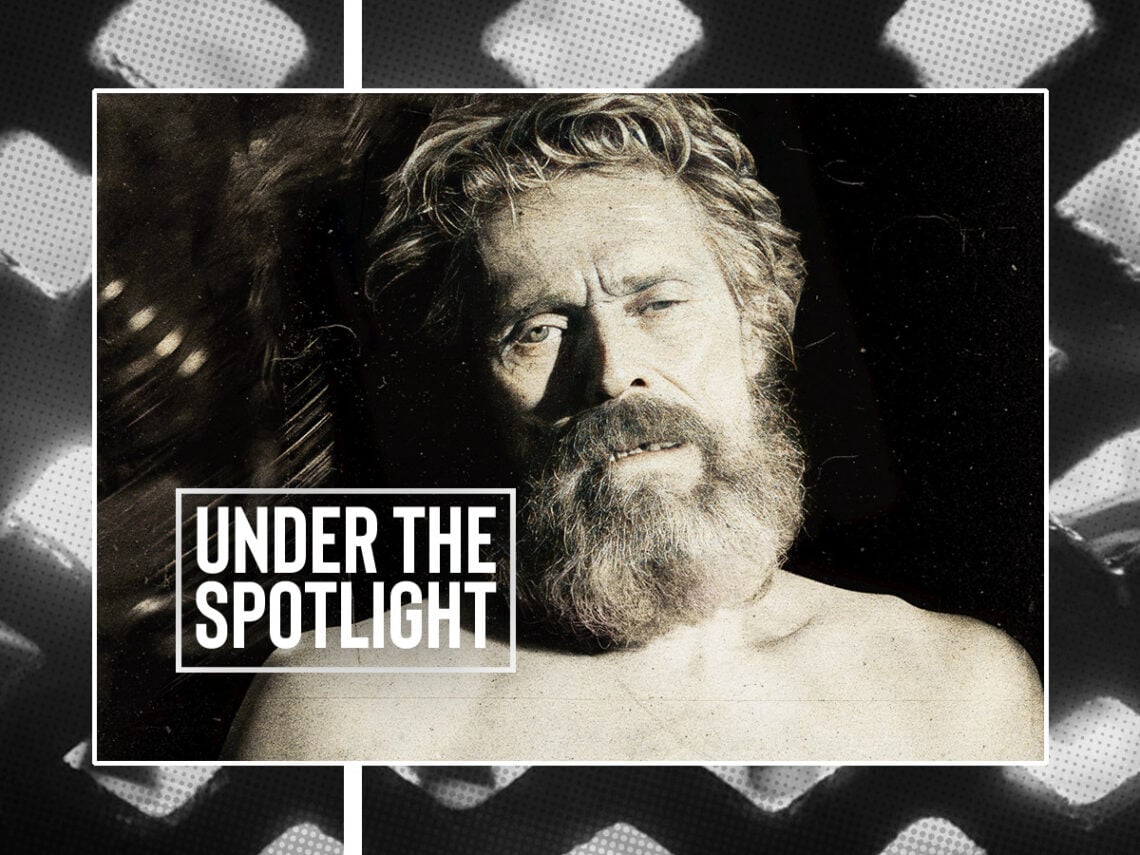
Under the Spotlight: Willem Dafoe in ‘The Lighthouse’

“How long have we been on this rock?” he asks, voice croaking with fatigue and eyes narrowed in suspicion. “Five weeks? Two days? Help me to recollect.” For those that were eagerly anticipating the sophomore feature from director Robert Eggers, this final line from Willem Dafoe in the trailer for The Lighthouse was almost too exciting. After a kaleidoscopic montage of sea-faring sorcery, that last glimpse confirmed that unfettered madness was indeed going to dominate the movie.
Directed by Eggers, The Lighthouse revolves around two lighthouse keepers (Dafoe and Robert Pattinson) who become stranded on their New England post after a vicious and preternatural storm falls on their stony island. The isolation, coupled with the harsh weather and haunting environment, leads to a gradual descent into feverish paranoia – part ghost story, part murder mystery, total chaos. The drama that unfolds is a tour de force, and as the only two characters in it, Pattinson and Dafoe completely astound with their acting capabilities. It is Dafoe’s performance, however, that really lingers in the brain.
From the start, Dafoe establishes his character, Thomas Wake, with a thunderous authority. His character is a grizzled, authoritarian lighthouse keeper, a sea dog with stories of sirens and sea gods. Dafoe presents Wake as an embodiment of the sea itself – sometimes calm, often stormy, and always unpredictable. His hypnotic monologues, full of maritime lore, nautical language and theosophical undertones, are delivered with an utterly mesmerising blend of menace and charisma.
Dafoe’s transformation into Wake goes beyond the growling accent and sea-shanty dialogue; it’s in the weathered crevices of his face, the squint of his eyes, the gruff timbre of his voice, and the raw physicality he brings to every scene. Accentuated by the phenomenal costuming by Linda Muir and the entire make-up department team, when Wake barks an order, you can smell his smoke-tinged beard and taste his liquor-stained teeth. The immediate, physical and sensory identity that Dafoe’s character has in The Lighthouse is unlike any other.
The brilliance of Dafoe’s performance lies not only in his dominating presence but also in his ability to reveal the vulnerabilities and humanity beneath Wake’s hard exterior. He carefully peels back the layers of his character, revealing moments of fear, longing, and desperation. Whether it’s the genuine terror he feels when Pattinson’s character destroys a seagull (“Tis bad luck to kill a seabird!”) or the cocoon of ecstasy that he withdraws into whilst masturbating up in the tower, time and time again, Dafoe allows the fragility of Wake to surface.
A particularly memorable scene involves Dafoe delivering a gut-wrenching, two-minute-long curse after Pattinson’s character refuses to toast to his lobster cooking. The monologue is chilling, filled with such fervour and rage that you’d think he just found out his whole family had been set on fire. Using both Eggers brothers’ writing as a springboard, Dafoe pulls forth from the depths of his soul a guttural hex to bestow upon his lighthouse partner, using curses and defamations that even Melville and Shakespeare couldn’t dream of.
Dafoe has and will continue to deliver the most audaciously exciting performances in cinema and work with the highest calibre directors and filmmakers. But there is something about his role as Wake in The Lighthouse that may well make it his definitive performance. We’ve seen him as Jesus in Martin Scorsese’s The Last Temptation of Christ and a carnival compère in Guillermo del Toro’s Nightmare Alley, but it’s his briny, barnacle-crusted, tentacle-gripped, sexually perverted lighthouse keeper that truly feels like something more than just a performance – as if, like some deep-sea demon, he has been summoned to the surface of the 21st century to curse us all.
