


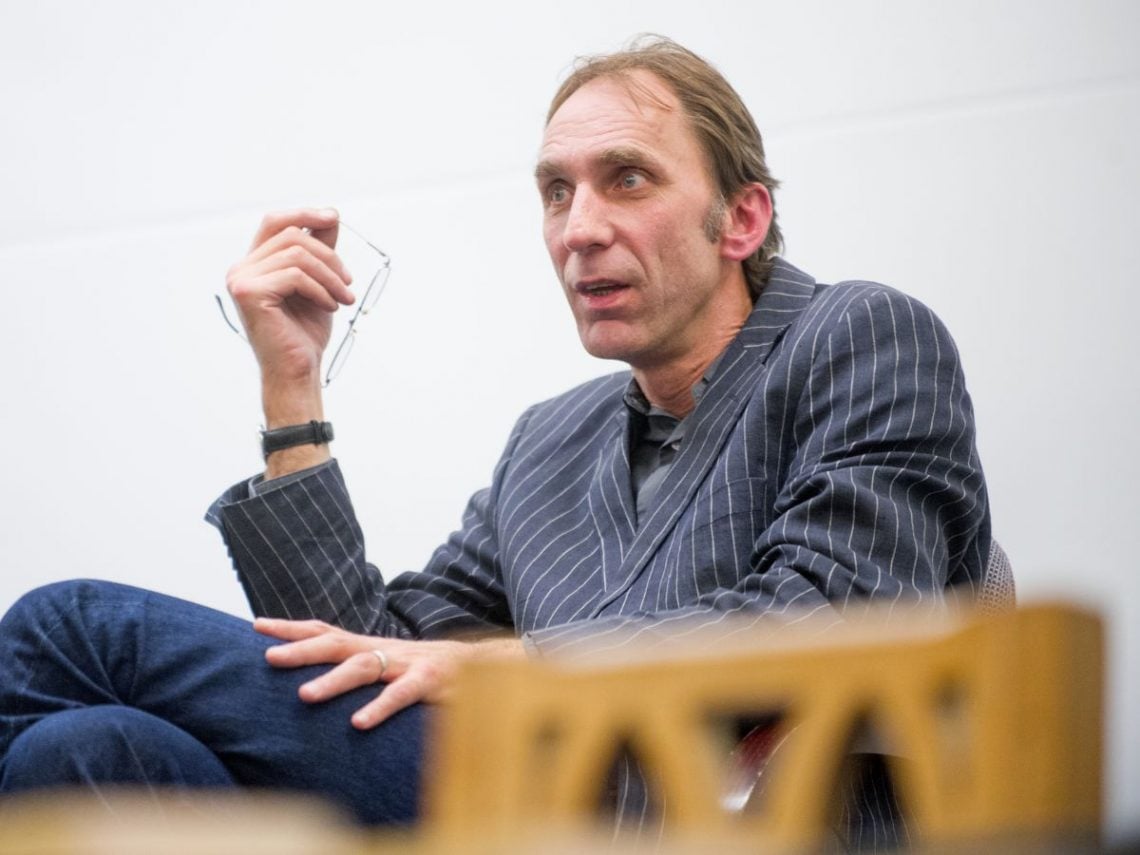
Will Self lists his five favourite books

When he’s not too busy making Conservative politicians quake in their boots with his death stare, Will Self is probably found writing books or out wandering in the open air, thinking about them. The London native is an enigmatic character who has been a staple of British culture for the past 30 years, enjoying a career that has seen him try his hand at various occupations and publish numerous celebrated works.
Hailing from a line of respected academics and policymakers, Self did not follow this path and trod his own instead. It has been a resounding success since his literary efforts are widely discussed and celebrated.
Taking early inspiration from J.G. Ballard and Philip K. Dick, he would later find the canon stifling and draw as much on his range of real-life experiences as fiction authors. In doing so, he cultivated an unmistakable style, leaning heavily into surreal social commentary. Some of his works, such as The Book of Dave and Great Apes, have been so inventive and thought-provoking that their substance is akin to the very finest produce from Ballard and Dick.
Outside of his writing, Self is best known for his work on the BBC comedy panel show Shooting Stars, where he served as a team captain in the early 2000s, replacing the outgoing Mark Lamarr. Elsewhere, he’s an active journalist, and for decades he has been sharing his reflections in respected publications such as The Guardian, Harper’s Magazine, and The New York Times.
He is currently a Professor of Modern Thought at Brunel University London, where he teaches psychogeography, a field that he has helped to develop and bring more into focus in the mainstream discourse.
When sitting down with Five Books to promote his novel Umbrella, Self listed his five favourite books and went into depth about why they inspired him. Of course, not all of these are wholly serious, with him bringing his typical form of sarcasm to the fold. There’s sex, urbanism and anthropology contained within the list, and all are titles that go someway in accounting for the unapologetic writing style of Will Self.
Find the list below.
Will Self’s favourite books:
Awakenings by Oliver Sacks (1973)
1973’s Awakenings is one of the most celebrated titles by the late neurologist and writer Oliver Sacks. It tells the life stories of some of those who had been victims of the “sleeping sickness” epidemic of the 1920s. Sacks chronicles his work in the late 1960s at a hospital in the Bronx, New York, where he helped these patients using the new amino acid L-DOPA.
Self said: “I must have first read this book in the early eighties and found it – like a lot of Sacks’ writing – absolutely fascinating. Not just because of the philosophical and scientific perspectives that he is involved in but because of his involuntary self-characterisation. I used some of Sacks’s modes and mannerisms quite shamelessly as one of the sources for my character Zack Busner, who is a repeat presence in my fictions. So in a way, the seeds of Umbrella were planted here, many years ago.”

The Great War and Modern Memory by Paul Fussell (1975)
Paul Fussell has long been hailed as one of the greatest cultural and literary historians that America has ever produced. A veteran of the Second World War, he made the segue into academia after being injured in service and produced a variety of works on numerous different topics. These range from critiques of America’s class system to accounts of both World Wars, and they’re a must-read for anyone wanting great insight into America’s golden age.
The work that Self chose was 1975’s literary criticism, The Great War and Modern Memory. A startling body of work, it details the literary responses of English participants in World War I to their actual experiences of combat and the trenches. Eventually, the insanity and futility of the entire period become metaphors for life itself.
Self explained: “Fussell’s book brilliantly articulates many views which were inchoate in me before I read it. It’s ostensibly literary criticism, but it does much more than that. His thesis is the juxtaposition of the great powers marching off in August 1914, with their banners and tootling – “Dulce et decorum est pro patria mori” – and the reality of war. They expected a swift victory by Christmas but got bogged down on the Western front in the worst kind of mechanised slaughter that the world has ever seen. The reversal between those two states is what created the ironic cast of the 20th century. I think that’s a very powerful argument, with a lot of explicatory force.”

My Life and Loves by Frank Harris (1963)
Much like Will Self, Frank Harris always followed his own path. He gained notoriety for My Life and Loves, his autobiography published between 1922 and 1927. It is decked with drawings and photographs of nude women and gives a graphic account of Harris’ many sexual experiences. The book was much ahead of its time, as Harris suggests that sexuality can have a vital impact on personal and professional development.
Self said: “I only included this book to show that cocks went in cunts before 1961. That’s all it’s there for. It’s a dreadful book. Appallingly written. But the great virtue of Harris is that he fucks a lot, and talks very explicitly about his fucking in a way that is totally believable. When you were young, you would read 19th-century novels and sit there thinking: Are they fucking? Aren’t they fucked? Does that mean they fucked? There are children, but where’s the fucking? The conventions were so absolute about the representation of sex that you are always slightly confused about whether characters actually had sexual intercourse. Frank Harris is there to clear it up.”

City of Cities by Stephen Inwood (2005)
Telling the story of London in the 30 years before the first World War, Stephen Inwood’s City of Cities describes a city breaking off from the past and jumping into the future with all the tubes, automobiles and technology it offered. Inwood argues that the War was the product of a period of revolutionary change and that this made it occur, and not the other way around, as we’re taught in school.
Of the book, Self explained: “My perception is that London was the modernist city par excellence in 1900, and over the last century or so has retreated from its position on the cusp of modernity. In the early 1900s, you had stock market quotes, electrified underground railways and pneumatic mail systems – the idea that we are significantly more modern in the physical fabric of the city today is a delusion. I wanted to try and evoke that. Inwood’s book is a very thorough and comprehensive social, political and cultural history of London during that period. He’s written other big books on London, but by narrowing his focus, he has got a lot more detail in.”

London Street Games – Norman Douglas (1916)
Controversial British author and probable paedophile Norman Douglas is best known for his 1917 work South Wind, but instead, Self chose the previous year’s London Street Games. A description of the life of the working classes in London at the turn of the century, Self feels that it is a wonderful piece of social anthropology.
He said: “Norman Douglas cottoned onto the fact that children’s games were a source of oral literature that lay outside of other kinds and had not been studied before. In this strange book, he went out on the streets in the early 1900s, watched cockney kids playing and wrote it all down. It’s an exceptionally good bit of social anthropology. It’s all there. And rather like the Frank Harris book with sex, it’s a very direct window into cockney culture at that time, unmediated by the requirement to fulfil the expectations of bourgeois culture. That makes it invaluable for getting a feeling of what a working-class child’s life might be like at that time.”

