


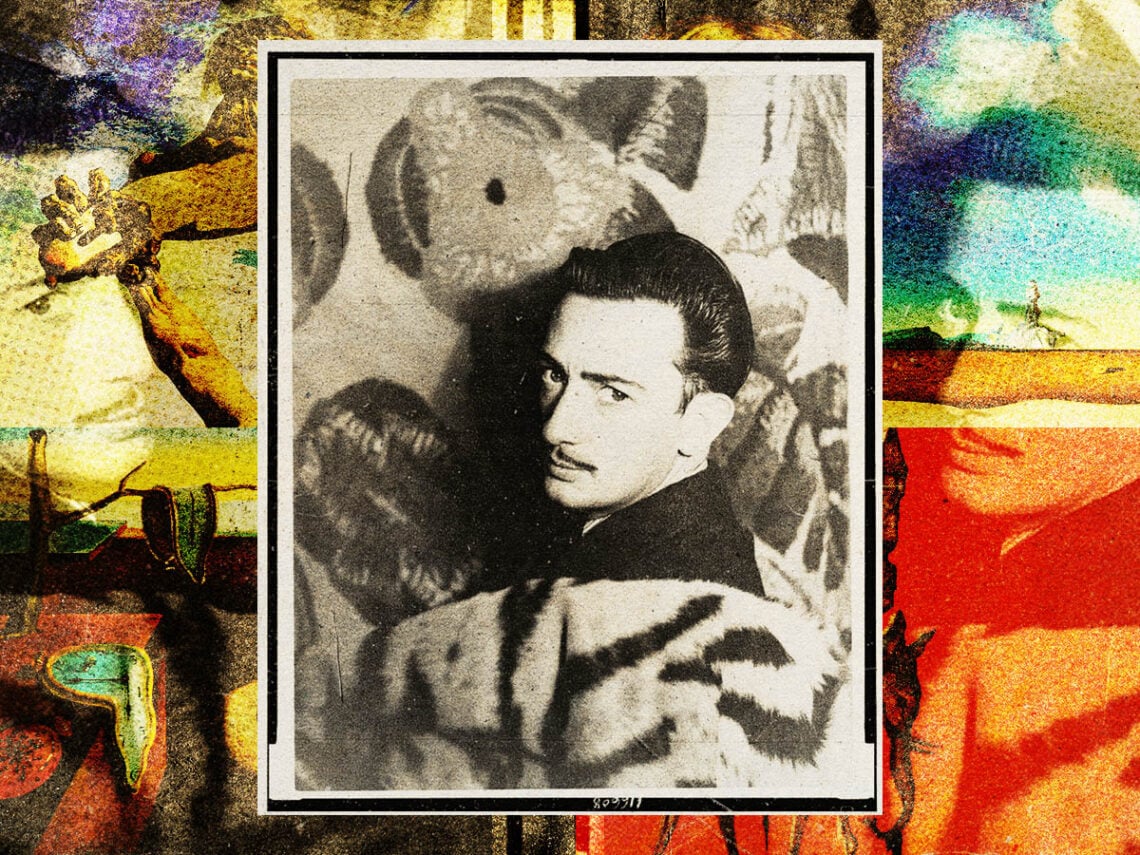
Why was Salvador Dalí obsessed with melting clocks?

No art movement is detached from the world around it; whether the artists like it or not, their works are a response to what is happening outside of their easels. Thus, it is perhaps no surprise that as surrealism was arising, science was reshaping our own views on reality. Coinciding with Salvador Dalí’s weird revolution were great leaps by Albert Einstein and Sigmund Freud. These had a huge bearing on the scholarly artist from Spain and his fresh outlook on the canvas.
While Dalí himself might have cited camembert cheese melting in the summertime as his aesthetic inspiration behind the recurrence of the gooey clocks in his work, it is easy to see that this was a mere wacky subterfuge for something a little deeper.
Surrealism looked to delve into the unconscious mind. Our waking hours had been documented in art since time immemorial, so at the turn of the 20th century, artists of all descriptions began delving into our dream state, a world that newfangled cameras could never capture. Naturally, the downside was that you have to be awake to create art. In order to subvert this reality, Dalí is said to have attempted to induce a trance from which he would paint and capture a world of surrealism.
This mindset helps to illuminate the prevalence of melting clocks in his work. For instance, think about your own experience waking from an overlong midday nap: that feeling of gloopy time dissolving itself, the disorientation of feeling like you’ve slept for a thousand years and all is now strangely illusory in the cartoon world around you. That is a familiar feeling that Dalí seamlessly invokes by placing melting clocks in a dreamscape.
In most of the works where the clocks or watches feature, the dreamscape itself isn’t all that bizarre. It is always grounded by an elemental presence like an old withered tree or ancient cliffs in the distance. These symbols showcase the physical constant of time. However, this reality is juxtaposed with Einstein’s more theoretical view when it comes to his Theory of Relativity. This sense of time not having a single flow was further compounded by Freud’s psychological symbology and understanding of lingering traumas.
These resulted in Dalí delving into dreams where the question: ‘What does time no longer being constant look like?’ is easier to answer. First appearing in 1930’s ‘Fish Man’, these melting clocks persisted throughout his next six pieces, culminating in the revered 1931 work ‘The Persistence of Memory’. This miniature 24x33cm work is now perhaps the most famous surrealist work in history and the fact it still asks more questions than it answers is perhaps why.
The canvas also being so small is another insight into its success. Dalí scaled things down for the sake of precision. By sweating over the finest details, he claims he was able “to systematise confusion and thus to help discredit completely the world of reality.” In truth, this is what was happening with science at the time. With works underway to split the atom (which happened successfully the following year in 1932), we were zooming into the minutia of science and discovering strange and destabilising things there. Dalí’s paintings also depict this and there was no finer emblem of that than the age-old clock slipping into a strange new world, one we know all too well if only in our dreams.
