


A Royal Obsession: Why do the royal family make for such good cinema?

The royals are everywhere. Whether on the news, in the evening papers, on television or film, they’re an inescapable aspect of our lives, especially if you live in the UK. But what is it exactly that has made series like The Crown and films like The King’s Speech and The Favourite so popular? Is it that we’re obsessed with the glamour of royalty? Perhaps. To many, the royals are aspirational figures, although you’d be mad to aspire to a life in which you’re surrounded by guards 24/7. Still, one wonders if the traditional royal drama caters to a sort of wish fulfilment. Alas, I doubt it’s that straightforward.
In British cinema, royals often serve as a conduit through which the nation can reassess its values or, as with Victoria and Abdul, reaffirm its view of itself as basically liberal. That film came out in 2017 when anti-Islamic sentiment in the UK was at an all-time high. At a time when more anti-Islamic attacks were reported than ever, Stephen Frears painted a portrait of Queen Victoria – the very emblem of British colonialism – as some anti-racist progressive fighting the good fight.
It was never quite convincing, but people lapped it up nonetheless. Why? Because royals have always been regarded as symbolic of society’s values. Queen Victoria was prim, prude and family-oriented, so surely the Victorians must have been too. King James was deeply distrustful of women and fascinated by Witchcraft, so Britons went about hanging women by the cartload. I could go on, but you get the picture.
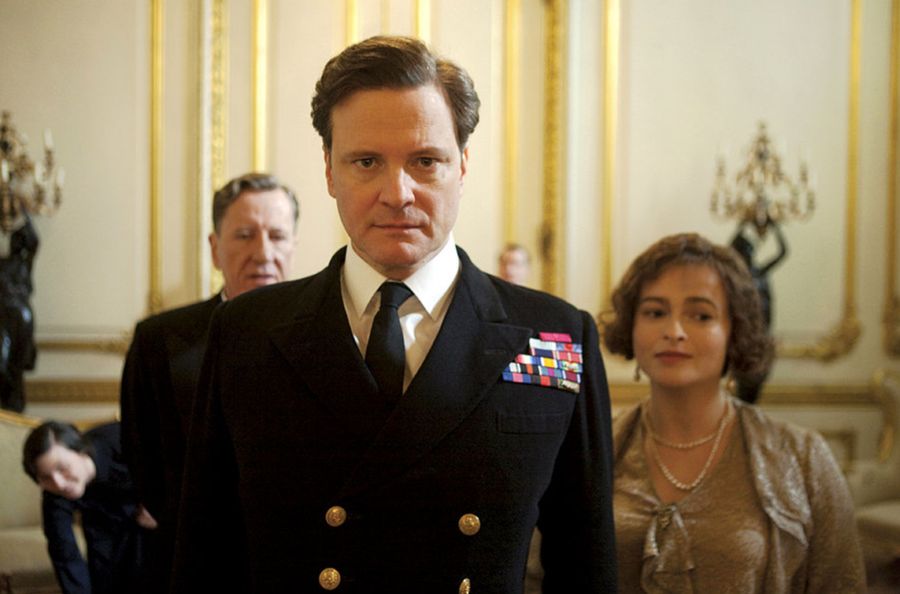
Perhaps our view of royals as somehow encapsulating the nation’s spirit is why The King’s Speech became such a hit on release in 2010. The film focuses on chain-smoker, depressive and serial stammerer King George VI, who develops a bromance with a speech therapist called Lionel Logue. In focusing on this reluctant royal’s journey towards public confidence, it’s possible director Tom Hooper was telling us a story about Britain, specifically how the threat of war catalysed a reshaping of the British national character.
At the start of The King’s Speech, Colin Firth’s face is as grim as the underside of a tin bath. Being ill-suited to public duties, he would much rather stay out of the public gaze. To combat his various nervous ticks, he smokes constantly and drinks scotch before 11.00am. Simply put, he is not the kind of royal you want leading a nation into war. By the end, of course, he is precisely the kind of stiff-upper-lip pragmatist we so readily associate with the war generation. Like Britain itself, George transitioned from a stuffy traditionalist to an outward-looking optimist.
Perhaps The King’s Speech was such a hit because it depicted the inception of national characteristics many Britons still treasure. The fact that the wartime character is long-dead doesn’t matter to the modern viewer; the fact that it existed at all is usually enough. Royals root us in the sense of the eternal, or at least in a shared history that stretches back thousands of years. The royals, in Britain at least, attract fascination not because they are inherently fascinating but because, for some, they evoke continuity and stability. A lot of people cling to traditions such as royalty because they satisfy an embedded desire for predictability, safety and order. This is, of course, why so many films featuring royals are historical.
If you think our nostalgia for rulers appointed directly by god sounds a little regressive, you’re not wrong. J.R.R. Tolkien’s Lord Of The Rings trilogy (later adapted for the screen by Peter Jackson) focuses on, among other things, Aragorn and his journey towards kingship. Like George IV in The King’s Speech, he is a reluctant royal destined to take the throne. He is, in essence, a sacral monarch who, like King Arthur, reveals himself to be the one true king after accepting a sword – the symbol of his great destiny.
It’s all very romantic, but some have argued that Tolkien essentially says that the ideal ruler is one with a divine claim to the throne. When laid bare, it sounds pretty hardline, but countless films indulge in a similar kind of nostalgia. Indeed, it’s possible royalty offers viewers an imaginative escape from ineffectual modern governments; the success of The King – an adaptation of Shakespeare’s Henry V – back in 2019 would certainly seem to suggest so.
For whatever reason, it’s clear that our obsession with royalty isn’t going anywhere fast. The Crown continues to pull in viewers, and last year’s psychological drama about Lady Diana Spencer earned rave reviews for offering a gothic slant on a story many of us know like the back of our hand. Whether that’s because of what it offers us or represents, royalty remains a rich source of narrative complexity. They are like us, yet they exist in a completely different world we’ll never truly know. Perhaps films trick us into thinking that it’s our world too.
