


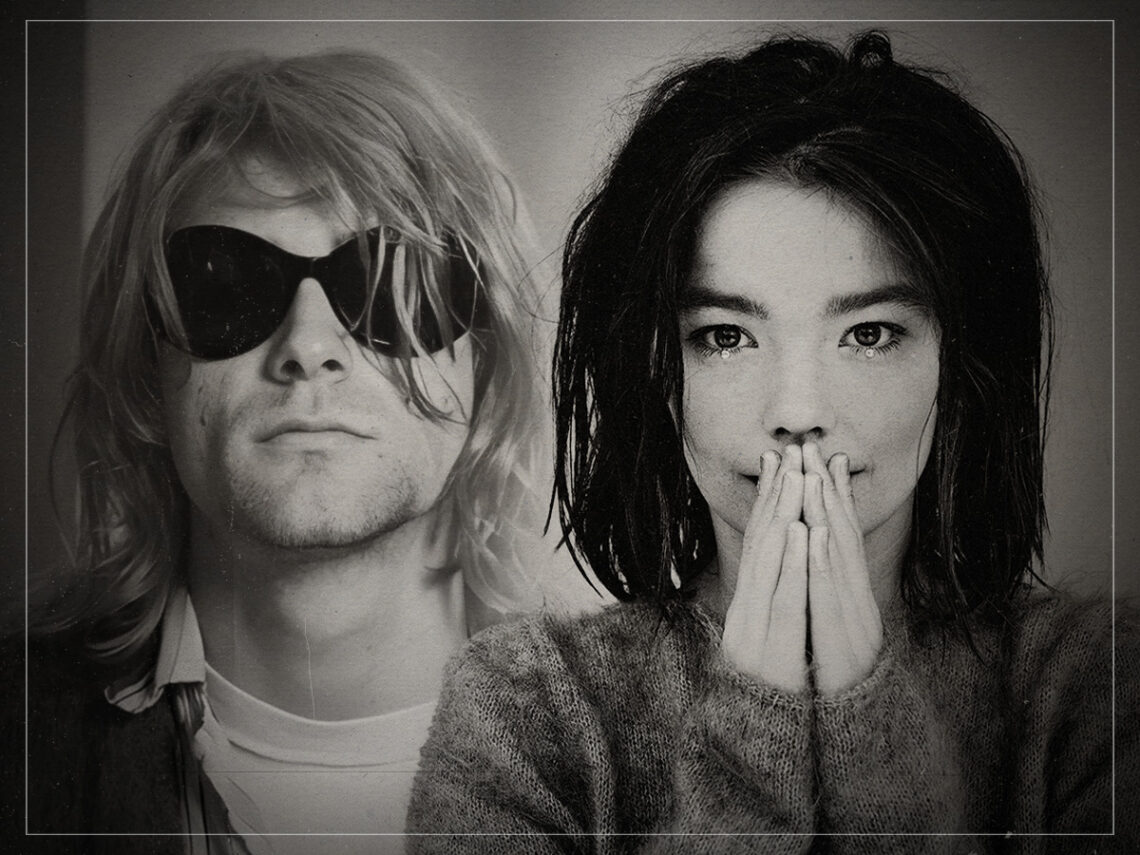
“Larger than life”: Why Kurt Cobain became Björk’s only rock and roll love

There are few musicians in history who could take any idea, genre, or concept and be trusted to deliver it well. Björk is no doubt one of them, as is one particular musician who stands out as an anomaly in her broader range of influences: Kurt Cobain.
On paper, the pair resemble anything except each other, with both seemingly occupying two distinctive spaces in music and in history – Björk, a certified experimentalist virtuoso, seems worlds apart from Cobain, a rock legend whose journey was shaped by his own struggles, and who sits atop any hierarchy of defining rock figures, not just across the 1990s but in music history.
However, when you dive deeper and look beneath the surface, they may be more alike than we originally thought, because after all, when it comes to some of music’s most independent innovators and those who solely chase artistic greatness for the purpose of art itself, few people fit the bill as effortlessly as Björk and Cobain.
Just like Cobain’s incessant need to remain true to his own thoughts and experiences, Björk chases the kinds of concepts and visions that reflect her own worldview, sitting entirely in a league of her own and constantly venturing against conventional structures and expectations. While Cobain was a bit more formulaic in his approach to melodies and song structures, he still adopted less familiar tropes, spotlighting his own truth so as not to create for the sake of commercial success.
Artistically, Björk embodies many principles of modern feminist ideals, both in her cultural positioning and the concepts she explores in her music. Beyond her belief that “everything a guy says once, you have to say five times”, much of her music explores concepts of femininity and strength, and those that are less subtle do so by simply coming from her and her unique navigation of the world around her.
Although he could never relate to any of these experiences, Cobain also fancied himself a feminist, repeatedly showing his passion for gender equality by separating himself from society’s biggest perpetrators, or, namely, the rock scene at large. As he once quipped about Aerosmith and Led Zeppelin, “It took me so many years to realise that a lot of it had to do with sexism. The way that they just wrote about their dicks and having sex.”
It probably comes as no surprise, then, that of all the rock maestros that Björk could have become endeared to, it was Cobain. In fact, Cobain was an anomaly among Björk’s list of favourites, especially as no other rock figures managed to pique her interest, but he ticked that box simply because of his personality and the fact that, no matter what he decided to do, Björk trusted that he could do it well.

And because of this, she also knew that, had he been given the chance, she would have likely followed anything else he went on to do creatively. As she told Rolling Stone, “It doesn’t happen very often when you get a character that is sort of larger than life.”
She added that she’s not the biggest fan of rock music, but she liked Cobain because “he could be playing any style of music and I would have been interested”.
And therein lies another common interest the pair shared – their ability to take any idea, genre, or concept and attract interest from anyone willing to listen, simply because it was they who created it. Few musicians in history hold this broad scale appeal, and clearly, those who do seem to gravitate toward each other, even when they couldn’t be more different.
