


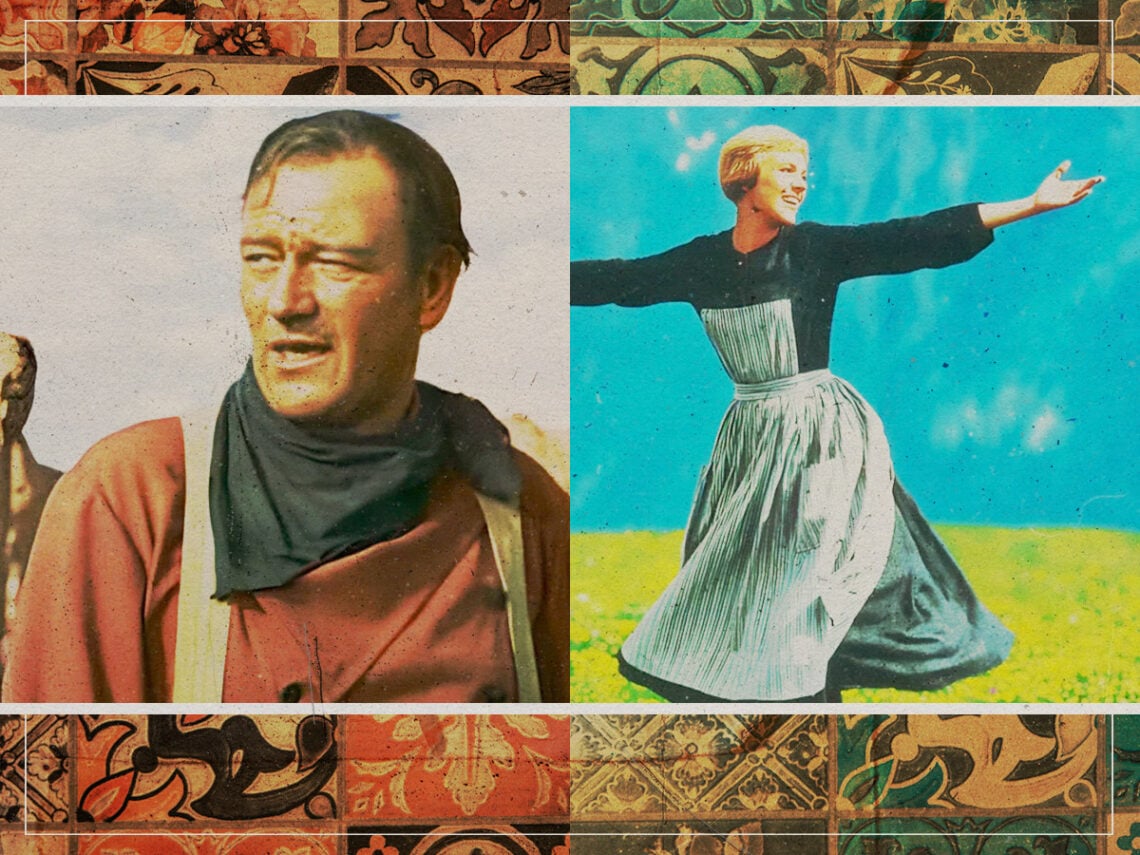
Why John Wayne thought Julie Andrews’ career “fell flat on its face”

There’s not exactly a lot that John Wayne and Julie Andrews have in common, but despite that, he still felt the need to single her out as being endemic of the issues Hollywood was facing as the end of the 1960s began to usher in a brand new era for cinema.
‘The Duke’ rose to superstardom as the embodiment of on-screen Americana and the stoic face of the western genre, but when the industry began to focus its attention on more socially and politically-conscious stories that sought to push the boundaries of established convention, he absolutely hated it.
Wayne was no stranger to railing against the way the industry he’d dedicated his life to became increasingly concerned with avoiding the very aspects of the medium that had helped him forge such an illustrious career, with Andrews winding up right in the crosshairs through no fault of her own.
Exploding onto the scene, the Mary Poppins star achieved a remarkably rare feat when her first-ever role in a feature film won her an Academy Award for ‘Best Actress’, transforming the English actor and singer into a global sensation. Receiving another nomination in only her third big screen credit in The Sound of Music, Andrews was keenly aware that she was in danger of being typecast.
In order to showcase new sides of herself as a performer, she began to take on a number of parts that were as far away from the magical nanny and Maria von Trapp as possible, but Wayne wasn’t a fan. Although he doesn’t name the specific movie that left him so affronted, he suggested that the current complexion of the film business had convinced her to try her hand at becoming a sex symbol.
“Take that girl, Julie Andrews, a refreshing, openhearted girl, a wonderful performer,” The Duke told Roger Ebert. “Her stint was Mary Poppins and The Sound of Music, but she wanted to be a Theda Barra. And they went along with her, and the picture fell on its face. A [Samuel] Goldwyn would have told her, ‘Look, dear, you can’t change your sweet and lovely image.'”
Bara was one of the silent era’s most prominent sex symbols and earned the nickname of ‘The Vamp’ for the number of femme fatale characters she played. Looking at Andrews’ filmography between The Sound of Music and Wayne’s comments in June 1969, though, it’s hard to figure out exactly which feature he’s talking about.
Andrews played the assistant and fiancée of a rocket scientist in Alfred Hitchcock’s Torn Curtain, the wife of a 19th century missionary in Hawaii, the naïve title character in musical rom-com Thoroughly Modern Millie, and the famed Gertrude Lawrence in biopic Star!. The latter was the only one of them to flop at the box office to a major extent, and it would be a stretch to suggest she was in full-blown sexpot mode in any of them.
Still, when ‘The Duke’ took it upon himself to lambast how “stock manipulators” had taken over Hollywood despite the fact “they don’t know a goddamned thing about making movies,” he clearly felt Andrews was fair game.
