


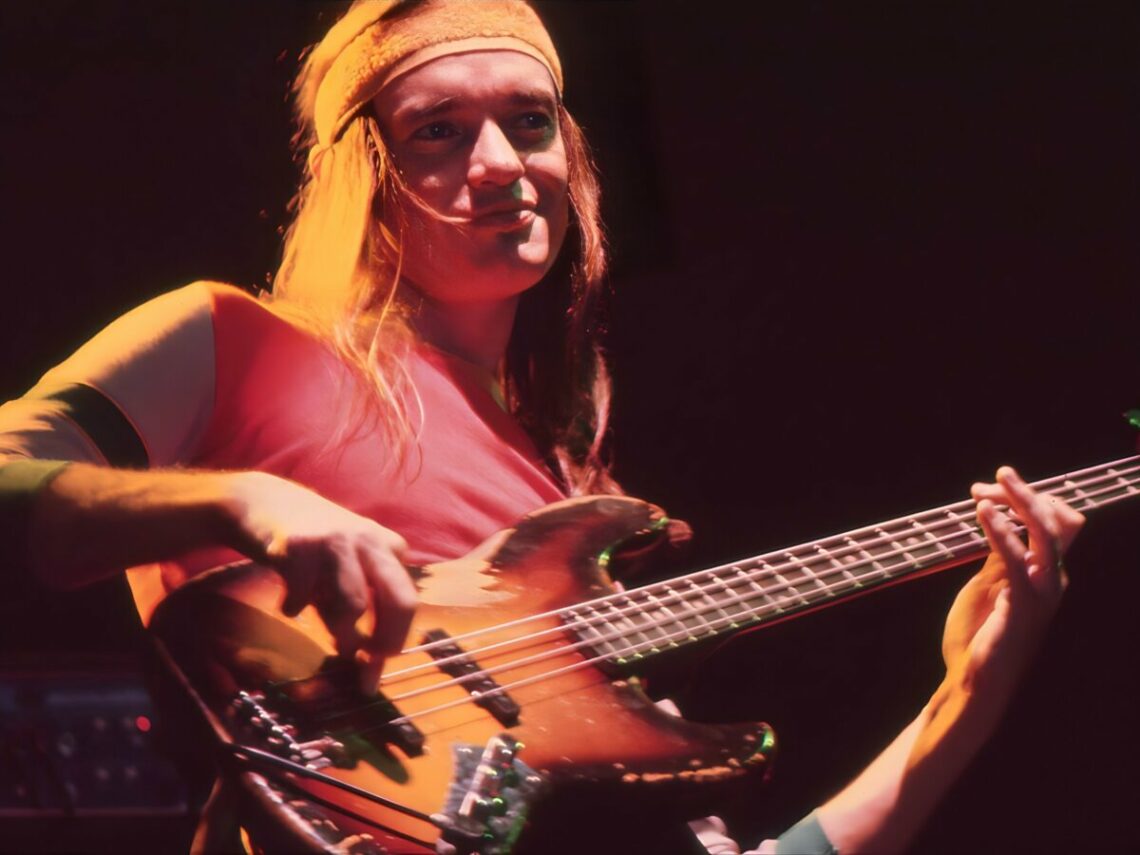
Why did Jaco Pastorius switch to the fretless bass?

Only a select few can be considered the true bass-playing greats, with the likes of Carol Kaye, James Jamerson, Bootsy Collins and Flea some of the most influential to pick up the instrument. Then we have the late Jaco Pastorius, one of the most technically gifted boundary-pushers the four-string has ever seen. His undoubted ability propelled the bass into a more cerebral space and redefined it for the modern era.
Fusing funk and jazz, Pastorius drew on various genres and employed harmonics, chords and lyrical solos to establish his style, which is regarded as the pinnacle of bass playing. As one of the ultimate virtuosos, the likes of Victor Wooten and Robert Trujillo wouldn’t be the masters they are today without his efforts. Pastorius made his name in the 1970s and ’80s as a solo artist and leader of jazz fusion heroes Weather Report. In his short life and career, he was highly prolific and collaborated with various celebrated musicians, including Joni Mitchell, Pat Metheny, and Mike Stern.
Pastorius was a key player in facilitating Joni Mitchell’s transition to the jazz-influenced, unrestrained music of her post-countercultural years. He worked on four of her albums between 1976 and 1980: Hejira, Don Juan’s Reckless Daughter, Mingus, and Shadows and Light. His most notable appearance with the Canadian songstress, however, came on Hejira, with his now-iconic fretless bass playing overdubbed on four of the songs, including the opener ‘Coyote’.
Effusing about Pastorius’ undoubted skill whilst also noting the darker side to his personality – including the drug addiction and attitude that played a role in his September 1987 death aged 35 – Mitchell told Musician Magazine in December that year: “He was an innovator. First of all, he was changing the bottom end of the time, and he knew it. With that went a certain amount of confidence, which at its worst was offensive to some people.”
She continued: “It didn’t offend me. His drug problem hadn’t begun. You take a big flaming juicy ego like that and add drugs to it-it’s no good. I mean, Freud thought he’d made great breakthroughs treating inferiority complexes with cocaine. Imagine what it does to add that to someone who’s already Mr. Confidence!”
Whilst Pastorius was a complex character, it is the effervescence of his bass playing that he is primarily remembered for, and rightly so. In a clip from Pastorius’ 1985 instructional video Modern Electric Bass that tutoring hub Scott’s Bass Lessons recently unearthed, the bassist explains why he switched from using a standard bass to the fretless Fender Jazz model dubbed the ‘Bass of Doom’. Arguably, this was the most significant moment in his career. Two things influenced the decision; the desire to emulate the sound of the upright, and necessity, thanks to the baking hot Florida sun destroying his upright.
Pastorius explained: “I took the frets out of my bass, you know, because I was getting into jazz a lot, and I wanted to have that upright sound, you know? So, I had an upright; it took me years and years to get enough bread to get it. I’m from Florida… So one morning, I woke up, went to the corner, and the bass is in like 100 pieces, you know, because the humidity’s so bad. I mean, the upright just blew up. I said, ‘Forget it, man, I can’t afford this anymore.’ So I went out, got a knife and took all the frets out of my Fender.”
Watch the clip below.
