


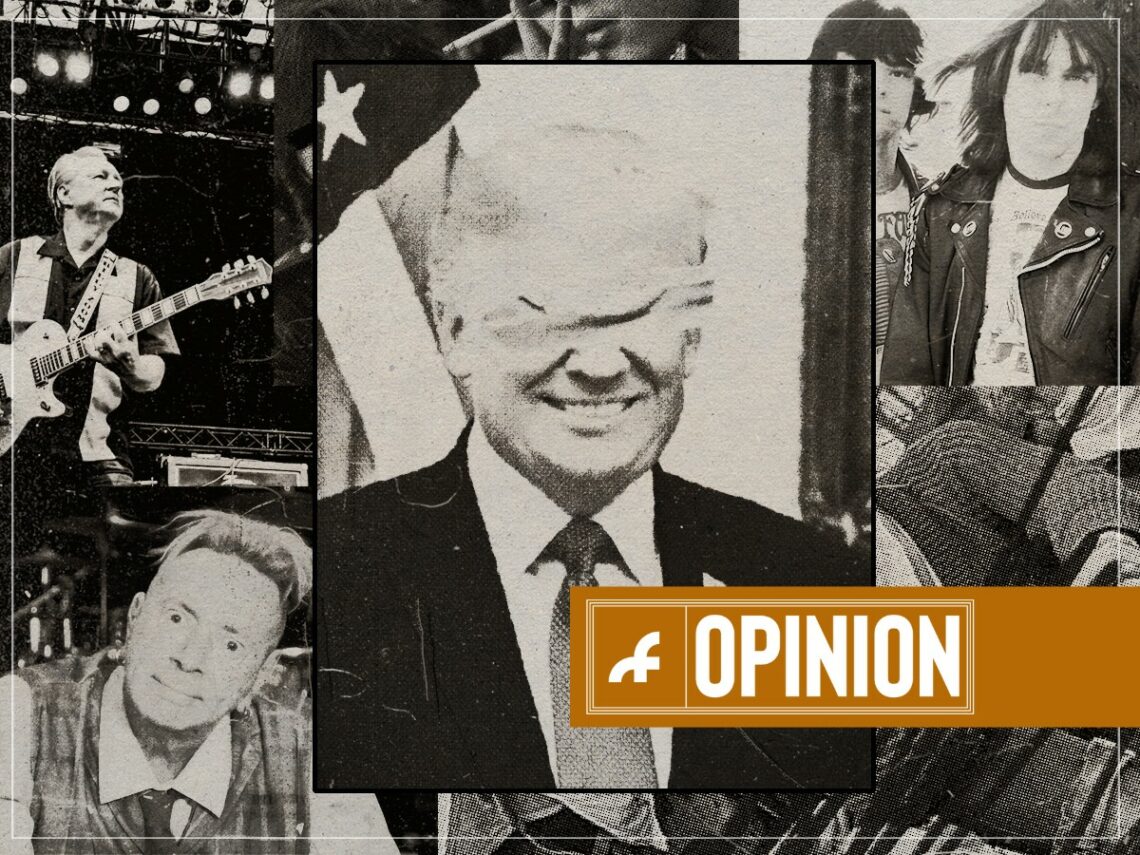
Why does punk appeal to the right-wing?

Since the Sex Pistols burst onto the scene with their debut single in 1976, ‘Anarchy in the UK’, punk has been inextricably linked to left-wing politics. After all, in the song, frontman Johnny Rotten admits in the introductory verse, “Oh I am an anti-Christ / And I am an anarchist”, before outlining his vision for the world, which involves the destruction of what he perceived to be right-wing and establishment incarnations.
Despite the overtly anarchic parameters of the debut Sex Pistols single, punk’s relationship with left-wing politics has taken on many forms. Perhaps the most varied subculture, at its core, punk is concerned with a host of concepts. Most common are themes such as mutual aid, class, anti-war, anti-corporatism, gender and racial equality, animal rights, free thought and non-conformity. Mostly, these topics fall under the left-wing bracket for a host of different reasons.
One of the central tenets of punk at its base is also a rejection of the mainstream and corporate mass culture and its values. It is also a dynamic subculture in that it evolves with the times. From the work of bands such as The Clash and Dead Kennedys in the early days to today, you can still see the left-wing philosophical strand alive and well, even if the music is very distinct.
Famously, The Clash frontman Joe Strummer sang about racism and wealth distribution in ‘(White Man) In Hammersmith Palais’ and ‘White Riot’ in 1977, with other groups of the first wave echoing this sentiment. Following this point, today, groups at the scene’s forefront still maintain a left-wing edge. This ranges from hardcore supergroup God’s Hate discussing killing white supremacists in ‘Finish the Job’ to the all-Black powerhouse Zulu addressing racism, disenfranchisement, racial injustice and police brutality. Clearly, then, the left-wing essence of punk is still very much alive in contemporary times and has taken more forms than ever, given the sonic development of the genre.
Although punk is ostensibly left-wing, thanks to many of its major players fitting into the category over the years, it doesn’t necessarily lend itself to a particular political ideology. It is said that the prevalent leftist angle is due to the dominance of liberal ideas in the mainstream. Therefore, whilst it is mainly anti-establishment in a left-wing sense because of the issues at hand, there is also significant room for the movement and its many offshoots to appeal to the right wing. There have been various notable figures and bands who have been self-professed right-wingers over the years. With that, some of the aforementioned concepts are also important to right-wing politics.
Although the number of left-wing punk artists outweighs those on the right, a host of renowned names have rejected liberalism, socialism, communism and leftist anarchism and provided credible reasons for doing so. The most famous of these is Ramones guitarist Johnny Ramone, a man credited with establishing the quintessential punk guitar sound in a group hailed for crystallising some of the genre’s core features.
Also fitting into this set are the likes of Forgotten Rebels, X guitarist Billy Zoom, and former Misfits frontman Michael Graves, who Reuters reports has connections to the Proud Boys and was in Washington, D.C. on the day the Capitol was stormed in 2021. Furthermore, even Johnny Rotten himself – now known as John Lydon – has recently expressed Conservative views in an inversion of the musical themes of Sex Pistols.
Johnny Ramone managed to hide his political persuasion from the public until 2002, a time when it all came spurting out as Ramones were inducted into the Rock and Roll Hall of Fame. With 9/11 fresh in the memory and him knowing he was on a major platform, the bowl-cutted axeman proclaimed: “God bless President Bush, and God bless America.”
Whilst most fans were shocked at Ramone’s admission of his Republicanism, that was misplaced. He was so outraged at his bandmates for penning the 1986 classic ‘Bonzo Goes to Bitburg’ – a critique of then-President Ronald Reagan after visiting a Nazi cemetery in Germany – that he forced them to change the name to ‘My Brain Is Hanging Upside Down’.
Johnny Ramone explained to the Washington Times why he said what he did at the Hall of Fame and why he was a Republican. “I said that to counter those other speeches at the other awards,” he commented. “Republicans let this happen over and over, and there is never anyone to stick up for them. They spend too much time defending themselves.”

“It was in 1960, the Nixon-Kennedy election,” he recalled to the publication, claiming that he first realised he was a Republican aged just 12 years old. “People around me were saying, ‘Oh, Kennedy’s so handsome,’ and I thought, ‘Well, if these people are going to vote for someone based on how he looks, I don’t want to be a party to that.”
He added: “People drift towards liberalism at a young age, and I always hope they change when they see how the world really is.”
Johnny Ramone was so right-wing that his bandmates nicknamed him the “Rush Limbaugh of rock-n-roll” in reference to the prominent commentator. He even listed his ten favourite Republican figures of all time, a collection including Richard Nixon, Arnold Schwarzenegger and Vincent Gallo.
Following his death in 2004, the conservative magazine National Review relayed an anecdote depicting the punk legend’s political stance in action. Allegedly, after he heard Slim Jim Phantom of the Stray Cats complaining about high taxes, Ramone told him the charges would be higher without the Bush tax cuts. “I told him he needs to vote Republican to keep his taxes lower–and donate to President Bush’s campaign,” he said.
In 2008, Ramones drummer Marky Ramone told NME that Johnny Ramone wasn’t his only bandmate to find themselves on the right wing of politics. According to him, bassist Dee Dee was also a staunch Republican to the point that the pair were “fanatics”. He said: “I’m a Democrat, Joey was a Democrat. Johnny and Dee Dee were staunch, avid right-wing conservative fanatics. Our political views were definitely different.”
Meanwhile, during a 2004 interview, Billy Zoom, the guitarist of influential Los Angeles punks X and an open Christian, reluctantly explained his right-wing leanings. Following questioning about his religion in light of being raised an atheist, he said: “It’s something you have to experience for yourself. I don’t try to push it on other people. If somebody’s interested, I’ll talk to them. But uh… The political part is hard to answer too, except that I like – No, the political part’s actually easier.
He continued: “I am not a Republican; I am a Conservative. The Republican Party is a political party, and I think all politicians are basically full of crap. However, I lean towards Conservative values because, basically, what I want is a government that provides national defence so that we are free to do what we want within our borders and that keeps criminals off the streets so we’re free to do what we want in our homes, and that provides a fire department to help fight a fire if my house is burning down. And basically, other than that I kinda want ’em to stay out of my life. I’m a big fan of things like freedom and liberty, and I see those as being Conservative values, and I see Liberals as wanting to have a bigger government that sticks their nose in everybody’s business and takes away our freedoms.”
Asked if he liked the incumbent President George W. Bush, he said: “I like him, okay. I know a lot of people really hate him, but I don’t know. I’m disturbed to see people getting so bent out of shape and in peoples’ faces about it, because it was my understanding that the whole point of a democracy is that everybody is entitled to their opinion, and in matters involving voting, the electoral majority rules. You should basically respect peoples’ rights to disagree with you.”
Zoom made a strong point at the end. As with anything personal that manifests in a democracy, whether it is opinions on different styles of music or political ones, there is a diverse array to be had as a natural byproduct of what such freedom of thought allows. Accordingly, punk is a widely mixed area with many different motivations emerging as it’s developed with the times.

Johnny Rotten forsook the left-wing punk norm more objectionably in a shouting match with host Susanna Reid on Good Morning Britain in 2020. Explaining his decision to advocate for Donald Trump in the US election, the punk pioneer said his support for the Republican candidate was a rejection of “intellectual, left-wing ideas”. This stance loudly echoes the earliest punk ethos of anti-establishmentarianism and spurning the mainstream, even if it disregards the other critical left-wing foundations of the genre.
“I’m working-class English; it makes complete sense to me to vote for a person who actually talks about my kind of people,” he expressed, missing the irony of what he was saying.
“Trump’s not a politician. He’s never claimed to be. How unusually, exceptionally wonderful is that for people like me?” Maintaining that the public was bored of “intellectual, left-wing ideas”, he continued: “We can’t take much more of you, you talk twaddle. Everything you do, you just miss the point of who the general population are.”
Not finished there, Lydon asserted that the Democratic Party do “nothing for these people”, adding: “This is why they now support him so loyally because he’s the only hope. You can call him a narcissist, you can call him nasty, he can do many different things, this fella’. But he’s the only hope because the system as usual, is an S-H system.”
Following on from this, things can get even more extreme. As is well known, for decades, Nazi punk has been running concurrently with the broader movement. Pushing a white nationalist ideology and starting Rock Against Communism as a reaction to the gregarious and vital Rock Against Racism, the reasons people advocate this dark facet of the subculture need no explanation.
I’ll leave the commenting to the former Dead Kennedy’s frontman, Jello Biafra, who penned the most famous reaction to this subgenre in the 1981 classic ‘Nazi Punks Fuck Off’. Regardless of being left or right-wing, I’m pretty sure most punks of a humane disposition would agree with the central message of the following lyrics: “Punk ain’t no religious cult / Punk means thinking for yourself / You ain’t hardcore ’cause you spike your hair / When a jock still lives inside your head”.
Through his customarily surreal Yippie lense, Biafra states later in the song: “You still think swastikas look cool / The real Nazis run your schools / They’re coaches, businessmen and cops / In a real fourth Reich you’ll be the first to go”. Of course, this is all ensued by the classic refrain, “Nazi punks, fuck off!”
In terms of punk appealing to the right wing, it’s a natural part of a society that champions free speech and different opinions; as Biafra said, punk is about thinking for yourself. Whilst you might not agree with those on the left or right regarding the latter outlook, there will always be those in society who are fiscally, socially or religiously conservative, or all three together. In theory, these people are equally entitled to subscribe to a genre as those on the opposing side of the fence, despite how frowned upon their outlook may be.
Considering the right’s inherent propensity for being supposedly anti-establishment, it makes sense that some punks should support it, regardless of the satirical proportions of such a position. In recent years, it’s also been claimed that being right-wing and conservative is even the new counterculture, but that’s another topic entirely.

Never Miss A Beat
The Far Out Punk Newsletter
All the latest Punk content from the independent voice of culture.
Straight to your inbox.