


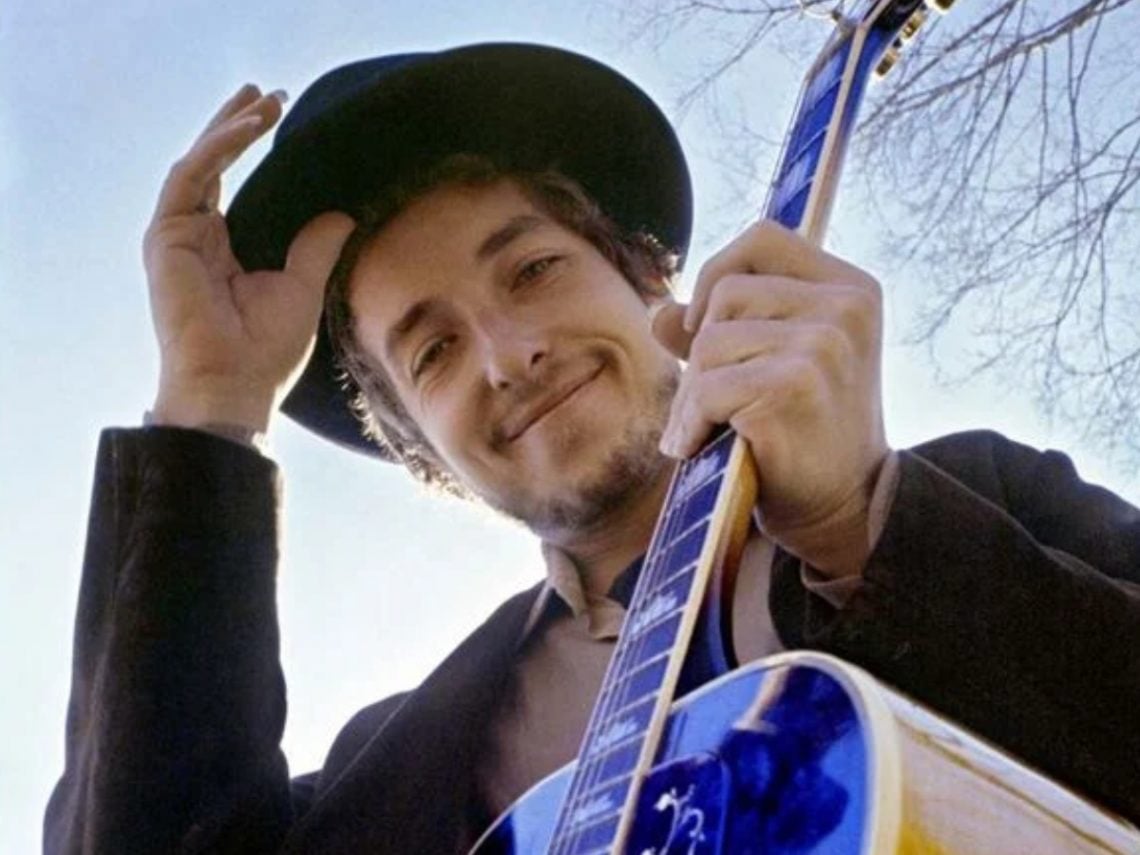
Why does Bob Dylan sound different on ‘Nashville Skyline’?

Bob Dylan’s self-titled debut album was released in 1962; by the time Nashville Skyline came around in 1969, he had already released eight studio albums, found himself adorned as the ‘voice of a generation’ and started to retreat from the limelight. For many, this would represent a career beyond reach; for Bob Dylan, it was all condensed into seven years that seemed to go by in some sort of paradoxically adrenalised somnambulant state.
Therefore, it is no surprise that Nashville Skyline found him in a more reflective voice. However, it wasn’t just his ‘voice’ in terms of an increasingly inward and introspective philosophy that had changed. His vocals seemed to have literally transformed, too. David Bowie once dubbed him a singer with a “voice of sand and glue,” but for this country-inclined record, his pipes had been jetwashed.
You don’t have to trawl through everything the great man has said to find evidence of Hank Williams’ impact on him. Never a man to shy away from shining a light on his influences, Dylan has continually cited Williams and other country stars as being central proponents of his musical inspirations. Nashville Skyline saw him dive in with an impassioned embrace. He leapt onto a big brass bed with the country stylings that he had been flirting with off and on throughout his career. And he lavished them with a fittingly honest vocal tone.
With the aforementioned big brass bed in mind, Dylan’s new crooning style sang out the clearest on the song ‘Lay Lady Lay’, which he wrote for the movie Midnight Cowboy. He smoothly sails through the lyrics in a self-evident departure from the near-rapping style of old. He doesn’t sound anywhere near as coarse to such an extent that, at the time, many wondered whether it was even him singing.
So, why does Bob Dylan sound different on Nashville Skyline?
When asked about this new baritone sound, his explanation was simple, “I tell you,” he told Jann Wenner, “You stop smoking those cigarettes, and you’ll be able to sing like Caruso.” In a nervous haze, Dylan had smoked copious amounts of tobacco as he attempted to deal with fame, but now he was trying to settle into a more sober existence, and his sweet pipes proved it was positively impacting his health.
Now that Dylan’s larynx was freed from choking on smoke, he was able to smoothly pipe out sounds that sat harmoniously alongside Johnny Cash’s dulcet tones on the record’s version of ‘Girl From The North Country’. It wasn’t just Dylan striving for something less pointed here, but genuine science.

How does quitting smoking impact your voice?
According to the Center for Vocational Health, the impacts of quitting smoking on your voice unfurl almost immediately. ”At 1-2 weeks: reduced fatigue of the voice. At 3-4 weeks: improved vocal range. At 4 weeks: improved power and endurance,” they report. Conversely, smoking literally causes a swelling of your vocal cords and polyps to form. This results in a drier, deeper, rougher sound.
Dylan’s careworn vocal cords were no doubt also altered by the fact that prior to Nashville Skyline, he enjoyed what essentially seemed to be his only spare five minutes of the decade. Although the gruff sound would return on later albums, the notable transition to silky tones on Nashville Skyline suits the record’s message of “Love and only love” down to an Adagio tee.
Dylan’s atypical coarse vocal style, which David Bowie perfectly encapsulated, may well have served him perfectly on his eponymous protest pieces, but the sultry delivery on this occasion resulted in one of his very best records. What’s more, there’s an undeniable health benefit for Dylan, to boot—an essential boon when you’ve played as many shows as he has.
You can hear him croon out, ‘I Threw. It All Away’, the song Nick Cave “wish he wrote” on his dear friend Johnny Cash’s TV Show below.

Never Miss A Tale
The Far Out Bob Dylan Newsletter
All the latest stories about Bob Dylan from the independent voice of culture.
Straight to your inbox.