


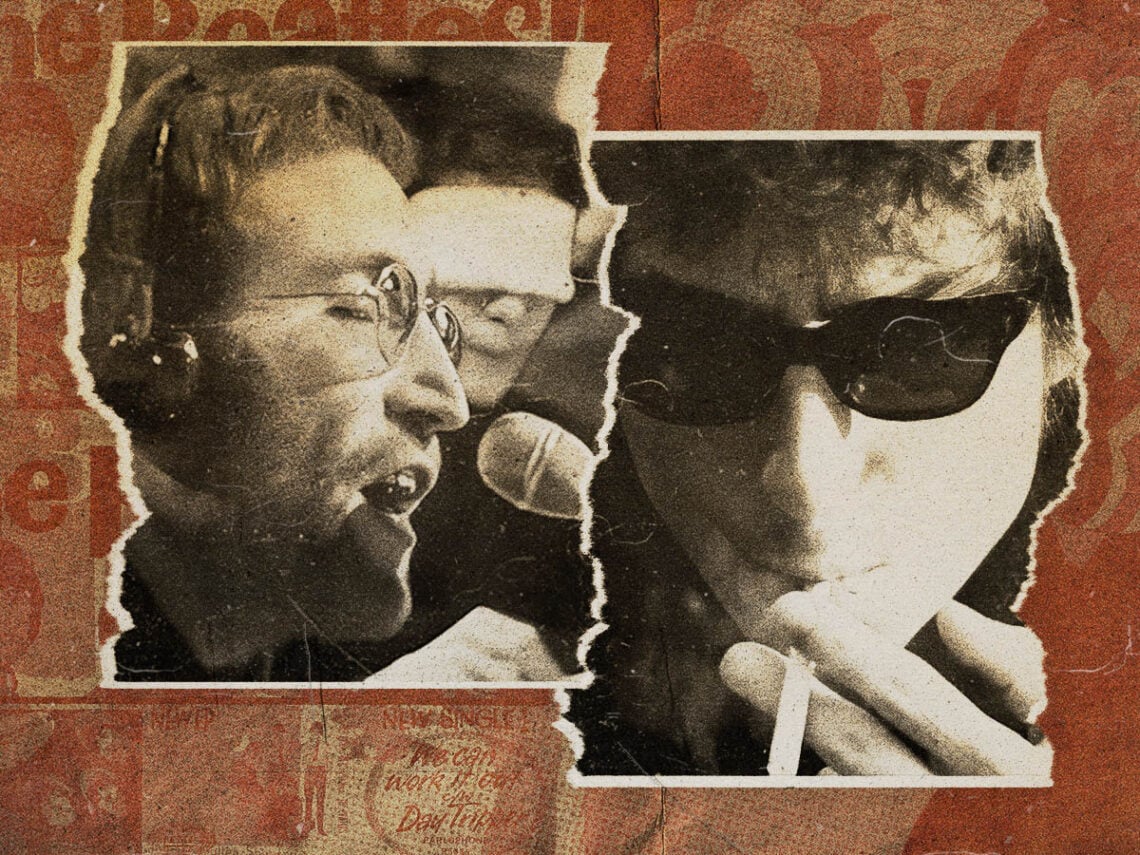
Why did Bob Dylan refuse to admit he liked The Beatles?

Although they reigned supreme concurrently, Bob Dylan and The Beatles shared a peculiar, somewhat one-sided dynamic.
The Beatles held Dylan in high regard, openly acknowledging his profound influence on both their individual artistry and the music landscape as a whole. However, Dylan exhibited reticence when it came to reciprocating this adoration, even though he equally harboured a secret admiration.
John Lennon, in particular, was hugely impacted by Bob Dylan’s musical style, actually openly admitting that many of his hits were written in an attempt to emulate his idol. During his “Dylan period”, Lennon wrote the likes of ‘I’m A Loser’, ‘You’ve Got To Hide Your Love Away’, ‘Norwegian Wood’ and ‘I Am The Walrus’.
Paul McCartney, too, once stated that Dylan was The Beatles’ biggest hero, labelling him as “our idol”, reflecting on the significant impact he had on the band. “I could feel myself climbing a spiral walkway as I was talking to Dylan,” McCartney added. “I felt like I was figuring it all out, the meaning of life”.
Despite channelling Dylan’s signature country and rock-infused sound, Lennon turned his back on Dylan in later years, calling out the act of blindly following others. When discussing ‘I Am The Walrus’, Lennon said: “The reference to ‘Element’ry penguin’ is the elementary, naive attitude of going around chanting, ‘Hare Krishna’ or putting all your faith in any one idol. I was writing obscurely, a la Dylan, in those days.”
Later in the same interview, Lennon discusses Dylan’s ‘Subterranean Homesick Blues’, stating: “Listen, there’s nothing wrong with following examples. We can have figureheads and people we admire, but we don’t need leaders. ‘Don’t follow leaders, watch the parking meters’.”
For Dylan, he met and became friends with all four members of the band, but expressing his appreciation for their music was a different story. The two rose to fame roughly around the same time, and in 1963, Dylan released his second studio album, The Freewheelin’ Bob Dylan, which consisted mostly of political songs, instating his reputation as a folk singer.
Dylan has repeatedly acknowledged that the album was responsible for kicking off his mainstream success, which The Beatles also took notice of. For the latter, 1964 would see the international rise of ‘Beatlemania’ and the release of largely enduring hits like ‘Love Me Do’ and ‘She Loves You’.
The Beatles were impressed with Dylan’s contributions to the industry, and the singer was equally as inspired by the Fab Four’s ability to secure mainstream adoration. In 1972, Dylan told Rolling Stone that The Beatles “were doing things nobody was doing”, adding: “Their chords were outrageous, just outrageous, and their harmonies made it all valid. You could only do that with other musicians.”
However, he didn’t want to admit that he was a fan for fear of seemingly jumping on the bandwagon. “I just kept it to myself that I really dug them,” he said.
Dylan added: “Everybody else thought they were for the teenyboppers, that they were gonna pass right away. But it was obvious to me that they had staying power. I knew they were pointing the direction of where music had to go. I was not about to put up with other musicians, but in my head The Beatles were it. In Colorado, I started thinking it was so far out that I couldn’t deal with it — eight in the top ten.”
While The Beatles were heavily influenced by Dylan, and Dylan appreciated their work, he didn’t learn much from the Liverpudlians and rarely spoke about the band in public. Had Dylan been more forthcoming on their influence and the friendships he once had, the story may have turned out differently.
The Beatles’ road manager, Neil Aspinall, said that Dylan “liked to say how much The Beatles learned from him. John used to mutter, ‘he learned a bit from us too’”.
Although the two acts engaged in small drippings of companionship and mutual respect in the early years, by the end of the 1970s, their relationship had soured, and Lennon criticised him as someone who was only in it for commercial success.

Never Miss A Beat
The Far Out Beatles Newsletter
All the latest stories about The Beatles from the independent voice of culture.
Straight to your inbox.