


Why David Crosby thought his most “important political song” was also his most “juvenile”

Many critics believe it was Neil Young who brought the darker sonic edge to Crosby, Stills, Nash and Young, but in dubbing him with that honour, fans are overlooking the role of David Crosby, who despite getting on board with the sun-kissed harmonies of the band’s early work, could also plug in and amp up the intensity just as good as Young.
Famously cantankerous and uncompromising, Crosby represented somewhat of a hippie contradiction. Within musical circles, he was well known for his blunt and outspoken nature, which warranted him the nickname of the ‘Old Grey Cat’, and so, with a reputation so far removed from the laid-back, easy-going nature of the hippie movement, it was hard to picture him at the forefront of this new liberal resistance.
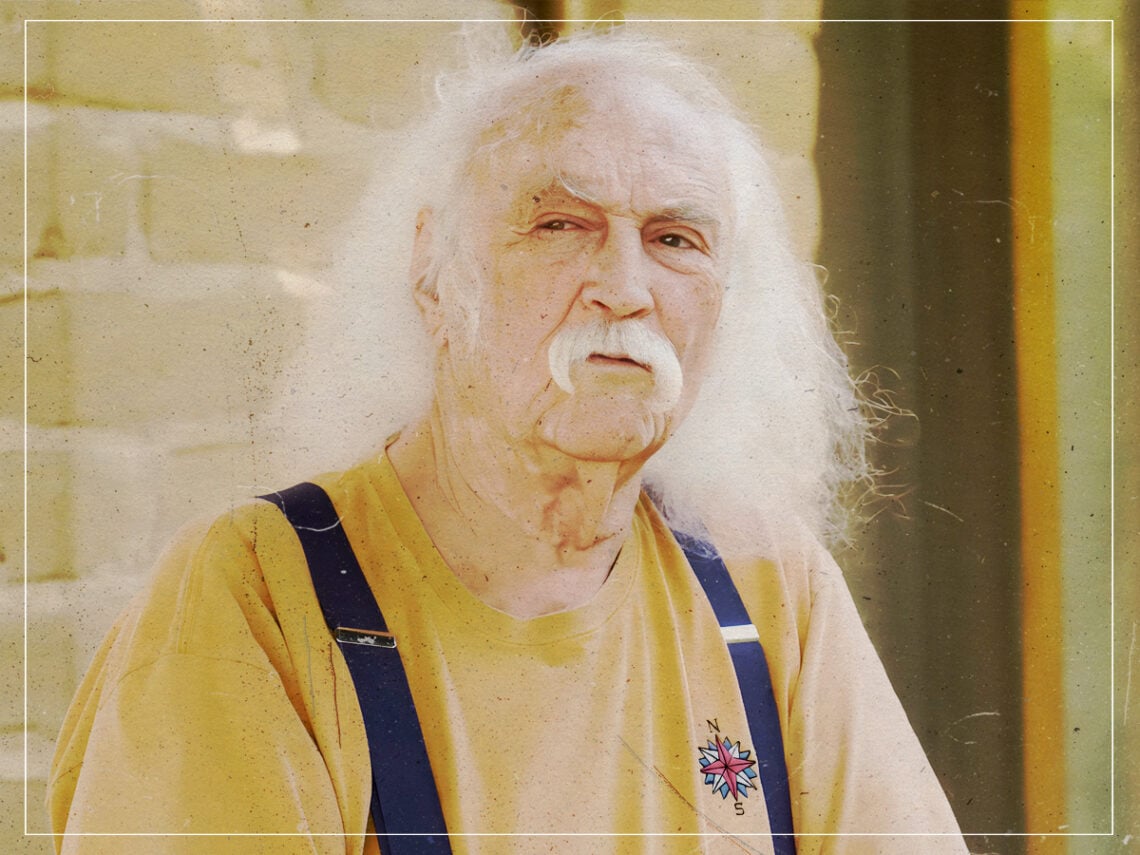
But, he was, with his bushy moustache and free-flowing locks, buying into the ideals of the counterculture movement, known widely as a champion of Woodstock 1969, or the counterculture “big bang” as Crosby called it.
He said, “Because the important thing about it wasn’t how many people were there or that it was a lot of truly wonderful music that got played. The important thing was it’s the moment when all of that generation of hippies looked at each other and said, ‘Wait a minute, we’re not a fringe element. There’s millions of us! We’re what’s happening here!’ It was that self-awareness, you know, that, up to that point, it really hadn’t happened.”
On that famous weekend, Crosby played alongside Stephen Stills and Graham Nash, in the original line-up of the band, celebrating the unwashed freedom of hippie culture. Inhibitions were thrown to the wind, clothes were stripped off, and, more crucially, hair was left uncut throughout the sea of faces that stared back at their stage.
As these fans held something of a mirror back up at Crosby, it dawned on him that the essence of his brave new movement was in the reluctance to cut their hair, despite societal norms and from that came one of his very best songs for the band.
Lamenting on the identity crisis that would come from shearing his signature tresses, ‘Almost Cut My Hair’ sees Crosby passionately defend the meaning of his look and how changing it would be to cower to structural demands. Lyrically, though, it represents the very surface level of the hippie resistance, which is why he has gone on to criticise it too, noting, “It was the most juvenile set of lyrics I’ve ever written, but it has a certain emotional impact, there’s no question about that”.
Ultimately, his remarks are true, as the lyrics are somewhat rudimentary when it comes to articulating resistance, but there was something in the vocal performance and heavy rock arrangement that made it a stirring and compelling anthem.
Young was right when he said it was “Crosby at what I think is his best”, for it showed how he could bring a much-needed sense of intensity to the otherwise delicate nature of the band, and sure, the sentiment may have been trivial, but there was a deep sense of authenticity that existed within what he was saying, which allowed him to find his voice of leadership within the band.
