


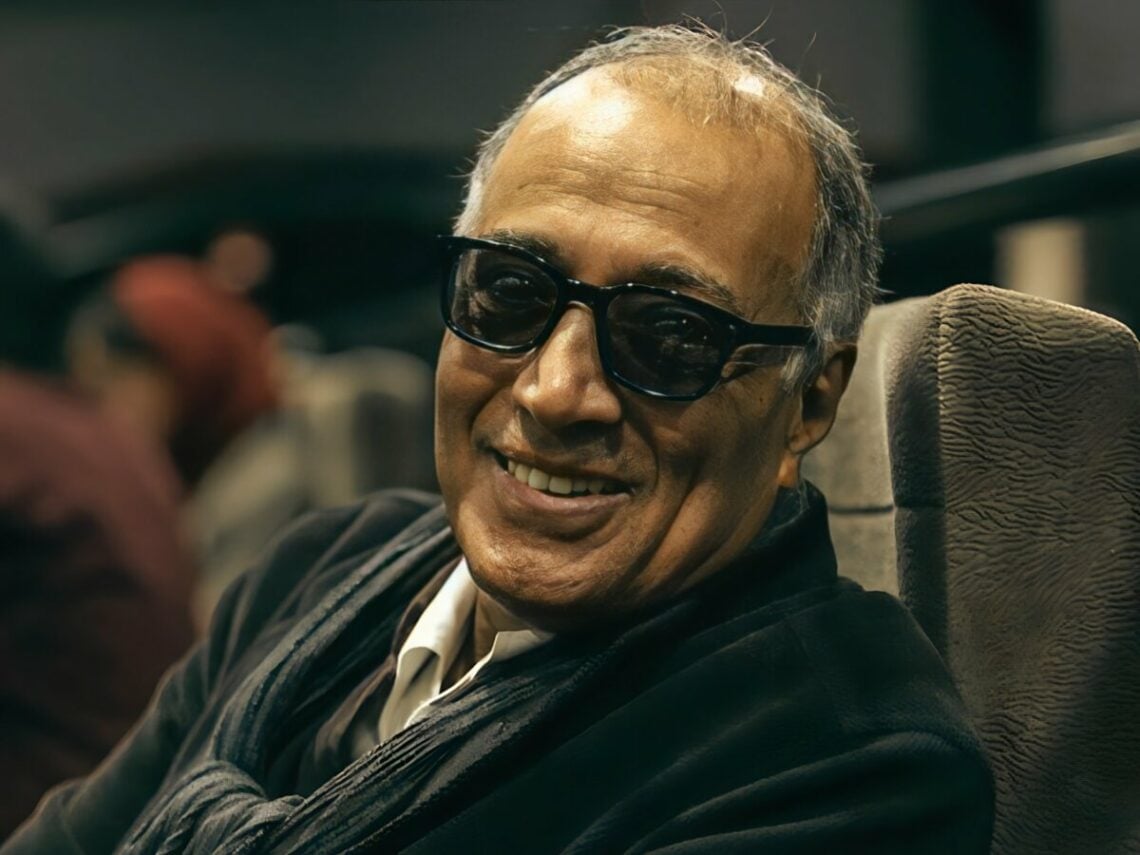
Abbas Kiarostami and the similarities between filmmaking to football: “Arbitrary choices”

The Iranian New Wave had a monumental impact on the way directors around the world approached their craft, propelled by the efforts of pioneering filmmakers such as Dariush Mehrjui and Mohsen Makhmalbaf, who completely changed the game. However, the movement wouldn’t have been the same without the efforts of one particular auteur: Abbas Kiarostami.
Known for his unique incorporation of documentary stylisations and fictional elements in his cinematic vision, Kiarostami played a significant part in redefining realism in Iranian cinema. Through masterpieces such as Close-Up, he used reality as a mere foundation upon which he based his dizzyingly complex investigations of the medium itself.
This tendency to use the lens of cinema to transform reality into something that is recognisable yet strange is also evident in his acclaimed Koker trilogy. Starting with a simple but moving story about the innocence of friendship in Where Is the Friend’s Home?, Kiarostami eventually ventured into metafictional explorations following an earthquake that left the region severely damaged in 1990. It’s these oscillations between fiction and facts that define Kiarostami’s singular voice, establishing a new form of cinematic truth.
In a conversation with Filmmaker, the Iranian auteur was once asked about the unique narrative structures that he employs in his works and whether they really represent a totality within the context of the storytelling. Interestingly, the Close-Up director compared his approach to filmmaking to a game of football, claiming that the fundamental principles that govern his narratives are rooted in both randomness and responsibility.
Kiarostami explained: “The starting point and the ending point are nothing but two arbitrary choices. You make them as in soccer games, where they chose that it’s 90 minutes, not less and not more. They’re arbitrary, but I guess it’s based on the attention span of viewers, of soccer games and of movies. But the choices are the responsibility of the filmmaker. You have to choose to join the story at an arbitrary point, and you leave it at an arbitrary point.”
Elaborating on his point, the Iranian filmmaker added: “As long as I take the responsibility of the choice, I have to make the choice that is as right as possible. Of the hundreds of points to enter and exit that are offered to me, I have to choose the one that I feel is the least wrong, the least fake. It is fake, it is a moment that I choose to erupt the story, but I make it as smooth as I can. What enables me to do it is the skill of filmmaking.”
It’s a fascinating perspective which accurately describes the nuanced way in which Kiarostami viewed the rigid lenses of realism. The finest example of this is his 1997 opus Taste of Cherry, following the efforts of a man who drives looking for someone to bury him after he finally gathers the courage to kill himself. While some who haven’t seen the film might expect that death would bring the narrative to its natural end, Kiarostami subverts all expectations by breaking the fourth wall and revealing the fundamental fiction of cinema.
