


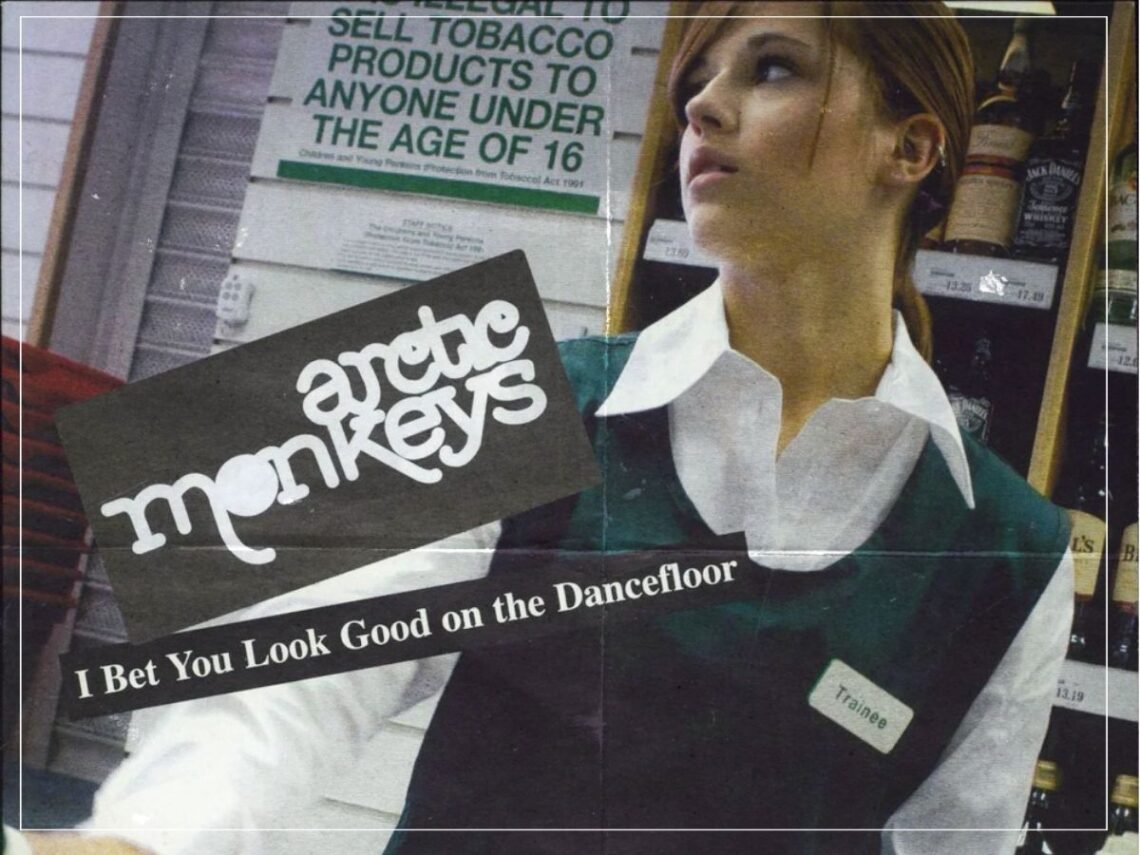
Who was on the cover of ‘I Bet You Look Good on the Dancefloor’?

“Stop making the eyes at me, and I’ll stop making the eyes at you,” Alex Turner drawls in the opening lines of the Arctic Monkeys’ ‘I Bet You Look Good on the Dancefloor.’
Opening with a clash of mangled riffs, the song enraptured early fans on the internet, who file-shared the free CDs they received at the Monkeys’ gigs. Through word-of-mouth, the fans’ insistence transformed the lives of the four-piece band, and suddenly, they grew from a working-class suburb of High Green, Sheffield, into the UK’s unofficial saviours of garage rock.
An unexpected anthem, the tune is beloved by the most ardent Monkeys fans and largely disliked by its writer, Turner, who, speaking to The Guardian in 2005, just before the single’s release and in one of the band’s first interviews, apologised, “It’s a bit shit. The words are rubbish. I scraped the bottom of the barrel”.
In his self-deprecating humility, Turner foregoes what ‘I Bet You Look Good on the Dancefloor’ achieves best: a mirror of the heady, adrenalised nightlife that defined the post-work lifestyle in Britain. Its promise of “Just bangin’ tunes and DJ sets and dirty dancefloors and dreams of naughtiness” has soundtracked club nights for 20 years and continues to electrify the Monkeys’ live sets. Released on October 17th, 2005, with the B-sides ‘Bigger Boys and Stolen Sweethearts’ and a jam track, ‘Chun Li Flying Bird Kick’, the track catapulted to number one, remaining in the Top 100 for 31 weeks.
The single’s cover featured a candid photograph of a teenage supermarket cashier, wearing a green apron with a collared white button-down layered underneath, her face frozen in a disinterested glare. The girl was, in fact, a 16-year-old named Jessie May Cuffe, a schoolgirl who had snuck out of her home to go drinking with friends in Liverpool and was, by chance, photographed by the graphic designer who was tasked with capturing the song’s artwork.

Her initial photograph shows her smiling, which allowed her to stand out among the rest of the girls, and due to not having a mobile phone, she gave the photographer her mother’s landline number. Now Jessica Rickards, she told the BBC that instead of getting paid for her “first and only modelling shoot”, she received tickets to the Monkeys’ next gig, “but when you’re 16, you would rather have that”.
Rickards recounts how she met the band after the shoot, remembering Turner’s extreme shyness. “I never thought the song would have such a huge legacy,” she admitted, “I think I knew how big they were going to be when my mum went into HMV just after the single had come out and the whole wall was just my face.”
Rickards revealed that it was her mum’s motivation, after all, that landed her on the cover in the first place: “I was painfully shy, and I wasn’t even sure I would go through with it,” she explained, “but my mum told me to. It really boosted my confidence”.
The following year, the band would debut with their first album, Whatever People Say I Am, That’s What I’m Not, fulfilling the expectation of a cultural shift with songs that chronicled Turner’s stories of small-town debauchery soundtracked to raucous guitars, but ‘I Bet You Look Good on the Dancefloor’ was the permanent standout that immortalised Rickards.
In its own way, the inclusion of Rickards on the cover perfectly matches the charm of the song, capturing the coincidental nature of a night spent partying, not knowing you may encounter someone who will shift the trajectory of your life, even for just a fleeting moment.
