


Who was the first hit novelty band?

Novelty music is as old as our traditional heritage of old campfire sing-alongs and nursery rhymes.
The collective repertoire of hummable tunes we all know but could never pin a title to has penetrated Western culture deeper than much of the classical canon due to its musical simplicity, but also, once upon a time, its populist vignette or working-class humour.
‘Yankee Doodle’ pre-dates the American Revolution, a jaunty number sung by British forces mocking the stereotypes of unsophisticated yanks sticking a feather in their cap to pass off as upper class. Or, jumping to the 19th century’s nautical age, the rowdy ‘Drunken Sailor’ sea shanty would be bellowed by a crew to keep a brisk pace of the ‘hand, reef, and steer’ of the ship.
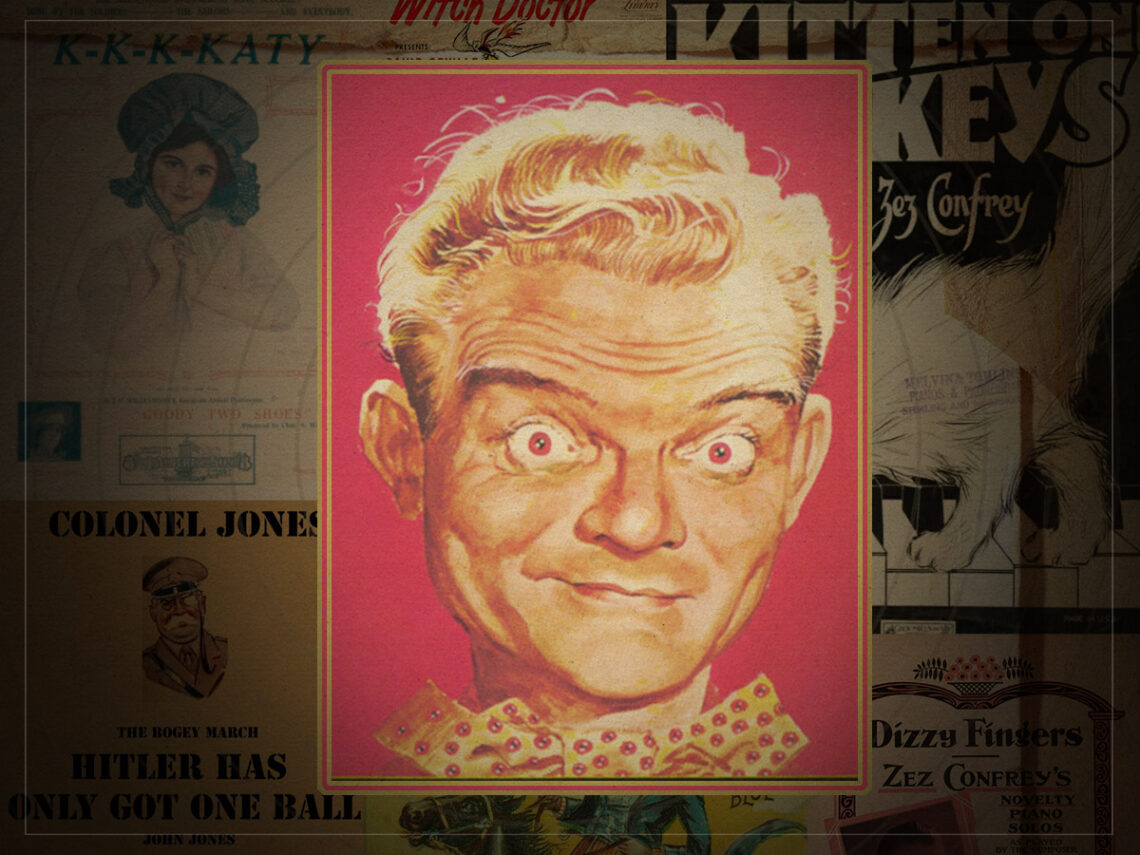
Music would evolve into a mass-produced industry by the turn of the century, and novelty numbers would remain ever as popular. Early Tin Pan Alley standards sung by Helen Kane would blur the lines between vaudeville comedy and straight-up novelty, silly numbers like ‘K-K-K-Katy’ and ‘I Wanna Be Loved By You’ providing the inspiration for Fleischer Studios’ Betty Boop character. As player pianos and phonographs became widely accessible, the ragtime musicians would pen gimmick numbers like Zez Confrey’s ‘Kitten on the Keys’, a piece played out as if a kitten were indeed playing on the keyboard, and ‘Dizzy Fingers’, a song deliberately written to be fiendishly difficult to learn.
War would provide a major audience for an uplifting novelty song. As the Second World War was heating up, morale was boosted by the British marching song mocking the Nazi leader in ‘Hitler Has Only Got One Ball’, and over in the States, Spike Jones’ ‘Der Fuehrer’s Face’ and Golden Gate Quartet’s ‘Stalin Wasn’t Stallin’’, all offered sorely needed light relief during the global conflict.
The 1950s would herald the novelty song as a lucrative business in and of itself. Patti Page’s ‘(How Much Is) That Doggie in the Window?’ would shoot to US number one in 1953, prompting novelty parody songs with tongues firmly in cheek by comedians and satirists Stan Freberg and Tom Lehrer. Dickie Goodman would pioneer sampling as well as the novelty single, 1956’s ‘The Flying Saucer’, a comedic mash-up of the day’s hits and triggering lawsuits from the artists pilfered.
Toward the end of the decade, David Seville’s sped-up cartoon ‘Witch Doctor’ jingle would spawn the Alvin and the Chipmunks franchise, the ingenious idea of taking contemporary hits, dialling up the vocals’ speed, and passing such amendments as the work of the fictitious rodent band. Such a success, The Nutty Squirrels were dreamed up as competition a year later.
So, who was the first hit novelty band?
When considering the first novelty band that found respected fame and forged a career for decades after, one has to go back to the rock and roll doo-wop group The Coasters.
While lauded in the R&B world, Carl Gardner and his vocal harmony outfit began their output cutting acclaimed but no less novelty records like ‘Charlie Brown’, ‘Down in Mexico’, and the number one single ‘Yakety Yak’, written by Elvis Presley collaborators Jerry Leiber and Mike Stoller. Despite the band’s embroiling in tragic murder cases, The Coasters would loom large in the world of music, standing as the first inductees to the Rock and Roll Hall of Fame in 1987.
