


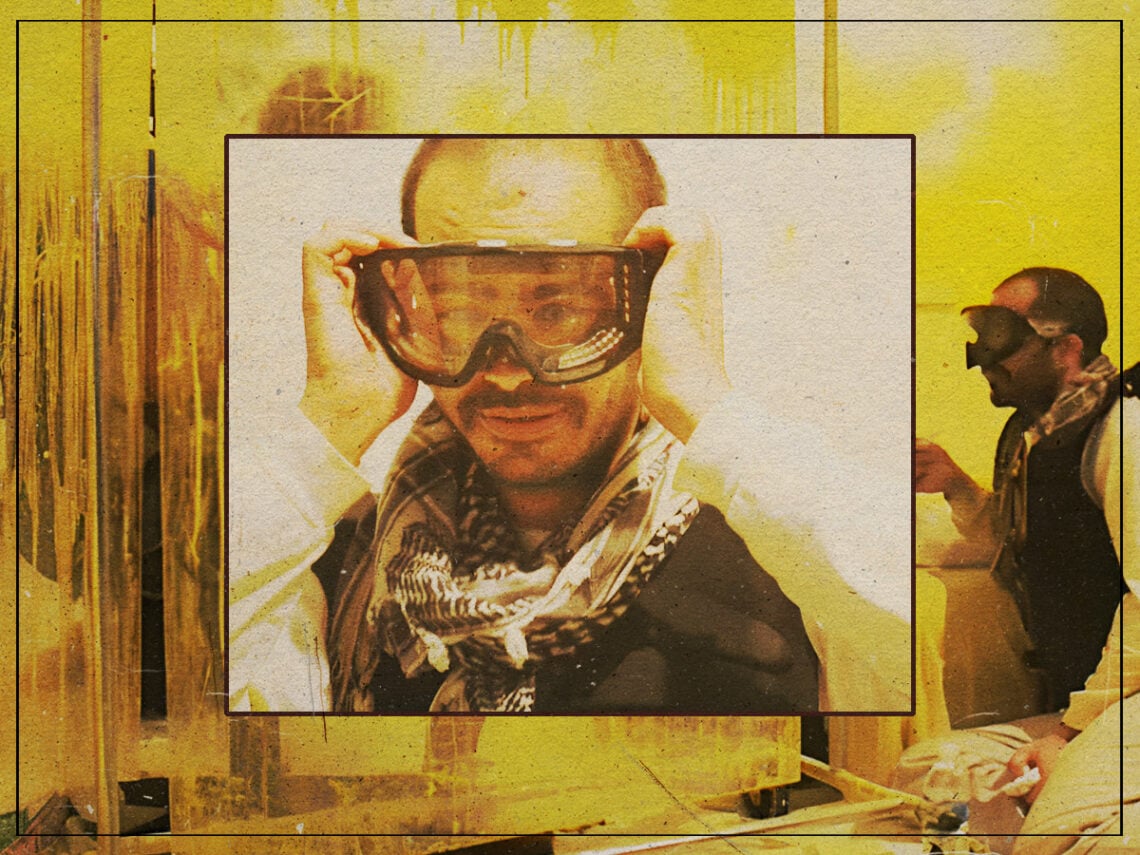
Who shot performance artist Wafaa Bilal?

In 2007, performance artist Wafaa Bilal opened himself up to torture. Locked inside the FlatFile Galleries in Chicago, a project was broadcast from his website 24 hours a day, a Stanford Prison Experiment-esque exercise that invited viewers to chat with him. Or, they could opt to shoot him using a remote-controlled paintball gun.
Domestic Tension brutally illustrated the constant fear of violence Iraqi families have lived with since the Iraq War, as well as highlighting the distinctly Western detachment to images and videos of modern warfare that proliferate the news.
“To the Western media it’s a virtual war going on in Iraq, we’re far removed in the comfort zone,” Bilal told In These Times. “We’re allowed to disengage from the consequences of war. We don’t see mutilated bodies, we don’t see the toll on human beings.”
His invite to people worldwide to shoot him, a defenceless Iraqi, yielded depressingly unsurprising results. Viewers from 132 countries tuned in and over 65,000 shots were fired. On the 24th day of the experiment, by which time he had welts all over his body and was gravely shaken by the experience, he saw the highest levels of shots yet. It was Memorial Day.
Naturally, the performance took its toll. There was no way to escape the constant paintball fire, which shot at him without any warning at any given time. The sound that rang out each time he was shot was designed to mimic that of a semiautomatic. Per The New York Times, the Pentagon provided more than 1.45 million firearms to various security forces in Afghanistan and Iraq in 2003, including more than 978,000 assault rifles, 266,000 pistols, and almost 112,000 machine guns.
Bilal became so overcome with the fear of being shot at he was treated for post-traumatic stress after the performance. He recalled racist comments from viewers that contained “explicit demonizing of all ‘otherness’” that compounded his distress. He wrote at length about his experience in Shoot an Iraqi: Art, Life and Resistance Under the Gun, which touched on his deeply personal attachments to the piece.
Having grown up in Iraq under the Ba’athist regime, he lived through the Iraq War, as well as spending periods in Kuwaiti and Saudi refugee camps before moving to the US. In 2005, the horror of the conflict struck him at a visceral level when his brother was killed at a US checkpoint.
That sense of unrelenting misery and fear is what he distilled in Domestic Tension. In many ways, it was bleak. People’s willingness to abuse and harm him saw hackers conspire to programme the gun to shoot constantly. But Bilal relented with the performance anyway. The piece is really a testament to the will to survive and the way art can educate on and illuminate societal ills. One of the most profound moments of the experiment came when a group of viewers who’d spent time chatting with him formed a group to protect him.
Calling themselves the “Virtual Human Shield”, they banded together, trying to give Bilal some crucial relief by always aiming to the left so he could hide from its bullets. It was almost reminiscent of the Christmas truce on the Western Front, which saw German and British soldiers play football together. A moment of pure human kindness in the madness of war. That’s what Bilal’s piece was aiming to draw out of people. Compassion.
