


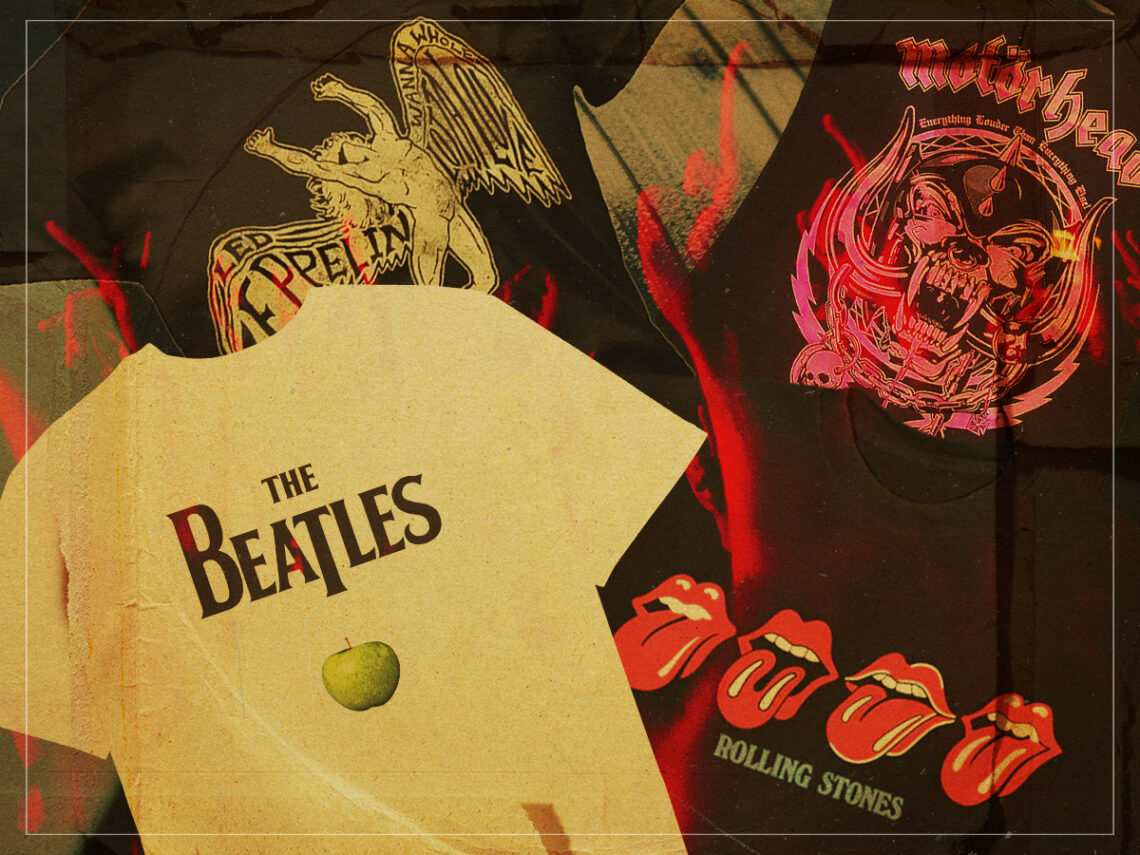
Who was the first artist to sell merch T-shirts?

Band merchandise annoys the hell out of me for two main reasons. First of all, my body just doesn’t cooperate. I come in at 6ft tall, which is by no means abnormal, but for some reason, genetics decided my arms should be disproportionately too long. And all band merch seems to be made by the same crappy T-shirt manufacturer, rendering it completely unwearable for me.
This I can swallow. It’s nothing more than a combination of my awkwardness and burgeoning artists being subject to the trying times of musicianship, where their merch needs to be made as cheaply and as accessible as possible. What I can’t stand are lazy designs. Simple replicas of the band’s logo or album cover lazily printed in square on the centre of a top. Where’s the originality?
It’s the very expression of their music that has brought me to the gig in the first place, and I would love to see a variation of that creativity through an illustrative adaptation or maybe even a collaboration with an artist. I want something I can wear proudly down the street, not exclusively in the sweaty hallways of the gig you’re playing.
After all, the merchandise is a necessary vehicle we fans can use to support our favourite artists in this troubling landscape. It’s the only commodity they can take full ownership of and price control, with touring becoming a financial impossibility and streaming royalties offering an absolute pitiful payoff.
But it wasn’t in the modern-day landscape of skinny margins and multiplatform marketing that the idea of merchandising came to fruition. Before it became a business necessity, it was a badge of honour for fans. Something to wear proudly down the streets in a bid to cement your own individual identity. Think of all the iconic band T-shirts from years gone by that have given disillusioned kids, from The Rolling Stones’ iconic tongue logo, all the way to the Ramones.
But you have to go a little further back than those classic bands to find the first piece of evidence pointing towards band merchandise. Back in the 1940s, a group of adolescent fans named bobby-soxers reportedly started the trend. They were initially just fans of Frank Sinatra in school-girl bobby socks, hence the name, but the moniker was later attributed to a subculture of young female fans writing the name of their favourite artists on T-shirts and wearing them proudly for performances.
However, this concept wasn’t merchandised as such, for bobby-soxers were simply an excited group of teenage girls. Monetising such an idea was reserved for more hard-nosed minds like Elvis’ notoriously bureaucratic manager, Colonel Tom Parker. He began selling Elvis-themed T-shirts after spotting a fan club of the singer wearing their own homemade versions in a simple bid to share their love for him.
It seems as though Elvis and Parker invented everything together. The idea of a popstar, commercialised blues rock and now the humble idea of band merchandise. But in the 1960s, an invention was made that Parker couldn’t take credit for. In that decade, the first rotatable multicolour garment screen printing machine was made, which then allowed a whole host of bands to get in on the act and mass produce T-shirts with bespoke prints on them.
How the band tee became political
Music and politics have always run parallel; that’s not news to us. But what the band tee enabled was a platform in which any given artist’s political leanings could be symbolised and subsequently worn. While The Beatles and Grateful Dead designed their T-shirts with left-leaning politics in mind, none of them were as overtly political as what the Sex Pistols introduced in the 1970s.
Legendary designers Vivienne Westwood and Malcolm McLaren teamed up to design the band’s iconic ‘God Save The Queen’ T-shirts for the punk outfit, showing how the very rebellious sentiment of a song can be worked into different platforms.
But as band merchandise grew, artists like the Sex Pistols were faced with the obvious conflict of merchandising their politics. In the 1970s and ‘80s, it was a sector of music marketing that proved to be extremely lucrative, with promoters on the Yes tour making a reported £250,000 profit from merchandise alone.
But music has of course moved on and artists are no longer in a position where highly priced merchandise is presented as another means to riches; instead it’s a necessary force to support up-and-coming artists who are otherwise crippled by the tight purse strings of music bureaucracy.
