


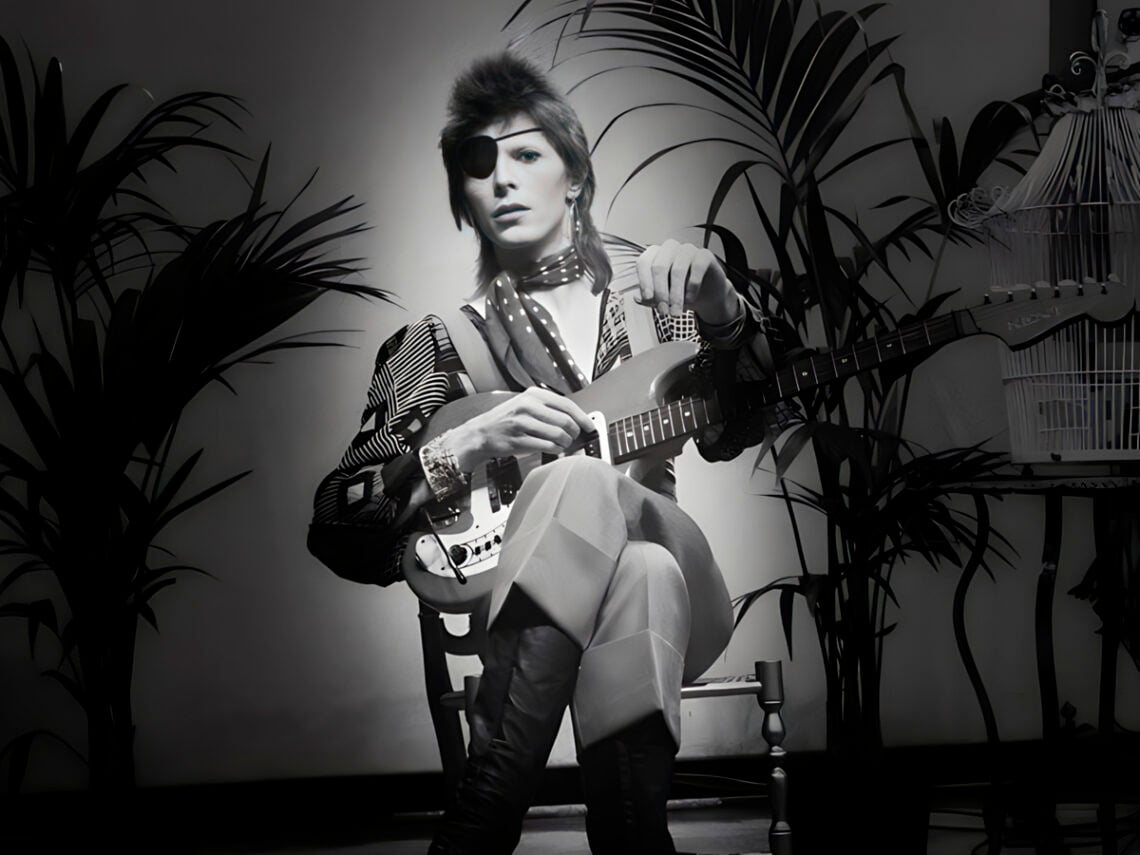
Which David Bowie song invented the archetypal punk rock bassline?

Punk rock hit music like a lightning bolt from the storm clouds of social discontent brewing over both sides of the Atlantic in the mid-1970s. And then, as fast as it flashed across a tepid musical landscape, it was gone, leaving a changed world in its wake. But punk wasn’t just a bolt from the blue. It was the progeny of high-voltage sound waves reverberating around rock and roll, many of which came from the fingertips of one David Bowie.
Bowie himself was a child of the 1960s folk and hippie movements who suffered a false start to his recording career mired in psychedelic posturing. By 1971, he’d created a sound all of his own, though, blending the musical traditions of ‘50s rhythm and blues, soul and music hall with the operatic elan and sparkling flair of theatre performance. Alongside Marc Bolan, Elton John and Lou Reed, he’d spawned a new form of popular music – glam rock.
While punk, in many ways, was a musical movement against the showy artifice of glam, as with many counteractive historical phenomena, it reappropriated the kernel of what it was reacting against for itself. The bare bones of Bowie’s music, in particular, gave punk rock some of its key building blocks. And there’s no more obvious building block than the bass hook in a song on the glam icon’s most celebrated album, The Rise and Fall of Ziggy Stardust and the Spiders from Mars.
The Spider from Mars behind this hook was Bowie’s 21-year-old bassist Trevor Bolder, although the artist himself likely had at least some input in its creation. Bolder’s talent as a musician was certainly a key factor, however, as the main element that makes the hook so catchy is his ability to bend its root note a semi-tone out of shape at high speed. But after him, everyone from Dee Dee Ramone to The Damned’s Captain Sensible and The Clash’s Paul Simonon was trying it.
So, what’s the song with the hook?
The track we’re talking about is the underrated proto-punk number ‘Hang On to Yourself’, which was actually released as a single a year before Bowie finalised the tracklist for Ziggy Stardust. Bolder’s bassline borrows its string-bending trick from Duane Eddy’s early surf-rock version of the theme tune from the ‘50s TV show Peter Gunn. It then jumps to a major fifth, followed by a fourth in rapid succession, played in tandem with Mick Ronson’s guitar, to signal the end of the song’s chorus.
This exact hook was lifted note-for-note by formative New York punk rock outfit the Ramones, who used it in one of their earliest compositions, ‘I Don’t Wanna Go Down to the Basement’. It soon inspired imitators, in Australian punk band The Saints, who adapted it in reverse as the riff for their seminal punk single ‘(I’m) Stranded’, and The Damned, who simply switched the I-V-IV part of the hook to before the string-bending repetition of its root note on ‘New Rose’, the first punk song released in the UK.
From there, the floodgates opened, and variations of the bassline began to spring up across the punk rock canon. We hear a carbon copy in the track ‘Deny’ on The Clash’s self-titled debut album. There are slightly different versions of it on ‘Holidays in the Sun’ and ‘Fast Cars’, with the opening numbers on the only studio album by the Sex Pistols and the first by the Buzzcocks, respectively. The style of that Bowie-Bolder bass part, if not the actual riff itself, quickly became a defining feature of punk’s sound.
Today, it’s difficult to listen to any record placed in the bracket of punk rock and its many offshoots without hearing a bassline that in some way, however indirectly, traces its origins to ‘Hang On to Yourself’. Bowie might have ruled rock music principally as a glam icon, but his music did as much as anyone’s to establish the punk movement.
