


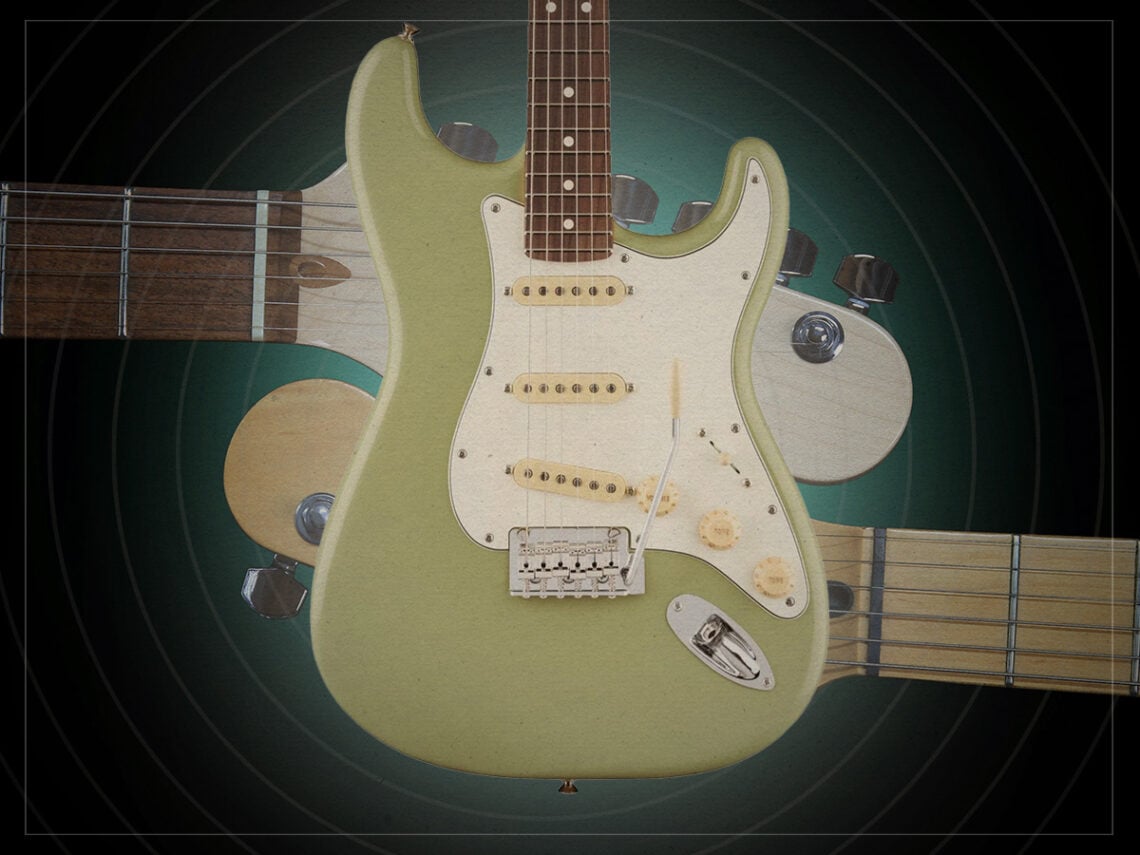
When was the first Stratocaster released?

When we think of the names that have dominated the market for guitars, two companies will immediately spring to mind: Fender and Gibson.
While it was Orville Gibson’s company that got off the ground first, producing their first instrument in the late 19th century, their main competitors would emerge in the late 1940s with the intention of dominating a world that was becoming more focused on innovative electronic design. As an electronics technician, Leo Fender had plenty of experience in repairing gadgets and designing means of amplification, but unlike his counterpart, he wasn’t as well-versed in the actual musical side of things.
So how did a man with no musical aptitude end up designing some of the most widely used guitars and revolutionising the sounds that were created by the instrument in ways that others didn’t manage to do earlier? Gibson may have had an understanding of what would make a good instrument, but Fender was more interested in what could produce a good sound, and this was where the two differed in their pursuits.
While the company have made several guitars since the mid-20th century, such as the Telecaster, Mustang and Jaguar, the most widely used and arguably their crowning achievement is the Stratocaster, the model of choice used by some of the most formidable guitarists to have ever lived. But when did this revolutionary instrument first become widely available for musicians, and why is it so revered to this day?
When was the Fender Stratocaster first released?
Having begun life as a company that specialised in amplification, Fender would produce their first guitars, the Esquire and the Telecaster, in 1950. After the commercial success of these early electric instruments, their ambition was to make an even more versatile instrument for their next release, and as a result, they ended up designing the three-pickup Stratocaster.
The ‘Strat’ was first designed in 1952 and became widely available in 1954, but what separated it from its predecessors was its sleek design and innovative technology. Equipped with a less bulky version of the vibrato arm that had been featured on earlier electric instruments, it was the simplicity of the Stratocaster that became appealing to musicians, but the fact that it could produce a far more versatile range of sounds than any of its competitors was an additional bonus that worked in its favour.
While some of the earliest players of the instrument, such as Eric Clapton, Jeff Beck and Hank Marvin, are among the most well-known users of the Stratocaster, it has continued to be a sought-after model that is still played by guitarists today, and is regularly copied by other manufacturers. The Stratocaster was frankly so far ahead of its time that technology hasn’t found a way to dethrone it with another versatile yet organic-sounding instrument, and it remains just as formidable now as it was over 70 years ago.
We may continue to make innovations in music technology that make things easier for musicians to create certain sounds, but while the simplicity of the Stratocaster can be replicated easily, it is far too advanced to ever be surpassed in its quality. The Stratocaster is perhaps the greatest invention in the history of music, and no matter whether you’ve come from a rock, blues or jazz background, this early electric guitar has likely played a part in reshaping the sound of whatever genre you find yourself immersed in.
