


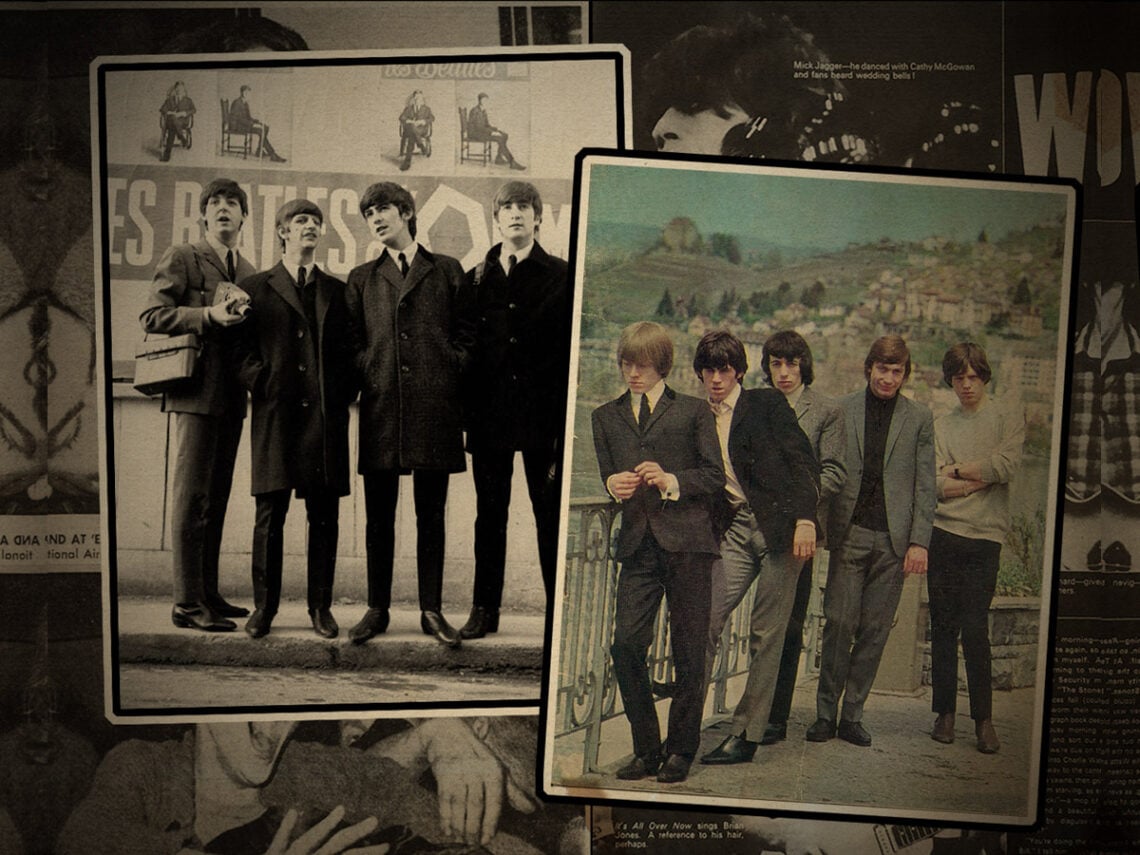
When The Rolling Stones knocked The Beatles off the top of the US charts

Whether or not you personally consider yourself a devotee of The Rolling Stones or The Beatles, chances are you’ve felt pressure from at least one person to make a choice between the two worlds.
When it comes to the rituals of fandom, not much has changed in the decades since Elvis Presley compelled droves of young fans into hysterics at his live performances. Such was rivalled only by Beatlemania in the early 1960s, the term coined by the British press to describe the fanaticism that engulfed The Beatles’ shows and image. Fans went beyond mere enjoyment of the music or fixation with the Fab Four’s looks, for instance; there were levels of obsession, worship, even, that were completely unprecedented.
We hear it in the audience screams that dominated the Fab Four’s live shows, so deafening that the band’s actual performances were barely audible, on television or in person. We see it in the influx of merchandise, worn like literal badges of honour: pins, T-shirts, bags, figurines, fan club zines – anything that could be adorned with one of The Beatles’ faces was to be sold. And, with their declaration of ‘I Want to Hold Your Hand’, it seemed that there would be no cure for Beatlemania.
That is, until The Rolling Stones arrived. Under the tutelage of their manager, Andrew Loog Oldham, The Stones were promoted as the “anti-Beatles”: where The Beatles were seen as teenyboppers with an overall sweet demeanour, The Stones were marketed with a sense of danger. Oldham supported provocative headlines to be printed, such as “Would you let your daughter marry a Rolling Stone?” He had them pose unsmiling on the cover of their 1964 self-titled debut album.
To many, The Stones were a shock in the aftermath of Beatlemania and to the young fans who first championed The Beatles’ success, they signalled a divide among fandoms.
In Pamela Des Barres’ legendary 1987 memoir, I’m with the Band: Confessions of a Groupie, she recounts the Beatles vs Stones divide as it personally affected her, then a young teenager in May of 1965, caught between fandoms. Outcast by her “Beatlefriends” for her newfound love of The Stones, a seemingly mortal sin as they deem her a “phoney” for doing so, Des Barres writes a letter to them in response, explaining, “I have not taken The Stones over The Beatles. I have just let them become a part of my life too. Is that so wrong? The Beatles can never be topped, but The Stones can never be topped either.”
Despite her efforts, a line had been drawn: The Beatles represented a classic, clean-cut boy band for the ages, while The Stones were, to some, an unwelcome shift in the burgeoning counterculture.
While a moment of adolescent melodrama, a story like Des Barres’ captures the strict divide drawn between the two bands, a contrived competition that would follow them as they ascended into rock royalty.
Later that year, another shift would occur when, on November 6th, 1965, The Stones would dethrone The Beatles’ ‘Yesterday’ from the top of the US Billboard Hot 100 charts, with their single, ‘Get Off of My Cloud’. Written in reaction to The Stones’ sudden popularity and demand after the success of ‘(I Can’t Get No) Satisfaction’, the song became a raucous cry against expectations.
“That was Keith’s melody and my lyrics,” Jagger explained to Rolling Stone in 1995. “It’s a stop-bugging-me, post-teenage-alienation song. The grown-up world was a very ordered society in the early ’60s, and I was coming out of it.”
With both ‘Yesterday’ and ‘Get Off of My Cloud’ reigning the charts for an equal four weeks, respectively (tied for 1965’s longest-running number one), The Beatles and The Stones got their first glimpse of competition for many years to come. Still, whether you were caught sporting an “I Love Mick” or “I Love Paul” button, a competitive streak was here to stay.

Never Miss A Beat
The Far Out Beatles Newsletter
All the latest stories about The Beatles from the independent voice of culture.
Straight to your inbox.