


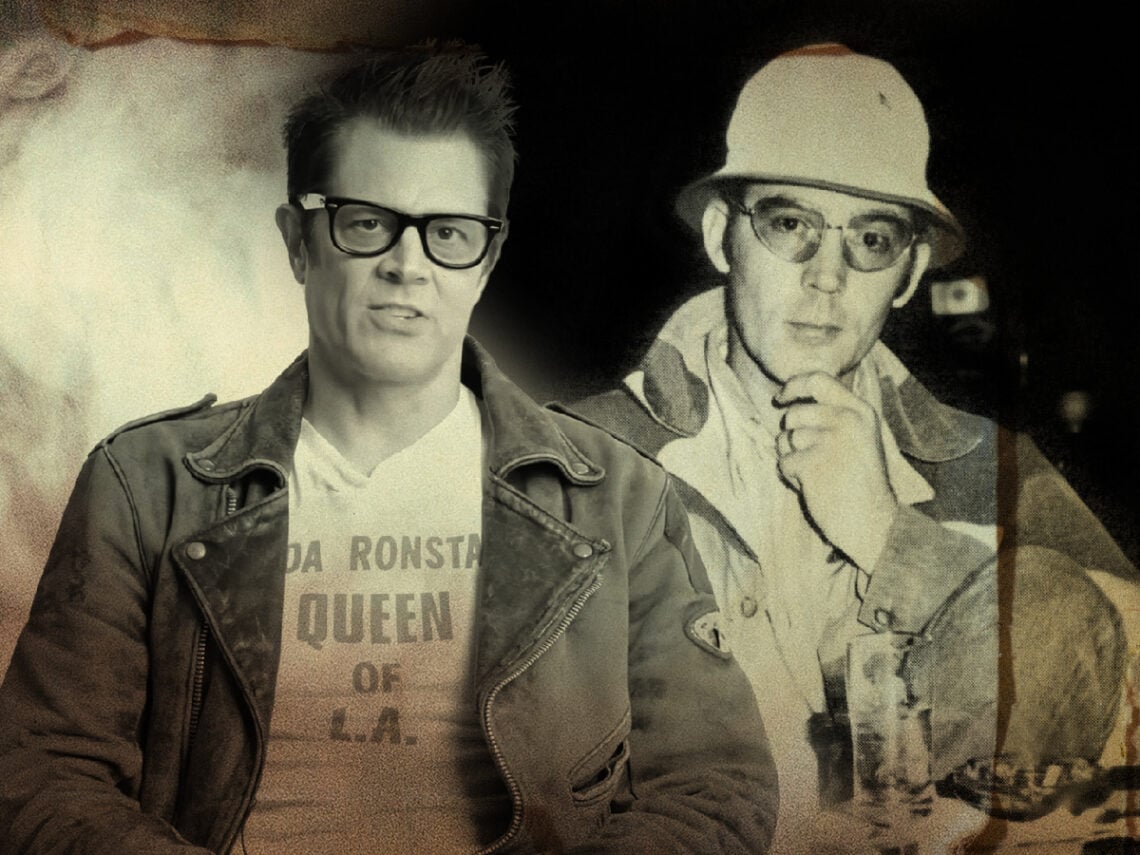
The day Johnny Knoxville met his hero Hunter S Thompson: “Mutual respect between bandits”

While many know Johnny Knoxville for his brilliant, gruesome pranks and self-inflicted tortures at the helm of the Jackass franchise, few recognise that before he was America’s favourite stuntman, he was a writer, following in the footsteps of his hero, Hunter S Thompson.
Spurred after reading a gifted copy of Jack Kerouac’s novel On the Road, Knoxville moved to California to pursue his dream of becoming an actor. “Kerouac’s On the Road inspired me to set out on an adventure, to leave Tennessee and head west,” Knoxville wrote in the introduction to Thompson’s Fear and Loathing: On the Campaign Trail ‘72, “But Fear and Loathing in Las Vegas blew the fucking roof off of my then-19-year-old mind. It changed the way I thought and behaved. I bought the ticket. I took the ride. I wanted to be a writer like Hunter.”
If Kerouac was the outlaw of the Beat generation, Thompson was the outlaw of the new journalism wave, forging his own underground within the Gonzo movement, placing himself not as a mere onlooker in a journalistic work, but as an active participant. In 1960, he moved from New York to Puerto Rico, where he worked at various magazines and dailies for a year, an experience he fictionalised in The Rum Diary, later published in 1998.
Having once lived near San Francisco’s Haight-Ashbury neighbourhood, Thompson scathed against the counterculture of the decade in Fear and Loathing in Las Vegas, a work of autobiographical fiction serialised in Rolling Stone. He brought adrenaline into every word he wrote, albeit a chaotic one, as his vices of alcohol and drugs often overshadowed his writing, and in the wake of his suicide in 2005, the writer left behind a complicated, vibrant legacy that permanently shifted the world of journalism.
Knoxville, in the introduction to his book, also describes his venture into journalism as “an homage (read: rip-off) of Hunter’s ‘gonzo journalist’ approach”.
As his acting career stalled, Knoxville pitched the most outlandish things that he could think of, ideas that would allow him to “act” while reporting at the same time. One of his concepts was pitched to various magazines, wherein he would test self-defence equipment on himself by getting pepper-sprayed, shocked with a stun-gun and taser and then shot in the chest while wearing a bulletproof vest. This became the true heart of Jackass, catching the attention of Jeff Tremaine, the editor of skateboarding magazine Big Brother and soon-to-be director of Jackass, which was recorded on VHS before the footage evolved into an MTV and later, a Hollywood film phenomenon.
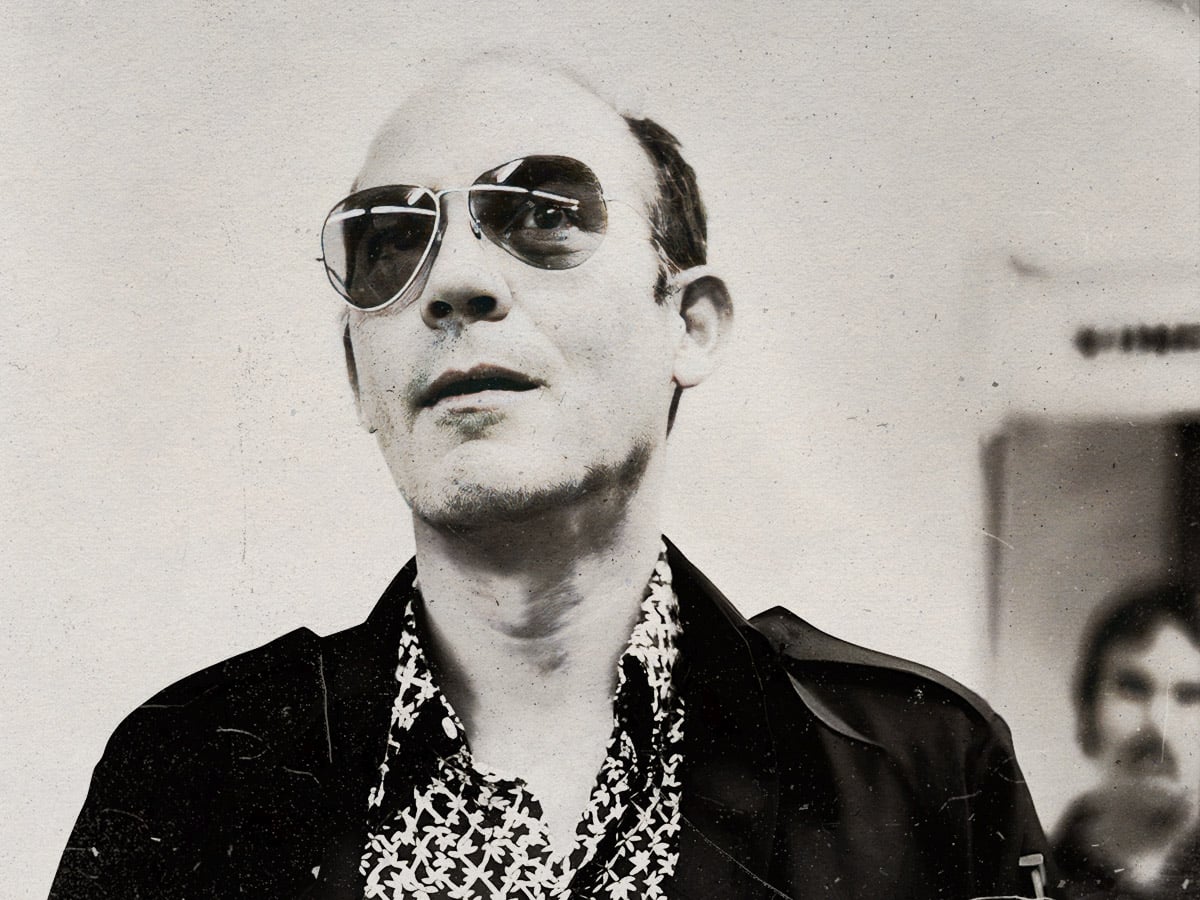
“A pretty good argument could be made,” Knoxville writes, “That there never would have been a Jackass had I not been trying to be a poor man’s Hunter S Thompson”.
Knoxville would soon skyrocket to fame as a poster for American chaos, as he and the Jackass crew unintentionally mirrored the physical comedy of Buster Keaton, the camp of John Waters and the male-driven absurdity of contemporary culture. Thompson was one of the first people to whom he sent a tape of the self-defence test, which earned him an unexpected phone call response.
The two would finally cross paths in the winter of 2004, while Knoville was filming a movie in Baton Rouge, Louisiana, and accompanied by actor Sean Penn, the pair found “the good doctor in a New Orleans gargle factory”. Thompson sat at the bar, facedown, with a black leather medical bag resting at his feet.
As Knoxville described, “He was distraught. He was complaining about how much pain he was in and how he wanted it all to be over with. It was unsettling. The night hadn’t even begun, and my heart was broken.”
Knoxville and Penn coaxed him out of the bar and took him back to his hotel suite, where “a small group of actors, editors, and dope fiends” were waiting. The colourful cast of characters sat in a circle and took turns reading passages from Thompson’s 1983 book The Curse of Lono, a disjointed work that follows his perspective on the Honolulu Marathon. In Knoxville’s words, he “was running pretty hard back then,” and distributed a handful of pills to Thompson, who, in turn, gave the actor a bottle from his doctor’s bag.
Without question, Knoxville swallowed the pills inside, correctly guessing that they were Vicodin. “This made Hunter smile wide,” Knoxville recalled, “A moment of mutual respect between bandits”.
Weeks passed after the pair’s strange night before Knoxville would receive a phone call from Thompson, urgently asking him to arrange a flight to his home in Woody Creek, but by the time he had found a private jet for the writer to join, he had found one of his own.
Sadly, just a few weeks later, Thompson would take his own life, of which Knoxville wrote, “I wish he was here. We need his madness. We need his medicine. We need his whiskey-soaked truth”.
