


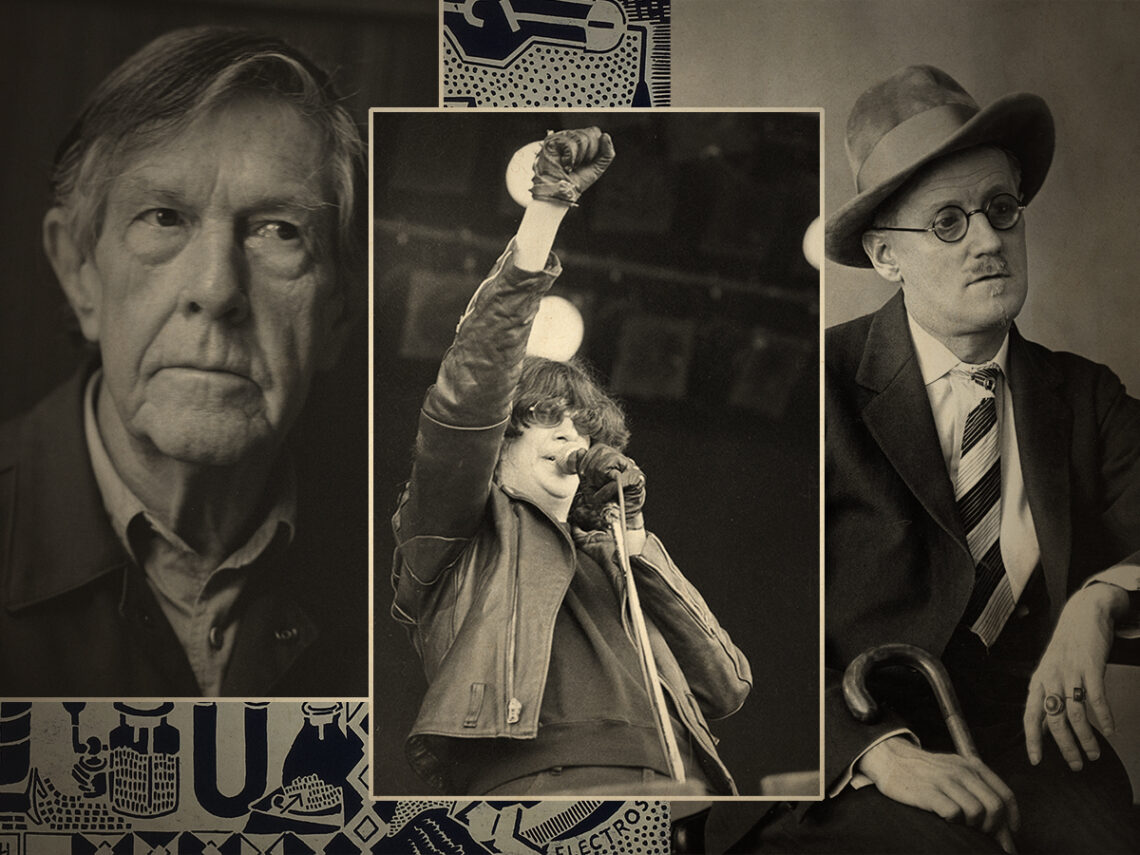
When Joey Ramone tackled a John Cage adaptation of James Joyce

While he’s probably best known for his avant-garde silent composition, ‘4’33”’, John Cage was far more inventive as a modernist composer than he’s given credit for by those who only know him for this controversial piece.
Early shitposts aside, for him to be active in the 1940s and beyond, writing demanding scores that asked musicians to play their instruments in non-standard ways, while also theorising about certain new ideas in music, such as indeterminacy and modern dance, you can say that he was one of the most forward-thinking figures in 20th-century music. Cage’s approach to musical composition is abstract, but that doesn’t mean that it is talentless, unimaginative, ‘anyone can do it’, or devoid of any praiseworthy elements.
Plenty of modern songwriters and composers cite him as a major influence on their work, especially those who have emerged from an art-school background or who were interested in merging the avant-garde with the underground. Acts ranging from Sonic Youth to Brian Eno to Frank Zappa all admired and recognised his works as having inspired their own creative output, and you can tell from their own approaches to the avant-garde that his bravery to attempt this long before them is something that has lived on through more recent examples as well.
The early part of the 20th century also produced plenty of other art that was considered to be dramatically different compared to the standards of what had come before it, and James Joyce was a prime example of this in the literary world. Often writing in a stream-of-consciousness style, with works that ushered in a new wave of modernist approaches to constructing prose, Joyce is perhaps a parallel figure to Cage in many respects, and the fact that the composer admired his work led him to pay tribute to him in a composition.
In 1942, one year after Joyce’s passing, Cage decided to adapt sections of the text from the Irish writer’s notoriously unreadable novel, Finnegans Wake, into his own score, ‘The Wonderful Widow of Eighteen Springs’, and while it isn’t one of his best-known works, it was later revisited by the next generation of the New York musical vanguard. When Cage died in 1992, a tribute album entitled Caged/Uncaged: A Rock/Experimental Homage to John Cage was pieced together with appearances from various members of the city’s punk, avant-garde and no-wave scenes providing their own interpretations of his works.
Among those was Joey Ramone having a bash at ‘The Wonderful Widow’, who takes his monotonous drawl and spreads it liberally over the jarring avant-garde arrangements. While one might think it unusual to have the punk icon deliver these poetic lines over frenzied percussion, Ramone captures the essence of the composition perfectly, with his voice being a perfect fit for the strangeness of the piece.
While some of the other appearances on the record from the likes of John Cale, David Byrne and Lou Reed may feel more suited to the abstractions of Cage’s work, given how they were far more in line with his abstractions, the way that Ramone eschews conventional melody in his intonation makes the song all the more surreal, and it’s a delight to hear him pay tribute to one of the most singular composers in the Western world.
