


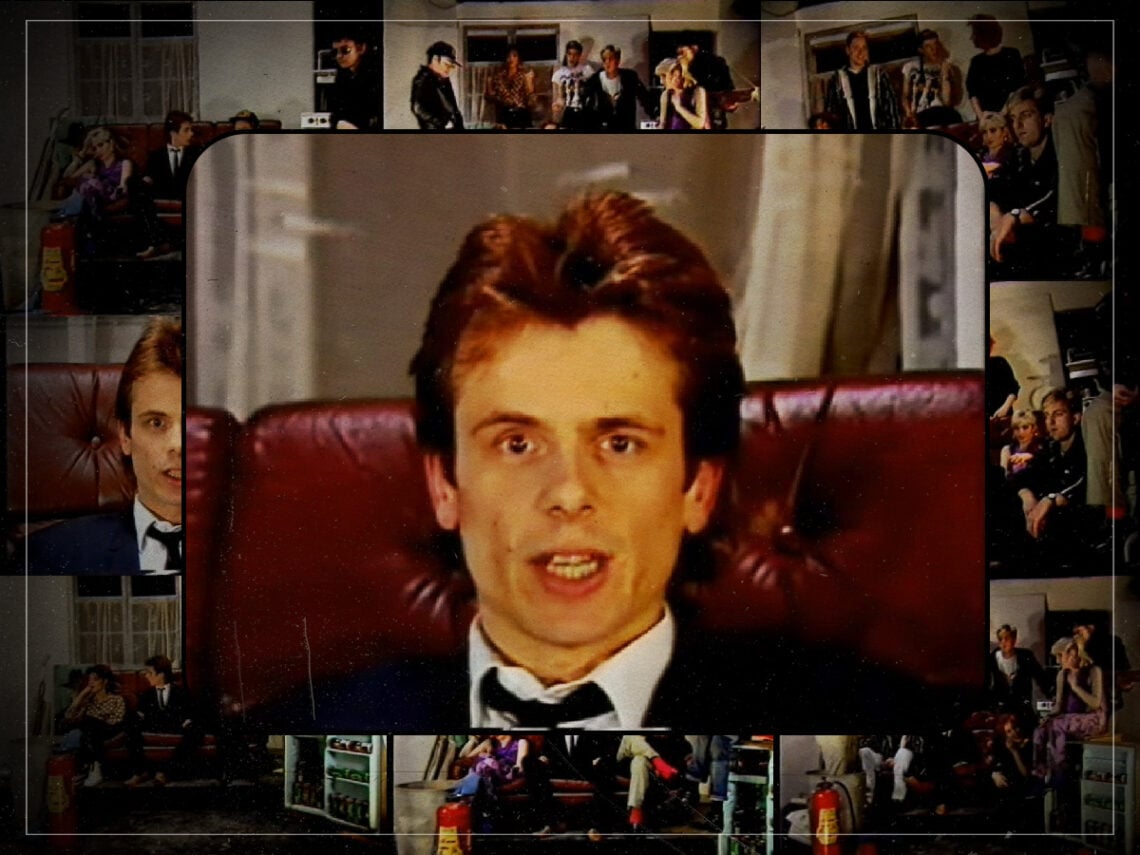
When Tom Watt from ‘EastEnders’ bizarrely joined forces with New Order to cover ‘Subterranean Homesick Blues’

While I’m perfectly aware of the fact that there’s not much to understand about the concept of soap operas, I will never quite be able to wrap my head around the unwavering popularity of television shows such as EastEnders.
For 40 years, the serialised show has been a staple of not just British television, but the very culture of the country, summoning households to their sitting rooms multiple times a week and provoking many heated discussions about how the lives of a number of ordinary London families will become intertwined before unravelling in dramatic yet predictable fashion.
Call me a snob, but its schlocky acting and production values twinned with the fact that I could just eavesdrop at the local pub and hear a more intriguing plotline renders EastEnders an utterly mind-numbing watch, and every time I’ve been subjected to its banality (thanks Nana), I’ve ended up scratching my head as to how something this devoid of excitement can become an institution.
And yet, the show’s enduring acclaim isn’t even the most perplexing thing that it has generated over the years, because shortly after it debuted, one of its original cast members released a song so bizarre that one has to question the motivation that went into recording it. Of course, actors have a long history of venturing into the world of music, with results that range from surprisingly competent to outright misguided, but Tom Watt’s sole single takes questionable decisions to a whole new level.
Rather than write his own original material, the actor best known for portraying George ‘Lofty’ Holloway opted to provide his unique take on a classic in the shape of Bob Dylan’s ‘Subterranean Homesick Blues’, but with more than a few alterations to the style. Gone was the talking blues delivery of the original, the janky guitar playing and honking harmonicas that punctuated the gaps between verses, and in came a cheeky cockney rap to an electronic new wave-inspired backing track.
Over 20 years had passed since Dylan released this classic, and if there’s anything that we’ve learned from the history of music, it’s that classics don’t require modernisation. They’re classics for a reason, that being that they’re timeless distillations of the period in which they were released, whereas Watt’s unfortunate attempt to ‘80s-ify the work of one of America’s greatest songwriters is exactly the sort of material that deservedly gets dismissed as a novelty with immediate effect.
In addition to the song, a music video was produced, which featured Watt rapping directly down the barrel of the camera lens without ever altering his gaze for a moment, but the friends who dance around him on the sofa aren’t just any ordinary extras, they just happen to be some of the most celebrated figures in post-punk from the era. Soaking up the atmosphere, grooving along to the song or simply having a snooze on the settee are members of New Order and The Fall, with Bernard Sumner, Stephen Morris and Brix Smith being among the most immediately recognisable faces who make cameos in the promotional video.
Trying to decipher why any of this exists is the most confusing aspect of all, and thankfully, my delayed confusion isn’t something I’m alone in. Both critics and the public slammed the song, with it only reaching a peak of number 67 in the UK charts, and Watt’s career in music ended up being deservedly short-lived. He can now be heard as a regular guest, sparking debate on football podcasts, and it’s probably fair to say that this is more his speed rather than awkwardly attempting to keep up with Dylan’s lyrical genius.
Not only does the context of the song vanish when sung by a Londoner who never experienced the US counterculture movement or had an infatuation with the Beat scene, but all of the imperfections that give it charm are brushed aside by the processed production that was typical of the mid-to-late 1980s.
Whatever Watt was thinking, it resulted in a disastrously laughable take on a song that shouldn’t be touched by mere mortals, but a nevertheless curious oddity spawned from the early years of EastEnders’ success. But hey, at least it isn’t ‘Anyone Can Fall in Love’…

Never Miss A Tale
The Far Out Bob Dylan Newsletter
All the latest stories about Bob Dylan from the independent voice of culture.
Straight to your inbox.