


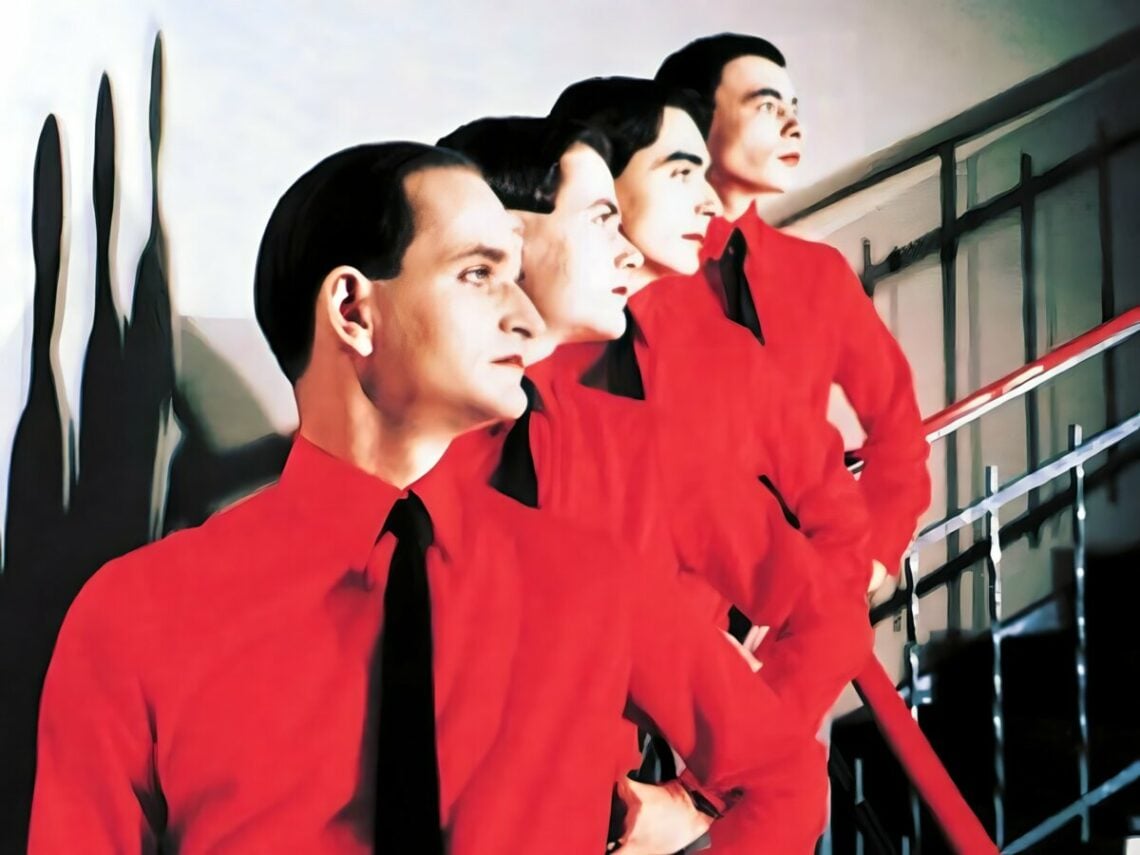
What is the real message of Kraftwerk?

While they were studying improvisation and composition in Düsseldorf, students Ralf Hütter and Florian Schneider formed Kraftwerk after establishing a mutual interest in experimental music and electronic instruments. They began performing together as a duo, experimenting with various electronic and synthesizer-based sounds, crafting music categorised by innovative and minimalistic electronic compositions.
Emerging as one of the most prominent and groundbreaking bands of the 1970s and beyond, Kraftwerk’s influence is often hailed as more profound than even some of the most era-defining acts. This is primarily attributed to their capacity to shape the prevailing sounds of the 1980s, across genres like synthpop, post-punk, techno, disco, and hip-hop, all borrowed from their pioneering drum sequencing and emotive synthesizers. As a result, the strength of their unique artistic vision served as a wellspring of inspiration for influential and diverse figures, including David Bowie and Steve Albini.
At the height of their career, they wholeheartedly embraced the whirlwind of technological evolution with a fervour that still has the potential to resonate deeply with their audience. Although “kraftwerk” translates to “power plant” or “power station” in German, their artistic endeavours are centred on the convergence of technology and music. In a manner reminiscent of H. G. Wells, they explore how humanity has arrived at an impassable juncture in the realm of communication and the digital age.
Being at the forefront of the electronic movement, Kraftwerk adopted a natural closeness to the progression of technological advancements. Following a surge of literature like Anthony Burgess’ A Clockwork Orange, Kurt Vonnegut’s Slaughterhouse Five, and Philip K. Dick’s Do Androids Dream of Electric Sheep?, the 1970s ushered in a sense of both dystopian and sentimental nostalgia in their approach to the future.
Following their 1974 breakthrough hit, ‘Autobahn’, a 22-minute trance-inducing ode to highway driving, the quintessential Kraftwerk experience was clear — unity. The song, in its gentle way, urges you, for your own benefit, to become one with the constant flow of traffic, harmonising with its tireless rhythm and partaking in a heightened awareness through the seamless operation of the machine.
Their offer of “computer music” was audacious but attractive. At the time, the idea of music being generated by machines may have seemed like something straight out of a George Orwell novel, but it fit perfectly with their simultaneous criticisms of dehumanising technology and celebrations of digital progress. Their robotic presentation, however, served as a protective barrier against the expectations of sincerity, challenging the concept of a singular ‘authentic voice’.
In 1975, Kraftwerk released Radio-Activity, their first all-electronic album, marking the introduction of key collaborators Karl Bartos and Wolfgang Flür, who contributed their distinctive layered drum patterns. As Hütter’s vocals chant, “Radioactivity / is in the air for you and me”, our minds are cast back to the Nuclear Age, specifically the unchecked spread of radioactive materials from atomic weaponry. A serious venture, it may seem, to conjure such imagery — but when Hütter mentions Marie Curie discovering radioactivity, we become exposed to a more iconographic whimsy.
This is the perfect example of Kraftwerk’s signature lamentation: are we cautioning against scientific advancements or applauding technological progress? Masterfully, it’s both.
This amalgamation is also evident in their 1981 album Computer World. The title track, in particular, appears as a sinister confrontation of powerful entities like “Interpol and Deutsche Bank / FBI and Scotland Yard.” In the following song, however, Hütter boasts, “I’m the operator with my pocket calculator“, set to a playful synth tune with electronic button noises.
The abrupt shift from grave warnings to frivolity hints at a harsh irony — a populace unwittingly embracing a new regime’s ability to perform simple calculations. However, Kraftwerk remains enigmatic, seldom granting interviews and meticulously curating their public image. They present themselves as emotionless automatons, concealing any indications of their human lives and intentions behind the act.
Much like the machines they replicate, Kraftwerk’s purpose revolves around fulfilling their mission, with no ulterior motives. Their unsettling apathy towards the technological transformation of humanity appears as the natural consequence of their total immersion in it. Paradoxically, this taciturn assimilation offers a more poignant portrayal of contemporary society than verbosity could. Technology has become deeply entrenched in our world, often outpacing our comprehension. It progresses ceaselessly, its influence silently permeating every aspect of our lives — the exact embodiment of how Kraftwerk operates.
