


What guitars did The Beatles first use?

It’s easy to forget just how well-oiled a machine The Beatles were by the time of their debut single ‘Love Me Do’ in 1962. While the dismissal of original drummer Pete Best and the live slogging around the Hamburg club circuit are well-known chapters of Fab Four lore, the group’s predecessor incarnations stretching back to even the 1950s were full of success and big-breaks for the budding musicians still in their teens.
From Paul McCartney’s first encounter with John Lennon in Liverpool’s St Peter’s Church fête to forming crooner Johnny Gentle’s backing band during his 1960 tour of Scotland, The Beatles were a tight and confident unit when first entering EMI Studios two years later with Ringo Starr officially behind the drum kit.
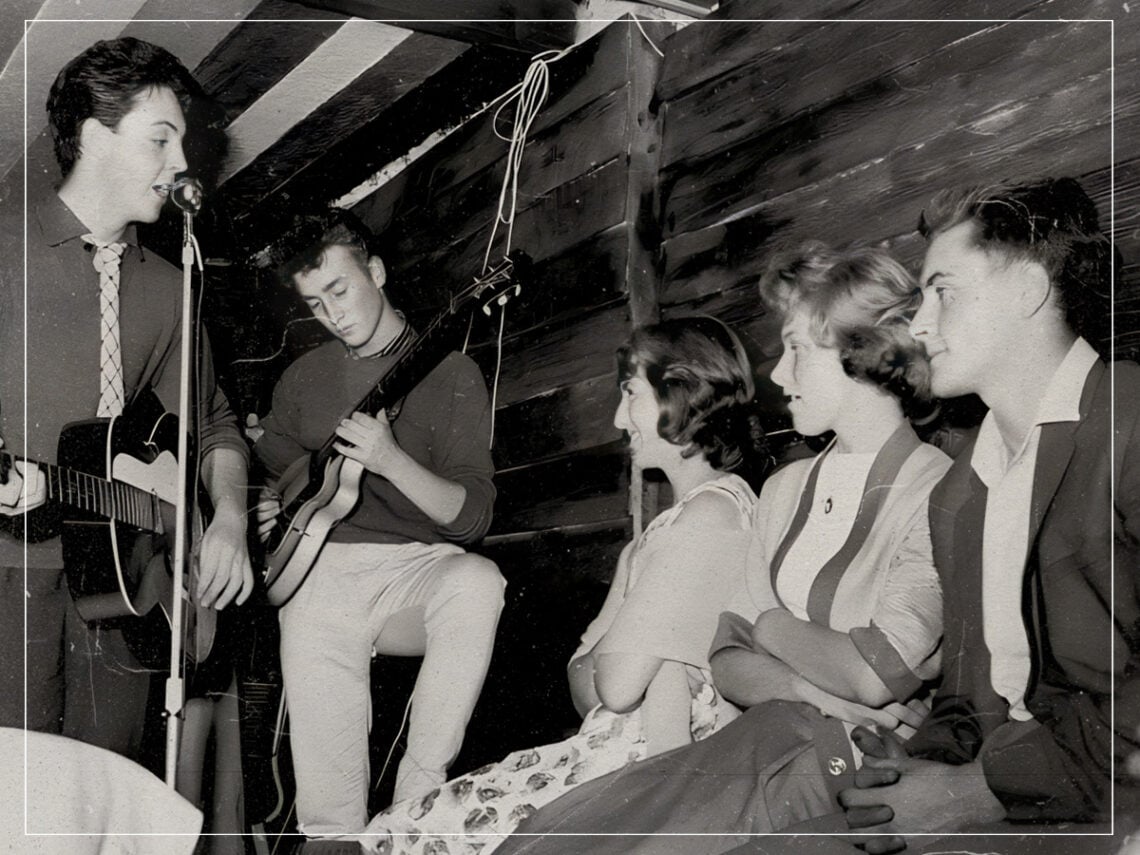
With such a storied history behind them so early on, there’s debate as to when exactly they formed if considering their guitar chronology. One could delve back as far as The Quarrymen, the skiffle group Lennon fronted who caught McCartney’s attention in 1957, later joining and playing a humble Antoria acoustic guitar as well as convincing Lennon to recruit a then 15-year-old George Harrison for lead guitar. What followed was their earliest recording session, cutting Buddy Holly covers as well as the unique McCartney-Harrison number ‘In Spite of All the Danger’ at their local Phillips’ Sound Recording Services in July 1958.
Two years later, with Lennon’s old art school friend Stuart Sutcliffe on bass and part-time forklift truck driver Tommy Moore on drums, The Quarrymen shifted their name to The Silver Beetles and embarked on Johnny Gentle’s mini-tour merely credited as “his band”. Cutting their teeth as Gentle’s backing group, Lennon played rhythm with a Höfner Club 40, McCartney a Zenith Model 17, and Harrison on lead wielding a trusty Futurama Resonet Grazioso.
Moore had fatigued with the backing band lifestyle—allegedly tiring of Lennon particularly—and took a steady bottle works job, the band recruiting Best for drums to be able to commit to the scheduled season booking in West Germany. Finalising their name to The Beatles, the gang played their first Hamburg show in August 1960, beginning a 48-day stint at the Indra Club in the red-light district’s Große Freiheit. Despite the enormous changes and career trajectory behind them, The Beatles’ instrument set-up saw little change, the Gentle guitars the same, apart from McCartney’s sole use of the Rosetti Solid 7.
So, what guitars did The Beatles first use?
Following altering dates between the north of England and Hamburg, cutting singles with local Merseybeat star Tony Sheridan, and London’s pull with a near signing to Decca Records, by August 1962, The Beatles were finally wavering on the cusp of national stardom. Signing with EMI’s Parlophone label, in-house producer George Martin pushed the band to lose drummer Best due to his insufficient timing for studio recording. Having already roped in Rory Storm and the Hurricanes’ Ringo on occasion to fill in for Best, the new drummer officially joined the band and played their first gig with the cemented line-up in Birkenhead’s Port Sunlight Horticultural Society’s annual show.
Across Ringo’s recruitment and his first EMI session with The Beatles, with the second recording of ‘Love Me Do’ in September 1962, all the members’ instruments had enjoyed major upgrades. Lennon was already two years into his famous 1958 Rickenbacker 325 after having spotted it in a Hamburg music shop, McCartney had assumed his bass role with the 1961 Höfner Violin, and Harrison was switching between a 1957 Gretsch Duo Jet and a 1962 Gibson J-160E for their acoustic moments.
Four years later, Beatlemania had swept the little-known Liverpudlians to global conquer, dropping a steady stream of smash LPs and singles and finally petering out as a live band in San Francisco’s Candlestick Park in August 1966. Lennon adopted the J-160E, McCartney’s bass a 1963 Höfner 500/1, and Harrison a steady cycle through his 1965 Epiphone Casino, 1965 Rickenbacker 360/12, and 1964 Gibson SG Standard for the odd song.
Ceasing touring from then on, the kaleidoscopic pop palette that would colour The Beatles’ eclectic output that would follow saw the very studio as much an essential instrument as their famous rack of guitars.

Never Miss A Beat
The Far Out Beatles Newsletter
All the latest stories about The Beatles from the independent voice of culture.
Straight to your inbox.