


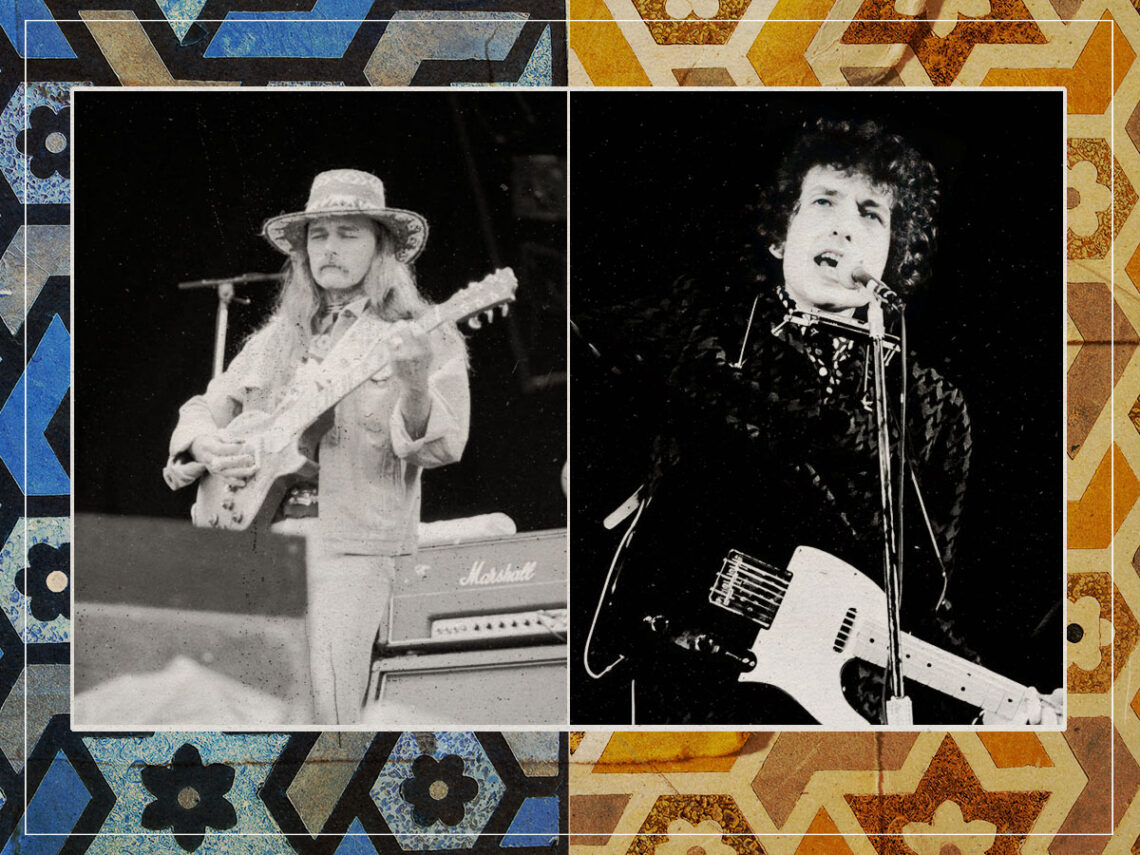
What Dickey Betts learned from Bob Dylan: “The words meant so much”

Every musician is going to want to become a better songwriter. You may think that you have your craft down once you have a few classics under your belt, but it’s every artist’s dream to take the crux of a song and warp it in a way no one else has heard before. Dickey Betts may have already given the world its fair share of Southern rock classics, but he knew that he could learn a thing or two from the way that Bob Dylan approached his art.
While anyone who’s ever written rock songs has stolen a few pages from Dylan’s playbook, Betts was much closer to the folk-rock superstar than one would imagine. When he wasn’t performing with his fellow Allman Brothers, Betts would find time to play with Dylan whenever he got the chance, including hopping onstage with the folk icon when he was in the area to play songs like ‘Rainy Day Women #12 and 35’.
Then again, Dylan never struck anyone as a person who plays well with others. Outside his backing group and The Traveling Wilburys, Dylan was known to collaborate only a handful of times, holding firm to the basis of his music and usually just putting a coterie of carefully considered suitors around himself.
If Dylan was writing from the perspective of a lonesome drifter during his early years, though, then ‘Ramblin Man’ may as well have been his unofficial anthem. Though Betts may have made the song about the life of a simple traveller going from one place to another, he initially wrote the track with another drifter in mind.
When Betts workshopped the song, he figured it might work better for one of his country heroes, telling Herald-Tribune, “I was going to send ‘Ramblin’ Man’ to Johnny Cash. This was when Johnny Cash was really vital in his younger days. I thought it was a great song for him. But everybody liked that song. Even my dad liked the song, before we recorded it or anything. And I’m thinking I’m going to send this to Johnny Cash and see if he wanted to do it”.
Betts may not have gotten his wish, but he got the next best thing when he went onstage with Dylan, and the singer recommended they do ‘Ramblin Man’. Betts certainly respected what Dylan brought to the table, but the Allman Brothers guitarist got a peek into how Dylan saw music when he played alongside him.
When putting together an arrangement, Betts recalled, “I said, ‘You don’t know the words to [‘Ramblin Man’], do you?’ He said, ‘I know all the words to ‘Ramblin Man’. I should have wrote that song myself’…He sang every word exactly the way I wrote it. He was talking and singing at the same time. He’d just go, and the words meant so much the way he sang it”. This sense of searching for profundity and meaning in what is already there drove Betts towards chasing greater depth.
While Betts and Dylan were both from polar opposite sides of the country, there were a lot of similarities in the way both of them approached music. This kinship meant they learnt from one another. Dylan may have been known to get a bit too wordy in some of his songs, but Betts was responsible for breaking down the simple aspects and tying them together so everyone could understand them.
In fact, there’s a good chance that Dylan took more cues from Betts than he realised. Looking at where he went later on in his career, Dylan made his work an extension of what Betts started, keeping that lonesome drifter persona while being able to cut to the chase a little more, not to mention the grooving guitar lines. Betts was more likely to let the music do the talking every time he performed, but in those few encounters with Dylan, he knew that modern pop was about more than just a nice melody. It was about saying what was on your mind.
Dylan finding adoration and inspiration in ‘Ramblin Man’ is proof that the late Betts always had that appealing sincerity up his sleaze. There aren’t too many musician who could boast that Dylan found so much to admire about them, that they even penned anthem’s he thinks he should have written himself.

Never Miss A Tale
The Far Out Bob Dylan Newsletter
All the latest stories about Bob Dylan from the independent voice of culture.
Straight to your inbox.