


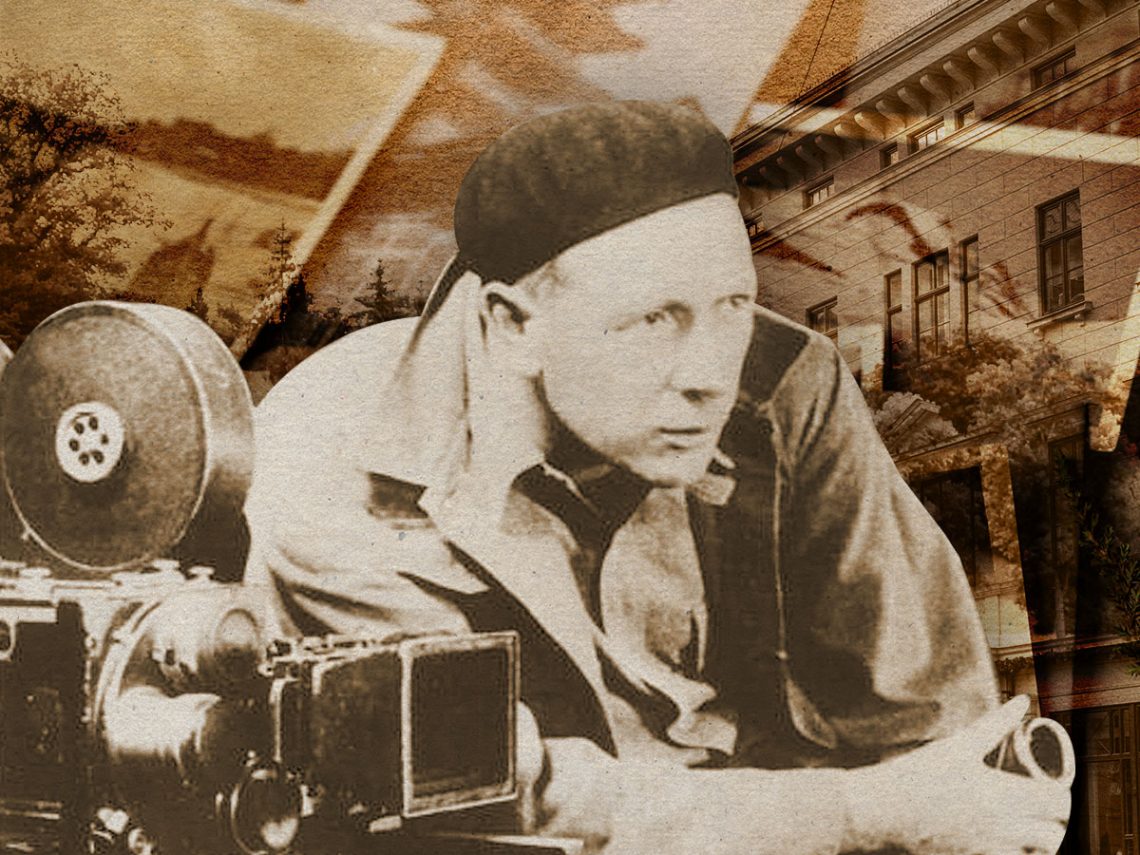
Travelling the Weimar Republic in the footsteps of the Expressionist directors

Coming so soon after a crushing military defeat and a failed socialist revolution, the birth of a new German cinema in the 1920s is frankly astonishing. More surprising still is that Weimar Germany, home to some of the modernist era’s most daring avant-garde thinkers, became such a powerhouse of innovative cinematic ideas that it rivalled Hollywood.
Expressionist cinema is intimately bound to the events and fallout of the First World War. In the years immediately following Germany’s defeat, the nation was attempting to adjust to the collapse of the Austro-Hungarian Empire and find a way of meeting the financial demands of the Versailles Treaty. After realising it couldn’t afford these war reparations, French and Belgian troops occupied the Rhu. By that point, inflation was already out of control, and a decline in values was taking hold.
This disquiet flourished alongside a new mysticism born in the trenches of the Western Front, where the continued presence of death and decay had quashed the optimism of youth. Those who survived lived a half-life haunted by the ghosts of their comrades. The same occultism that had stalked the German Romantics were suddenly revived, giving birth to a fascination with all things unknown and unmeasurable. With that, the doctrine of Expressionism was born.
Expressionism, it should be noted, was one of many genres to emerge from the New German cinema of the Weimer Republic. However, it was the most captivating, the most innovative, and arguably the most revealing. The films of Fritz Lang, F.W Murnau and Ernst Lubitsch, with their distinctive decor, mesmerising mise-en-scene and artful exploitation of shadow, have come to epitomise a troubled nation ravaged by modernity and on the cusp of yet more bloodshed in the name of nationalism. Join us as we explore the Weimer Republic in the footsteps of those directors.
Berlin
Key Film: Variety (E.A. Dupont, 1925)
E. A Dupont was one of the silent era’s most provocative and obscene directors. Like so many German silent films, 1925’s Variety was filmed almost entirely in Berlin, where most studios were located. It tells the story of Boss Huller, a former trapeze artist who opens a carnival with his wife and daughter after suffering a severe injury. Things get a lot less monogamous with the arrival of a beautiful trapeze artist played by the great Lya De Putti. Tragedy ensues.
Heavily censored on release in the United States – except in frisky New York – the original cut of Variety perfectly captures the seedy atmosphere of Weimar Germany’s entertainment underworld, which was doing big business despite the economic downturn of the inter-war years.
What To Explore:
Dupont filmed his trapeze scenes in Berlin’s stunning Wintergarten Theatre, once the most beautiful vaudeville theatre in Europe. It was here that the Skladanoswky brothers premiered their first short film in 1895. It was redesigned in the early 19th century and given its eye-wateringly beautiful interior. Covered in a flood of red velvet, the stage and orchestra pit sat below a “starry sky” of artificial lights set in dark ceiling panels. Sadly, the venue was heavily bombed during the Second World War, though you can find the reconstructed theatre on Potsdamer Strasse, where that same starry sky has been shining since 2009.
Another stunning Weimar Theatre, the Berlin Grosses Schauspielhaus, was the final work of Berlin-born architect Hans Poelzig before he began designing huge expressionist sets for films such as The Golem. The honeycombed building now only exits in black and white images, but the spirit of the city’s inter-war cabaret scene lives on in notorious establishments like Berghain and Kit Kat. At the dawn of the 20th century, Berlin’s reputation for debauchery was such that tourists were warned to stay away from certain city areas or risk corruption. Those who frequented the city’s countless bars and venues were, of course, less inclined to moral panic.
Oravský Podzámok
Key Film: Nosferatu (F.W Murnau, 1922)
This proto-horror masterpiece by F.W Murnau has been haunting audiences for 100 years and boasts one of the most unnerving monsters of all time: the spindle-fingered Count Orlock.
Rather unusually, Murnau shot chunks of Nosferatu using real-world locations, the most memorable of which are in present-day Slovakia, which was then part of the Weimar Republic. Boasting some of the most expansive wildernesses in Europe, Slovakia was the perfect place for Murnau to capture the far-flung kingdom of his undead antagonist.
What To Explore:
Without the rights to Bram Stoker’s Dracula, Murnau had to be careful not to make too many obvious allusions to his source material. He failed in this endeavour and was later sued by the Stoker estate. He really ought to have seen the lawsuit coming. Although he changed certain details, such as the name of the titular Count, he stayed true to the landscapes described by Jonathon Harker as he travels to Dracula’s castle.
Using Harker’s description of the Carpathian mountains as a guide, Murnau travelled to the Zilina Region of Northern Slovakia, where he shot footage of Oravský Podzámok, a small village on the foothills of the West Carpathians. The nearby Orava Castle was used to depict Orlock’s wind-swept abode. Nestled high above the Orava river, it is one of the most impressive castles in all of Slovakia. By the time Murnau arrived in the early 1920s, the 16th-century reconstruction – itself modelled on the original 13th-century fortification – had been consumed by a fire and rebuilt by Francis Zichy. Today, it serves as a gateway to Slovakia’s rich and complex history.
Potsdam
Key film: Metropolis (Fritz Lang, 1927)
Fritz Lang’s 1927 masterpiece Metropolis, one of the most innovative of all the expressionist classics, tells the story of a futuristic utopia, the apparent perfection of which disguises a much darker reality. The city’s privileged classes reside high above the cloudline, far from the grim underworld below. When the son of Metropolis’ master, Freder, discovers the plight of the workers and befriends the rebellious Maria, the scales fall from his eyes, putting him at odds with his father.
Highly influenced by the Rousseauean view of urban centres as innately destructive, it’s impossible to watch Metropolis without sensing the director’s profound anxiety about the future. Lang’s prophetic sensibilities regard the future as synonymous with exploitation, corruption, rampant capitalism and inequality. The director artfully depicts the city’s dominion over humankind through his crowd scenes, in which the population appear to have been re-configured into pyramids of arms and heads.
What to Explore:
While much of Metropolis was filmed in an old Zeppelin hangar at Staakan airfield on the western rim of Berlin, vast swathes of it were captured at Studio Babelsberg. It was here that Josef von Sternberg filmed The Blue Angel, where Alfred Hitchcock, Marlene Dietrich and Billy Wilder began their glittering careers. It remains one of the busiest film studios in Europe, having hosted productions such as Inglourious Basterds, Cloud Atlas, The Grand Budapest Hotel, The Hunger Games, Isle of Dogs and The Matrix Resurrections.
The studio is located in Potsdam, the capital of Brandenberg and the former seat of the Prussian Kings. This stunning encapsulation of all things Enlightenment is home to Sanssouci, the “Prussian Versaille”, which sits on the banks of the Havel River and once belonged to Frederich the Great of Prussia. A short ride from Berlin, you’re best off getting to Potsdam by train. On the whole, German railways are pretty well-organised (a rare thing indeed). Postdam specifically boasts some beautifully designed stations that’ll make you feel as though you’ve stepped back in time.
Stahnsdorf Südwestkirchhof Cemetery
Key Film: The Cabinet of Dr Caligari (Robert Wiene, 1920)
Highly stylised and shadowy to the bone, this 1920 silent horror film by Robert Wiene begins with an innocent trip to the carnival. On meeting the sinister Dr Caligari, Francis and his friend Alan are introduced to his hypnotised plaything Cesare, who can allegedly predict the future and ends up correctly prophecising Alan’s death.
Widely regarded as the first expressionist film, The Cabinet of Dr Caligari contains many elements that would define the genre. It occurs in an intentionally unreal reality where painted ghosts stalk one another in a highly-contrasted twilight realm. Profoundly gothic and marvellously grotesque, it captures the expressionist movement’s dark heart.
What To Explore:
If you’re looking to get lost in the mist, Stahnsdorf’s Southwest Cemetery in Brandenberg is the place for you. The final resting place of several expressionist artists and filmmakers, this forest-wreathed “gothtopia” is home to the grave of Nosferatu director F.W Murnau, who died in a car crash in California shortly before the premiere of his Hollywood feature Tabu: Story of The South Seas.
After a service at the Hollywood Lutheran Church on March 19th, Murnau’s body was shipped over – Dracula style – to Germany. With the hallowed director’s body lying six feet under the surface of Südwestkirchhof, his tomb became a site of occult pilgrimage. In 2015, the tomb was broken into by supposed Satanists, who are believed to have used his skull as the centrepiece of a candle-lit ritual. Nearly a decade later, the skull is still missing.
Lüneburg Heath
Key Film: Chronicles of The Gray House (Arthur von Gerlach, 1925)
The Expressionist movement infiltrated the lavish costume dramas of the 1920s. Zur Chronik von Grieshuus, or Chronicles of The Gray House, is surely one of the most intoxicating examples.
Directed by Vienesse filmmaker Arthur von Gerlach, it tells the story of a feudal landowner called Henrich, who falls in love with a peasant girl despite opposition from her family and his. Undeterred, he offers her marriage, sparking a chain of events that ultimately ends in tragedy.
What To Explore:
Lüneburg Heath features heavily in Chronicles of The Gray House. It’s one of the largest nature reserves in Germany and should be explored with the help of sturdy pair of walking boots. That being said, if you want to make the most of your time in this dizzyingly beautiful heathland, I’d recommend taking a bike as the park features brilliant cycling routes.
Shaped over thousands of years, Lüneburg Heath is most beautiful between August and September, when the heather is in flower. When those blossoms unfurl, the heath is transformed into an endless carpet of amethyst, occasionally interrupted by the odd juniper or silver birch. Those looking for a proper adventure would do well to head for the Nature Reserve around Wilseder Berg, which is car-free and, at 169-metres, the highest point in the northwest lowlands.
